Saves instantly, no account needed. Already a member? Sign in.
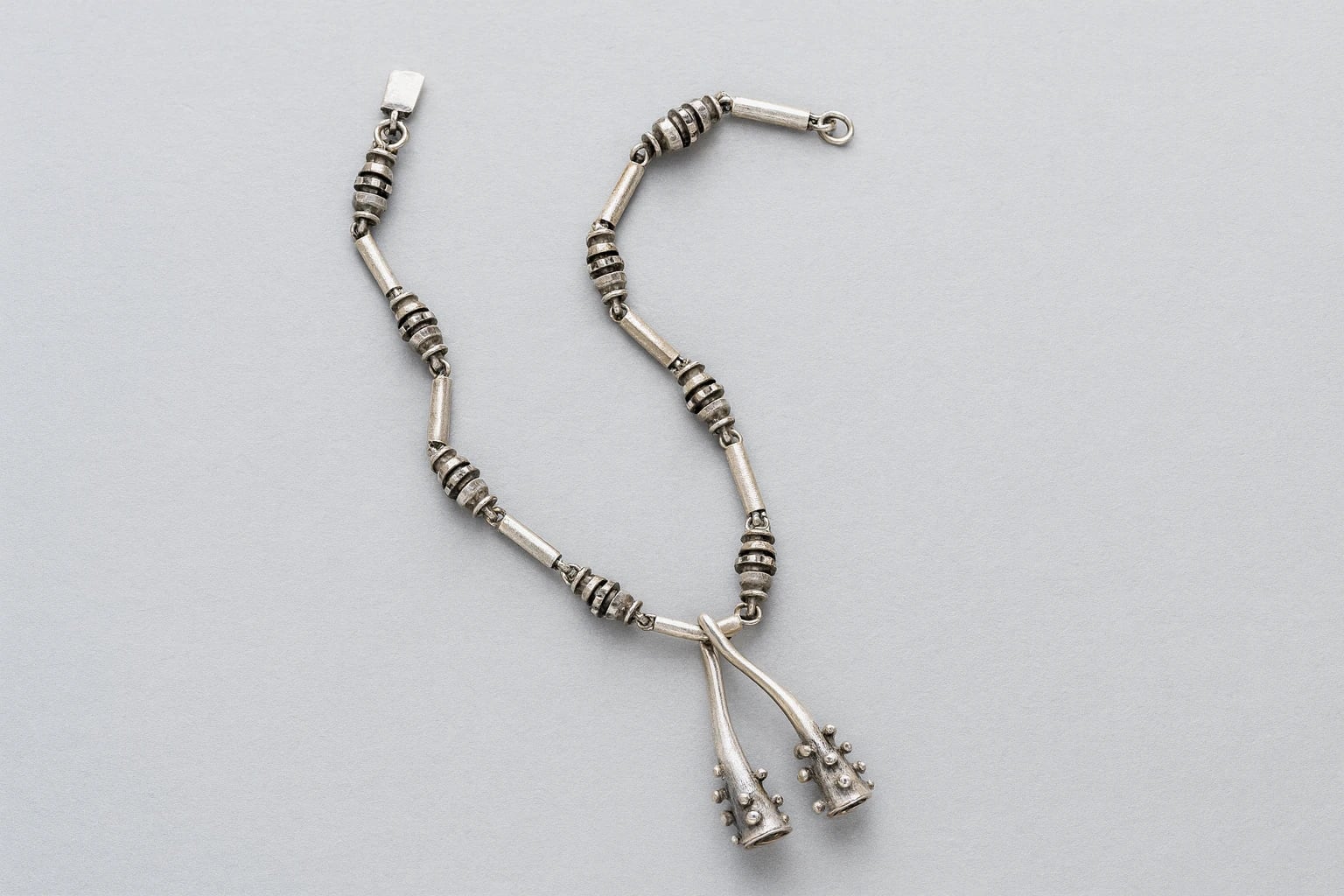
A row of slender silver tubes, hung from a fitted neckband and finishing in a dense cluster of tassels, gives this necklace its logic. Salvador Terán organized the design around repetition and fall: the tubes swing freely from their upper mounts, and their weight draws the tassels into a gathered mass at the front. At sixteen and a quarter inches, the piece sits close to the base of the neck, so the moving elements register against the collarbone rather than the chest. The result is a necklace that reads as sculpture when still and as motion when worn, its many parts catching light along their length as they shift.
The construction depends on articulation. Each tube is an individual unit, joined so that it pivots independently, and the tassels extend that mobility into finer, more numerous strands. This is a design built from multiplication of a simple form rather than from a single worked surface, and it demonstrates how Terán achieved density and movement through assembly. The relatively light weight of 2.55 troy ounces indicates hollow tube construction rather than solid rod, a practical choice that keeps a necklace of this visual scale wearable and allows the elements to swing. The silver surface, uninterrupted by stones or applied ornament, carries the whole effect through reflection and the rhythm of parallel forms.
Terán came to silver through the collaborative world of Taxco and Mexico City. He was a cousin of Antonio Castillo and, with the Castillo brothers, helped establish Los Castillo in 1939 after that circle's formative years in William Spratling's Taller de Las Delicias. Terán is credited with many of the Los Castillo pieces marked Cobre Artistico, the workshop's artistic copper line, before he developed his own production under his own name. The marks on this necklace, the Salvador stamp with eagle 36, place it within that independent output. The eagle registration supports a date from roughly the early 1950s onward, consistent with the design's circa 1950 conception, though the mark itself records the period of use rather than a single year of fabrication. The absence of a design number in this reading is worth noting, since Terán's documented marks frequently carry one.
Within Terán's work, this necklace shows his preference for reduced, repeated geometry and for surface left plain so that form and light do the work. It belongs to the current of the Mexican silver renaissance that pursued modernist clarity through the resources of the taller: specialization, hand assembly, and controlled repetition of a designed unit. The piece records how a maker trained in the Castillo and Spratling milieu could build a distinct language from the simplest of components, a tube and a tassel, multiplied and set in motion.
Museum of Mexican Silver. “Tube and Tassel Silver Necklace.” Catalog no. MoMS-001541. https://museumofmexicansilver.com/pieces/teran-necklace-silver-modernist
See something wrong with this record? Suggest a correction and the piece details fill in automatically.
Salvador Terán
Dancers and Stars Necklace