Saves instantly, no account needed. Already a member? Sign in.
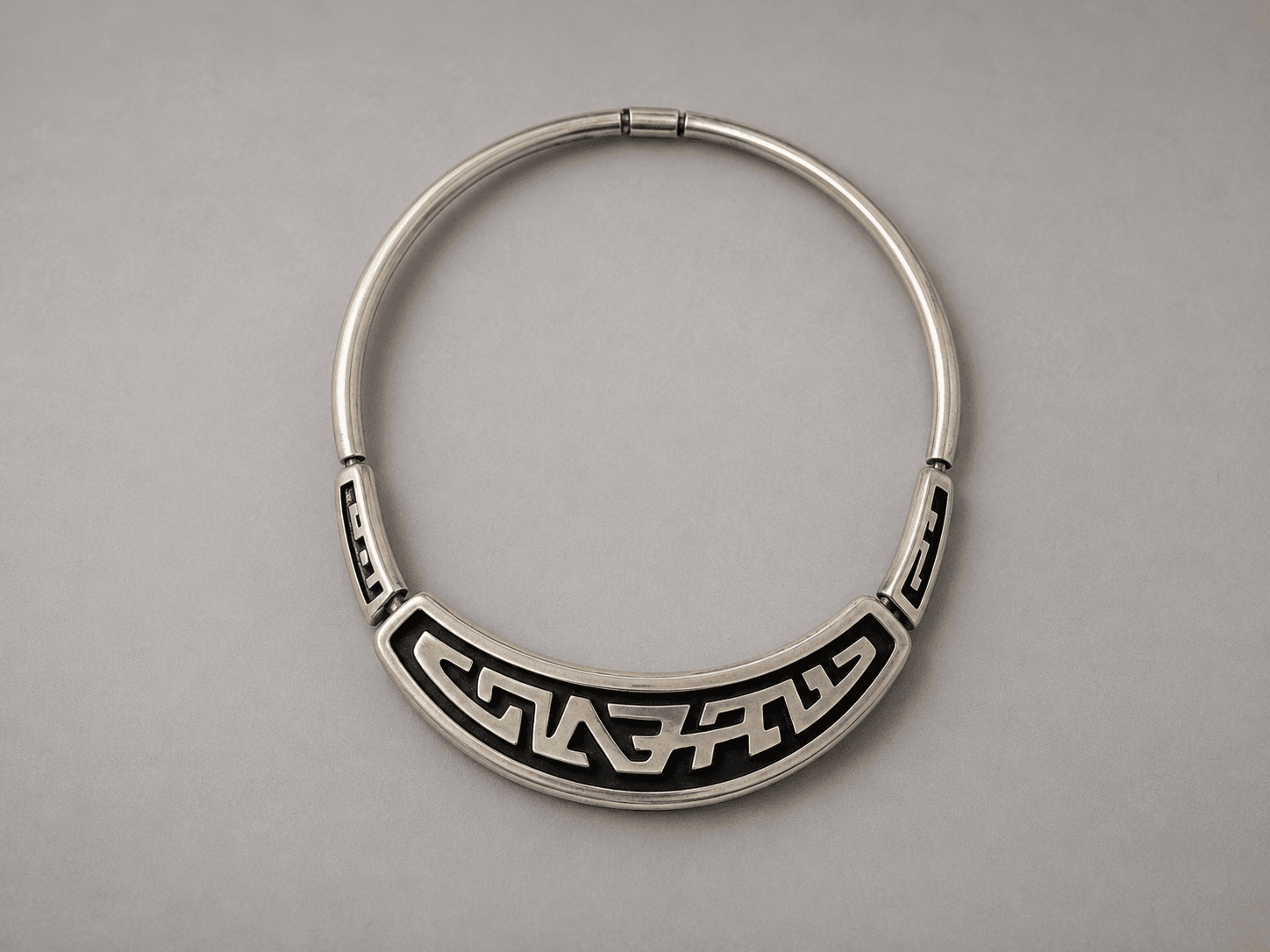
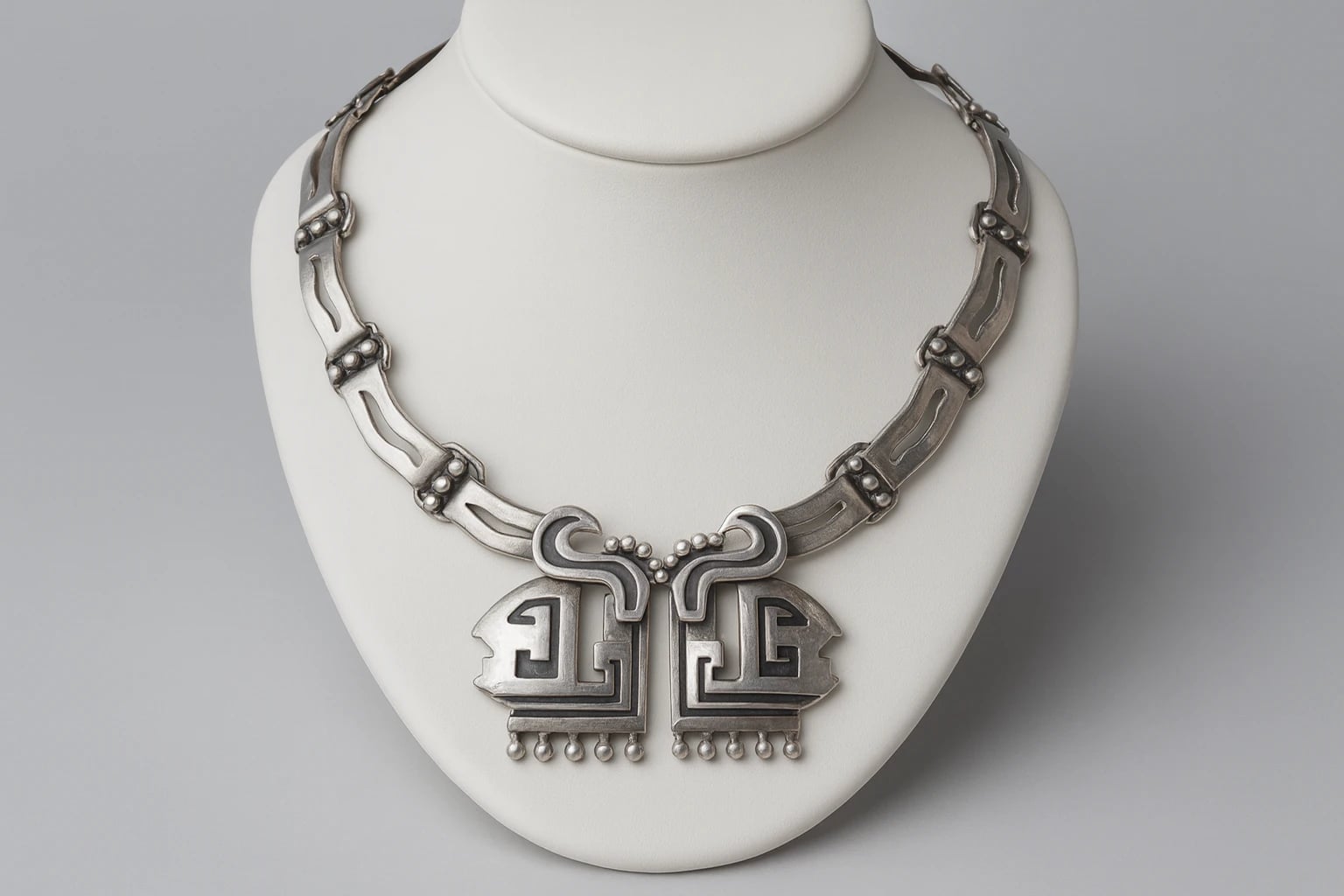
The necklace is organized around a compact sculptural image: two opposing profile heads, each pressed forward in high relief against a dark niello ground and crowned by stylized plumage. At 16 inches, it sits close to the base of the neck, with the central motif measuring 2 1/4 by 1 1/2 inches. Salvador Terán uses that intimate scale to give the pendant section an unusually architectural presence. The heads do not hang as a separate plaque. They are built into the curve of the necklace, so that the design reads as a continuous collar interrupted, and intensified, by a frontal emblem.
The construction depends on layered contrast. Bright silver outlines the profiles, eyes, stepped lower forms, and featherlike projections, while the dark ground sets those raised elements into sharper relief. The motif draws on ancient Mexican visual sources without copying a single identifiable prototype. Its force comes from translation: profile head, headdress, stepped geometry, and suspended beadlike drops are reduced to a set of silhouettes and planes that remain legible at bodily scale. The side links extend that language around the neck through narrow, branching silver forms punctuated by small raised details. They lighten the collar visually while preserving the sense of a sculptural object fitted to the body.
Terán’s mark strengthens the object’s place within his independent production. The necklace is signed Salvador in script, carries design number 132, and is stamped with Eagle 36. Hougart records Salvador Vaca Terán’s script mark, his use of Eagle 34 and Eagle 36, and the regular appearance of design or inventory numbers on his pieces. Morrill and Berk also note that numbered jewelry was part of Salvador’s practice, and that, for the most part, lower design numbers tend to indicate earlier designs within a workshop’s inventory. The number should not be treated as an exact date, but it supports the necklace’s position within the established sequence of Terán’s midcentury work.
The design belongs to the period after Terán had left the anonymity of Los Castillo and established his own workshop. Morrill and Berk describe him as one of the earliest young apprentices at Spratling’s Las Delicias, a first cousin of the Castillo brothers, and later the manager of the Los Castillo taller before he opened his own Mexico City workshop in 1952. That history matters here because the necklace carries forward the collaborative discipline of the Taxco taller while presenting a voice distinct from both Spratling and Los Castillo. Terán was especially drawn to overlapping planes and darkened grounds, a quality Morrill and Berk identify as characteristic of his jewelry. Stromberg similarly notes his use of silver motifs soldered onto oxidized surfaces to create a shadowed bas-relief effect associated with modern interpretations of ancient Mexican art.
Museum of Mexican Silver. “Pre-Columbian Head Profile Necklace with Niello.” Catalog no. MoMS-002337. https://museumofmexicansilver.com/pieces/salvador-teran-sculptural-necklace
See something wrong with this record? Suggest a correction and the piece details fill in automatically.
This necklace shows why Terán’s independent jewelry cannot be understood as a secondary branch of the Taxco School. The object compresses relief sculpture, collar construction, and modern graphic abstraction into a wearable form. Its ancient source material is not treated as ornament applied to a conventional chain. Instead, the entire necklace is structured by profile, ground, contour, and rhythmic extension. In the broader Mexican silver renaissance, such works demonstrate how midcentury jewelry could carry serious modernist thinking through the body, using silver not simply as precious material, but as line, shadow, surface, and articulated form.
Salvador Terán
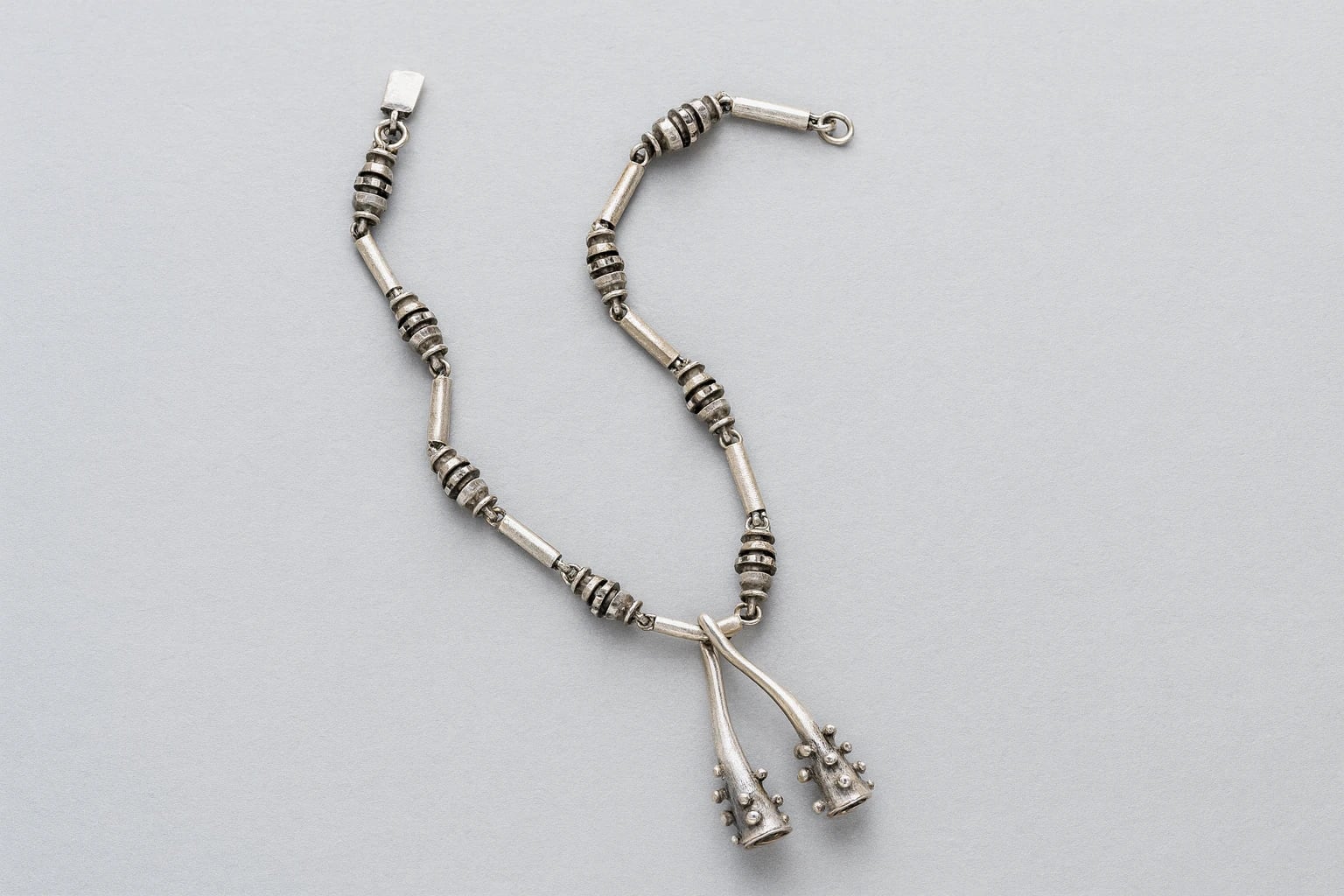
Tube and Tassel Silver Necklace
circa 1950
Silver