Saves instantly, no account needed. Already a member? Sign in.
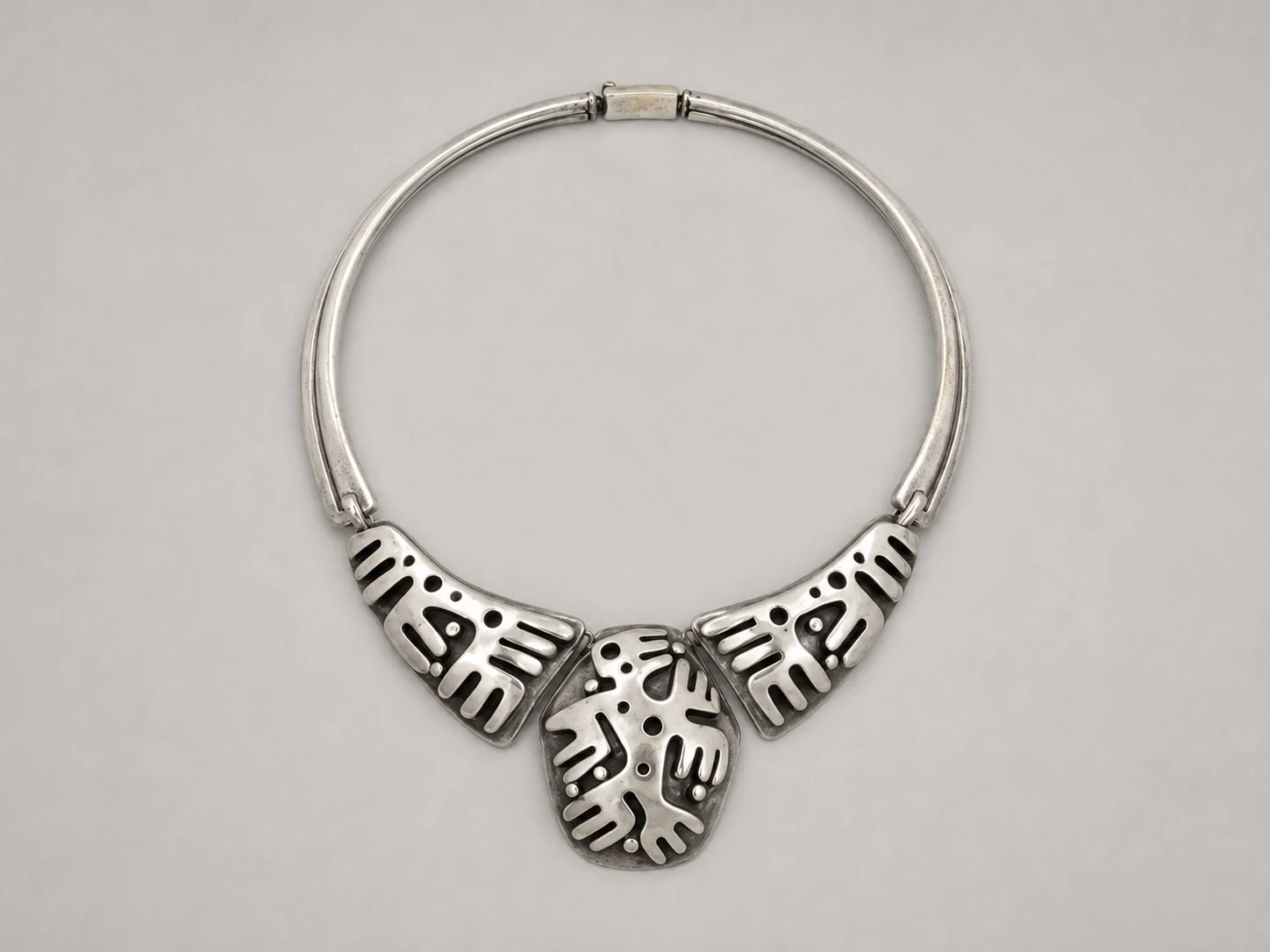
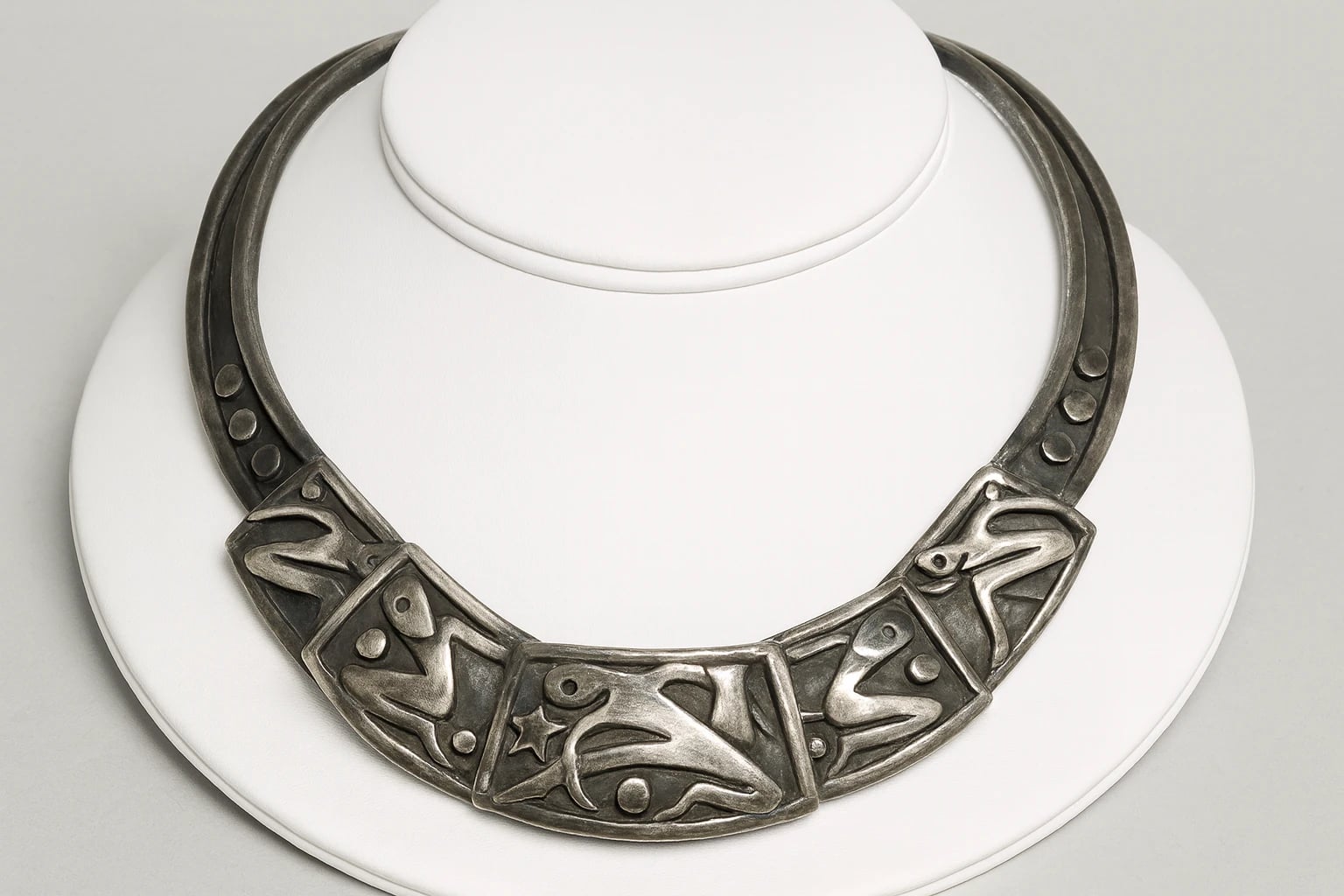
This necklace organizes a night sky as a sequence of shallow reliefs around the throat. Its curved collar form is narrow, only one inch at the center, yet the design opens a surprisingly active pictorial field: raised silver dancers bend, kick, and fold across a darkened ground, while small stars and round accents punctuate the intervals between them. The result depends on contrast rather than applied color. Bright silver bodies catch light against the oxidized surface, so that movement is read through edges, shadows, and interruptions in the black field.
The construction turns a repeated frontal format into a moving rhythm. Rectangular and trapezoidal sections carry individual figures, but the figures do not remain confined as static emblems. Their limbs angle into the corners, their torsos compress into abstract curves, and their silver surfaces swell slightly above the recessed ground. On the side panels, the small circular elements continue the rhythm established by the central dancers, drawing the eye back toward the neck ring. The necklace measures 15 1/2 inches, a close collar scale that makes the imagery encircle the body rather than hang from it. Its patina deepens the separation between raised motif and ground, preserving the graphic force on which the design depends.
Salvador Vaca Terán’s signed work is especially important for understanding how the Mexican silver renaissance moved between jewelry, architectural decoration, mosaic, and modernist relief. The piece is marked Salvador in script, Sterling, Mexico, with design number 159, a form of marking consistent with Terán’s numbered production. John Hougart records the Salvador script mark, notes eagle numbers 34 and 36 for Terán, and identifies the mark combination Salvador, Sterling, Mexico, 159 within the 1955 to 1970 period. That range should be understood as the period supported by the mark, not as proof of a single year of fabrication. Nearby numbered Salvador designs published by Penny Morrill in the mid 1950s and around 1960 help place this necklace within the mature phase of his independent work.
Terán had passed through the workshop world that formed many of the leading Taxco designers, leaving William Spratling’s Taller de Las Delicias in 1939 to join his Castillo cousins at Los Castillo. Morrill records that his designs were sold there under the Los Castillo mark for thirteen years, before he established his own Mexico City taller in 1952. That history matters here because the necklace does not read as a derivative Taxco souvenir. It uses the resources of the taller system, repeated elements, controlled surface, and precise applied motifs, to arrive at a personal language. Morrill identified Terán’s fascination with overlapping planes as central to his jewelry, and Stromberg later described his soldered silver motifs on oxidized grounds as a kind of bas-relief effect associated with his abstract interpretations of Mexican cultural imagery. This necklace is a concise example of that approach.
Museum of Mexican Silver. “Dancers and Stars Necklace.” Catalog no. MoMS-002353. https://museumofmexicansilver.com/pieces/salvador-teran-necklace-dancers-and-stars
See something wrong with this record? Suggest a correction and the piece details fill in automatically.
The design was published in Penny Morrill’s exhibition catalogue William Spratling and the Mexican Silver Renaissance, a useful sign of its place within the documented corpus of major mid-century Mexican silver. Its value to the Museum lies in the clarity with which it joins several strands of Terán’s practice: figural abstraction, darkened architectural ground, rhythmic surface relief, and the disciplined scale of wearable modernism. The dancers and stars are not illustrations applied to a collar. They are the means by which Terán makes silver behave like drawing, mural, and object at once, condensed into a necklace that carries the body into the visual field it creates.
Salvador Terán
Necklace, Design No. 162
after 1952
Silver