Saves instantly, no account needed. Already a member? Sign in.
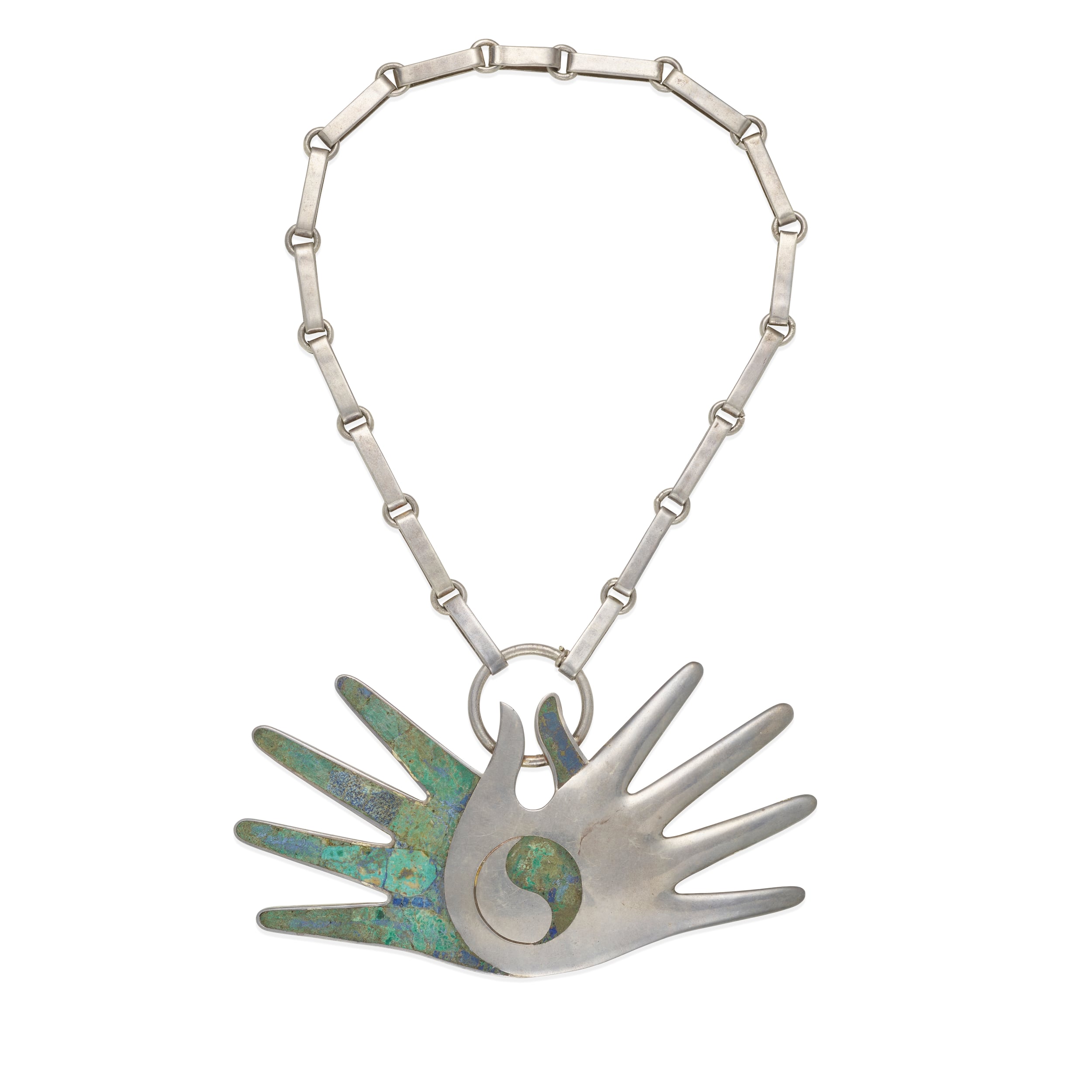
Two open hands, one raised in silver and one carved in azur malachite, join at the center of this necklace and enclose a yin yang symbol formed where their fingers meet. The design turns a recognizable emblem into a study of paired opposites made literal: metal against stone, cool reflectivity against dense green opacity, right hand against left. William Spratling built the composition so that the two halves are equal in form but unlike in substance, and the eye reads the balance before it reads the hands. It is a small pendant that carries an idea about duality without illustration or explanation.
The material contrast is the working principle of the piece. Silver returns light and holds a bright edge, while azur malachite absorbs it, giving the second hand weight and a matte, mineral presence. Spratling set the two hands as mirror gestures so that the yin yang, itself a figure of interlocked opposites, emerges naturally from their overlap rather than being applied as a separate motif. The elongated links of the chain keep the pendant reading as the focus, their repetition quiet against the paired hands. The design record notes that the same motif of open hands was carried into a belt buckle executed in tortoise shell, evidence that Spratling treated the hand-and-symbol composition as a flexible idea adaptable across object types and materials.
The material history of this design is unusually specific. Spratling catalogs before 1958 name azurite as the stone used, while catalogs from 1958 forward refer only to malachite and drop any mention of azurite. Azurite and malachite are closely related copper carbonate minerals, and "azur malachite" describes stone in which the two occur together, so the shift in catalog language reflects how the workshop chose to name the material rather than a change in the design itself. The necklace was also produced in tortoise shell, a less costly version, with the malachite variant priced higher. Wholesale catalog prices held nearly steady across the decade, listed at fifteen dollars and twenty cents in the 1958-59 catalog and fifteen dollars and sixty cents in both the 1961 and 1967 catalogs, placing this among Spratling's accessible production pieces rather than his major commissions. The design appears in Morrill and Berk's Mexican Silver and in Cederwall and Riney's Spratling Silver.
The necklace belongs to Spratling's third design period, the years when he had returned to independent production at his ranch workshop outside Taxco and was managing a small operation. By the mid-1960s Spratling had turned much of the production control over to Juan Gómez, and his own attention had shifted toward collecting ancient Mexican art. A modestly priced piece produced steadily across this period documents how the workshop sustained a catalog of repeatable designs alongside more ambitious work. The malachite version has since been reissued, which distinguishes examples fabricated during Spratling's lifetime from later production of the same design. As a compact demonstration of Spratling's habit of building meaning from the contrast of two materials, the hands necklace records a designer thinking through opposition at the scale of a pendant.
A William Spratling Silver and Malachite Double-Hand Necklace, Taxco, Mexico, mid-20th century Marks: (maker's mark), 925 Length of necklace: 15-3/4 inches (40.0 cm) 86 grams (gross)
Heritage Auctions · 2025-11-12
A William Spratling Silver and Malachite Double-Hand Necklace, Taxco, Mexico, 1951-1956 Marks: (maker's mark), 925 16-1/2 x 3 inches (41.91 x 7.62 cm) 84 grams (gross)
Heritage Auctions · 2025-05-09
William Spratling (American-born, 1900-1967) Taxco Silver and Chip Inlay Mirroring Hand Necklace, 1965-1967
Hindman · 2024-07-11
Museum of Mexican Silver. “Ying Yang Hands Necklace.” Catalog no. MoMS-000757. https://museumofmexicansilver.com/pieces/spratling-287
See something wrong with this record? Suggest a correction and the piece details fill in automatically.
A William Spratling Silver and Malachite Hand Necklace, Taxco, Mexico, circa 1955 Marks: (double stamped Spratling logotype), (effaced assay eagle) 16 inches long (chain) x 5-1/8 inches wide x 3 inches high (medallion) (40.6 x 13.0 x 7.6 cm) 3.19 troy ounces (gross)
Heritage Auctions · 2016-04-12
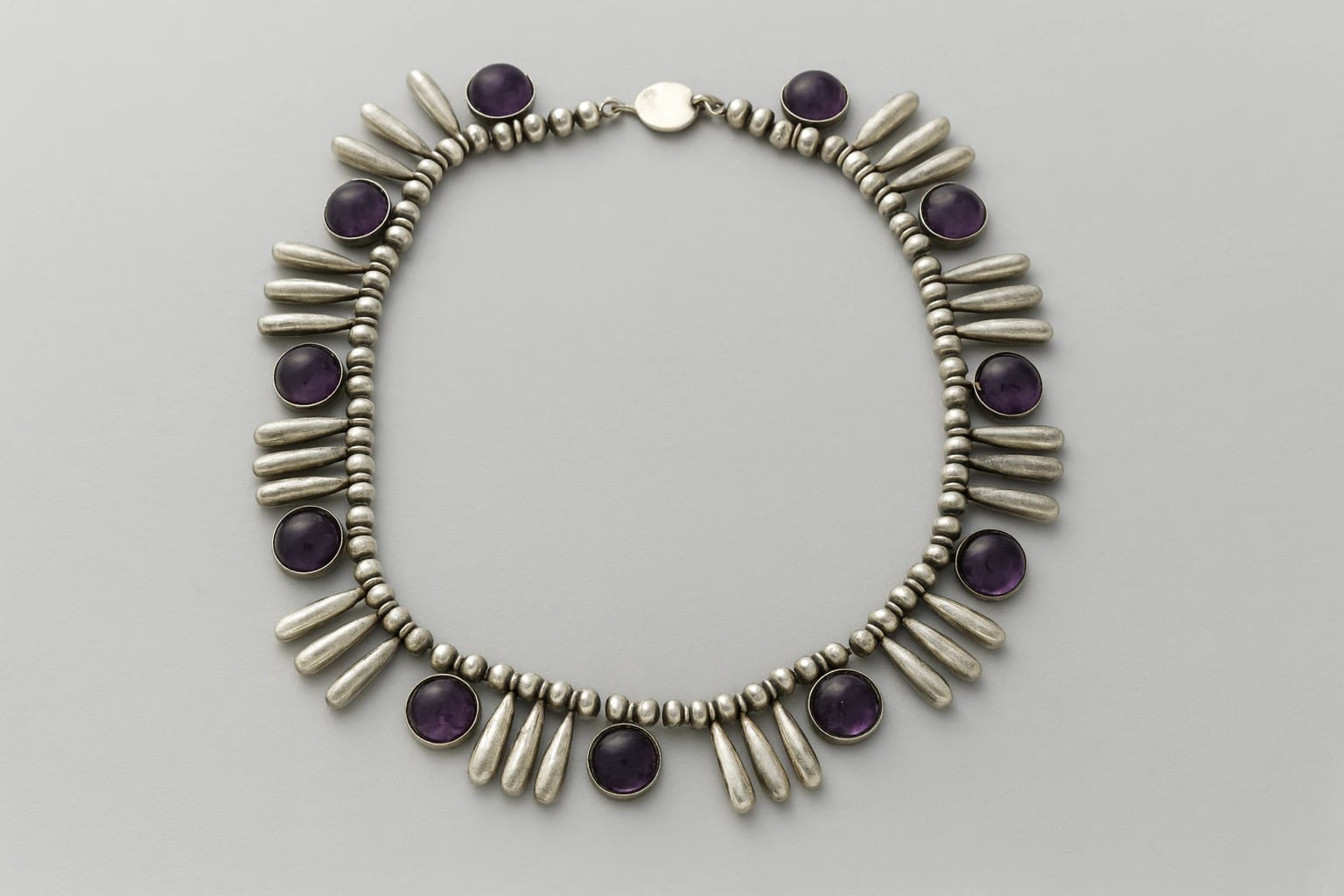
William Spratling
Eleven Amethyst Necklace
First Design Period: 1931 - 1946
Silver