Saves instantly, no account needed. Already a member? Sign in.
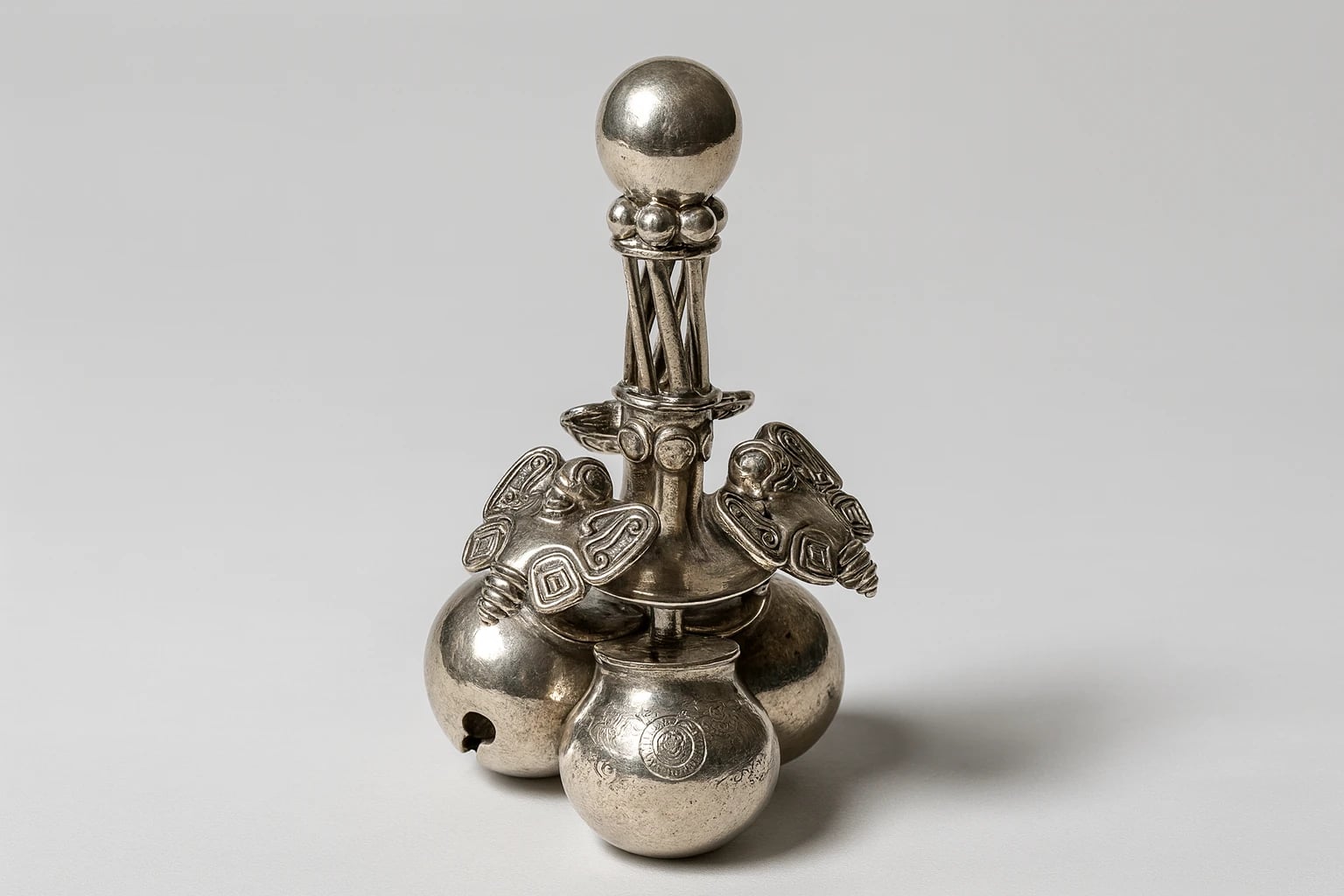
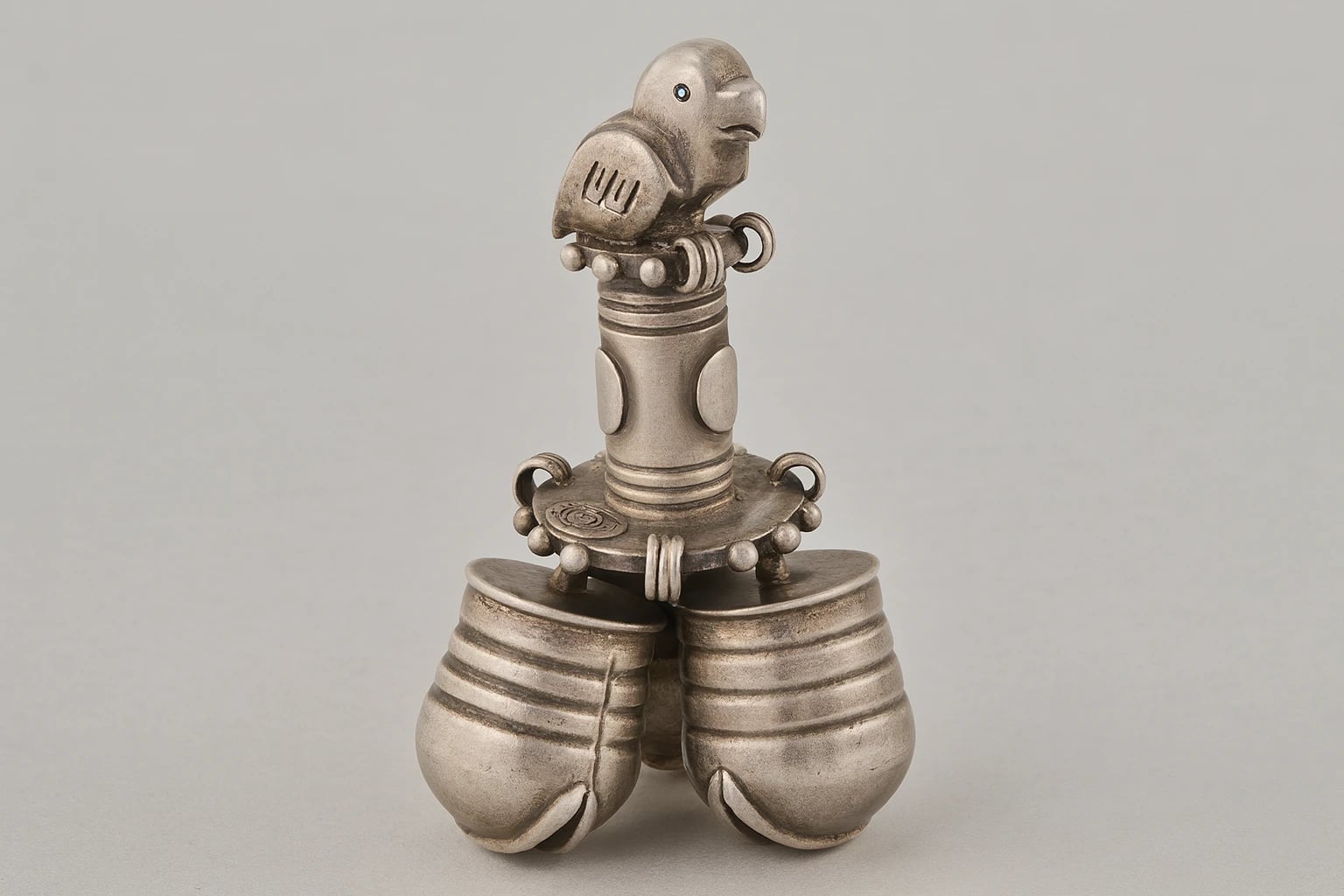
A silver bird presides over a hierarchy of forms in this bell: a round plate crowned with three wire loops, a stem banded with incised lines and set with oval discs, and three smaller bells suspended beneath. The object organizes its parts vertically, moving from the perched bird at the summit down through the plate, along the ornamented stem, and out to the ring of bells at the base. Rather than treating the bell as a single sounding vessel, the design distributes sound and ornament across several elements, turning a functional handbell into a small composition of stacked and clustered shapes.
The construction reads as an assembly of distinct silver components rather than a form raised from one sheet. The three wire handles are bent from round stock into loops, a simple and legible method that keeps the top of the object open and light. The stem carries incised lines around its circumference, a form of cincelar in which a hammered tool marks the surface, and applied oval discs interrupt that banding with flatter, reflective accents. At the summit, the bird stands on a small platform edged with beads along two sides, a detail that gives the figure a defined base and adds a granular rhythm against the smooth body of the creature. The three bells below hang as a cluster, so that the object's weight and its capacity for sound gather at the bottom while the visual interest rises toward the bird.
The work belongs to Spratling's first design period, the years between the 1931 founding of the Taller de Las Delicias and the mid-1940s, when his workshop was developing a vocabulary that drew on Mexican popular art and pre-Hispanic sources alongside a taste for clear, constructed form. The bird and bell motifs sit within that popular-art current, while the banded stem and applied discs reflect the workshop's habit of building objects from articulated, repeatable elements. Spratling's taller operated through the collaborative system that Stromberg and others have described, in which a designer worked with master smiths who translated a concept into finished silver. The name in the mark records the design authority and the workshop, not necessarily the hand that shaped each loop and disc, and this bell is best understood as a product of that division of labor.
Bells and small figural objects occupy a less familiar corner of Spratling's output than his jewelry and hollowware, and this one shows how the workshop's compositional instincts extended to modest domestic and decorative forms. The vertical stacking of plate, stem, and bells, resolved by the perched bird, demonstrates the same interest in assembling silver from discrete, clearly joined parts that runs through the first-period work. As a record of that early vocabulary applied to a functional object, the bell adds a useful point of comparison to the better-known jewelry of the same years and helps document the range of the Taxco School in its formative decade.
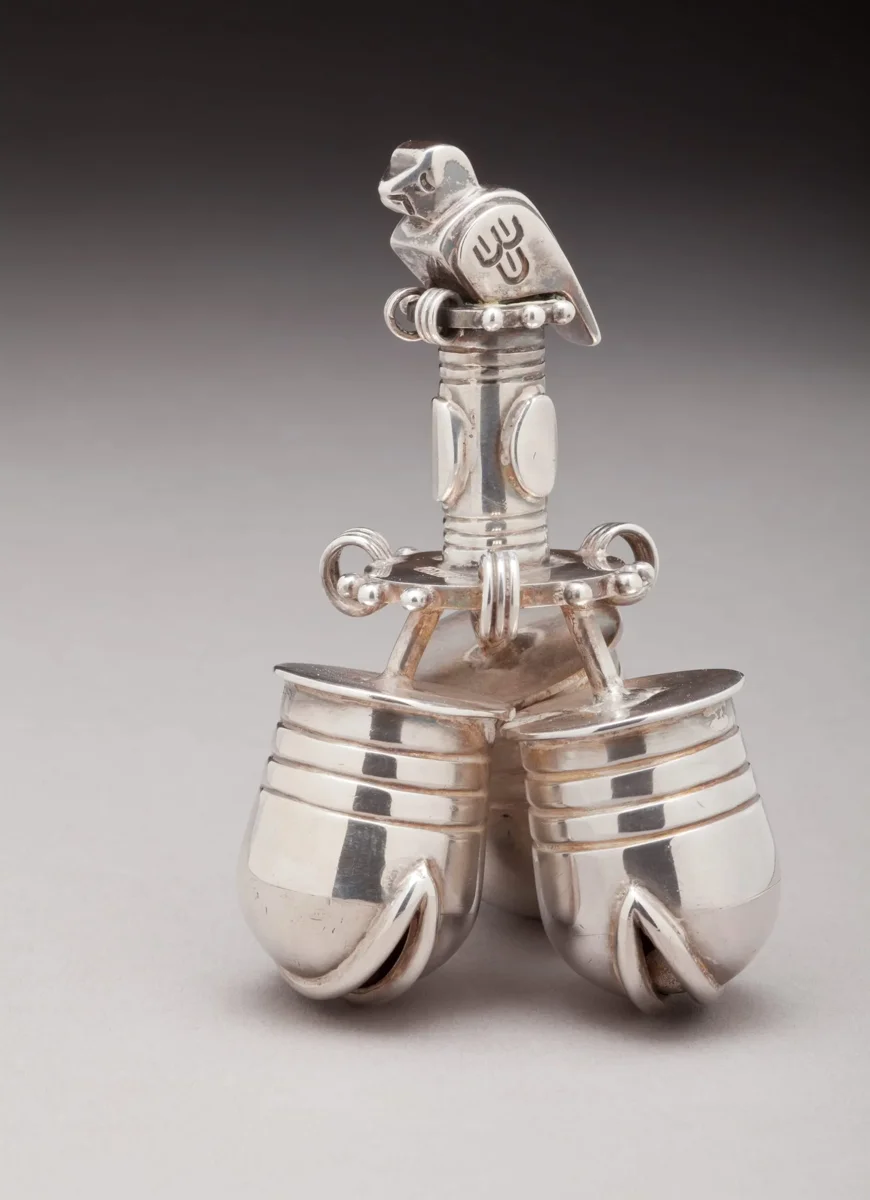
Rattle Bell with Bird Motif, circa 1940
Accession M.2013.211.2. Official museum record Photo: Los Angeles County Museum of Art.
Verified against each institution's own collection records. All museum collections
Museum of Mexican Silver. “Three Bell Cluster.” Catalog no. MoMS-000190. https://museumofmexicansilver.com/pieces/spratling-3088
See something wrong with this record? Suggest a correction and the piece details fill in automatically.
William Spratling
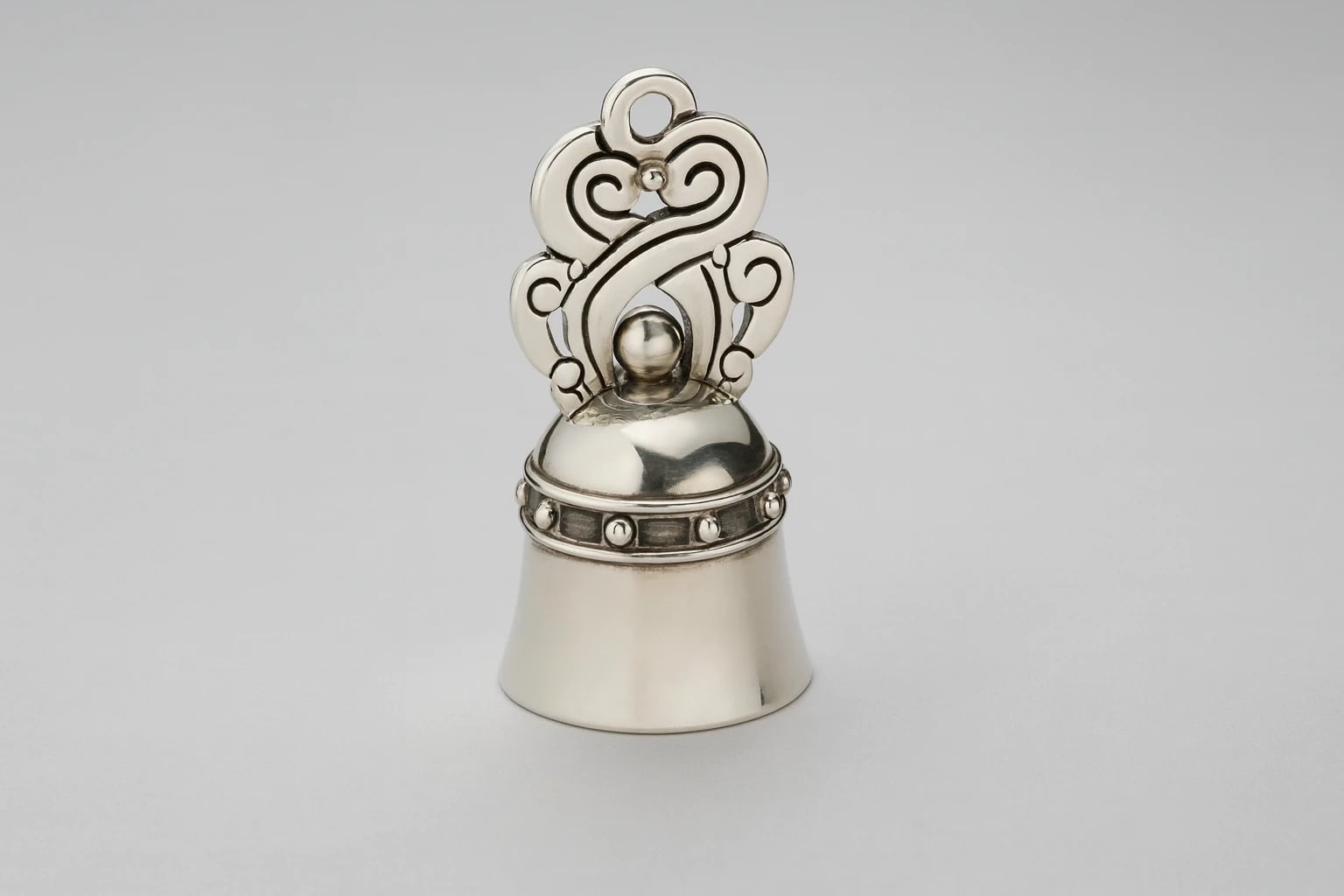
Bell with Mayan Type Handle
Silver