Saves instantly, no account needed. Already a member? Sign in.
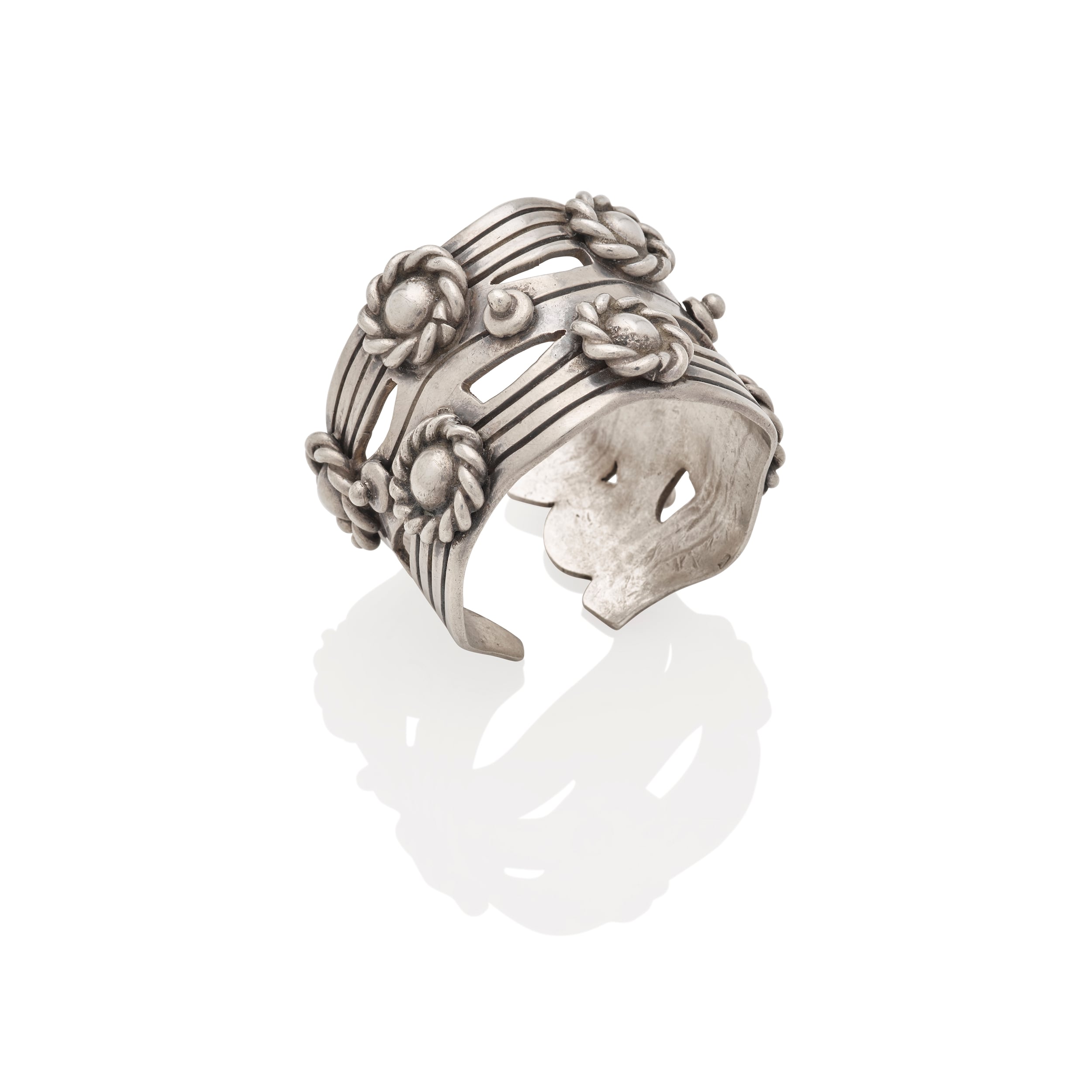
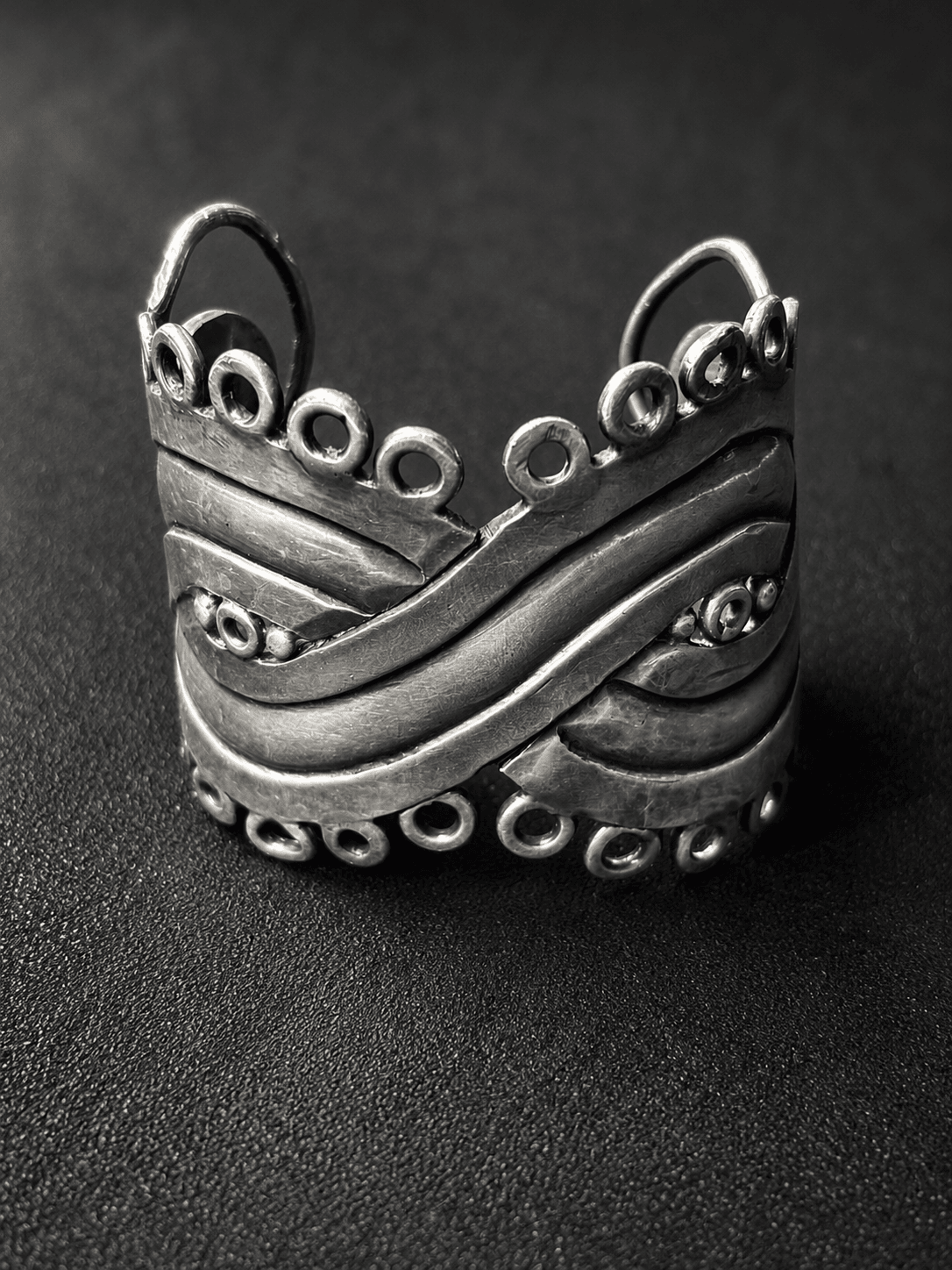
A broad silver cuff ringed with small wire loops, the Mask Cuff translates a single sculptural motif into something the wrist can carry. The loops run in a continuous rhythm around the perimeter, framing the central form and catching light along the edges where the band curves. Weight is central to the design's character. This is a heavy cuff, and the mass concentrates the eye on the face at its center rather than dispersing across ornament. The result is a bracelet built around one strong idea, held in place by a repeating border that reads as both structure and decoration.
The central motif is a mask, and the Montgomery Ward catalog of Fall 1944 described the design as "an ancient Aztec design." Spratling drew consistently on ancient Mexican sources during his first design period, and the mask relates closely to a pin of the same period, suggesting the motif moved between object types within the workshop's repertoire. The wire loops around the edge do practical and visual work at once. They soften the transition between the flat band and the wearer's arm, and they establish a measured cadence that contains the mask without competing with it. The band's breadth and the loops' regularity give the piece the presence of a single cast or worked form rather than an assembly of parts.
Spratling founded the Taller de Las Delicias in Taxco in 1931 and spent the following years developing a design language that drew ancient Mexican imagery into modern silver. This cuff belongs to that first period, before the eagle assay system, and its appearance in a national mail-order catalog marks a specific moment in how Taxco silver reached American buyers. The Montgomery Ward listing at $17.95 placed a Spratling design in front of a mass audience far from any Taxco showroom. That the same design was later produced in a silver-plated version by Victor Silson, marked with Silson's own hallmark, shows how quickly a successful Spratling motif could be copied and recast for the costume-jewelry trade. The distinction matters: the Spratling cuff is heavy sterling from the taller, while the Silson version is a plated commercial echo of the same form.
The Mask Cuff records how a Taxco design entered the American market through a distribution channel rarely associated with studio silver. Its documentation in the Spratling literature, including Cederwall and Riney's Spratling Silver and Goddard's field guide, ties the object to the catalog placement and to the related pin, giving a clear picture of how one motif circulated across formats and price points. As a first-period Spratling cuff with a documented catalog history and a known plated imitation, it preserves an unusually complete account of design, production, and reach in the early Taxco renaissance.
Museum of Mexican Silver. “Mask Cuff Bracelet.” Catalog no. MoMS-000047. https://museumofmexicansilver.com/pieces/spratling-63
See something wrong with this record? Suggest a correction and the piece details fill in automatically.
William Spratling
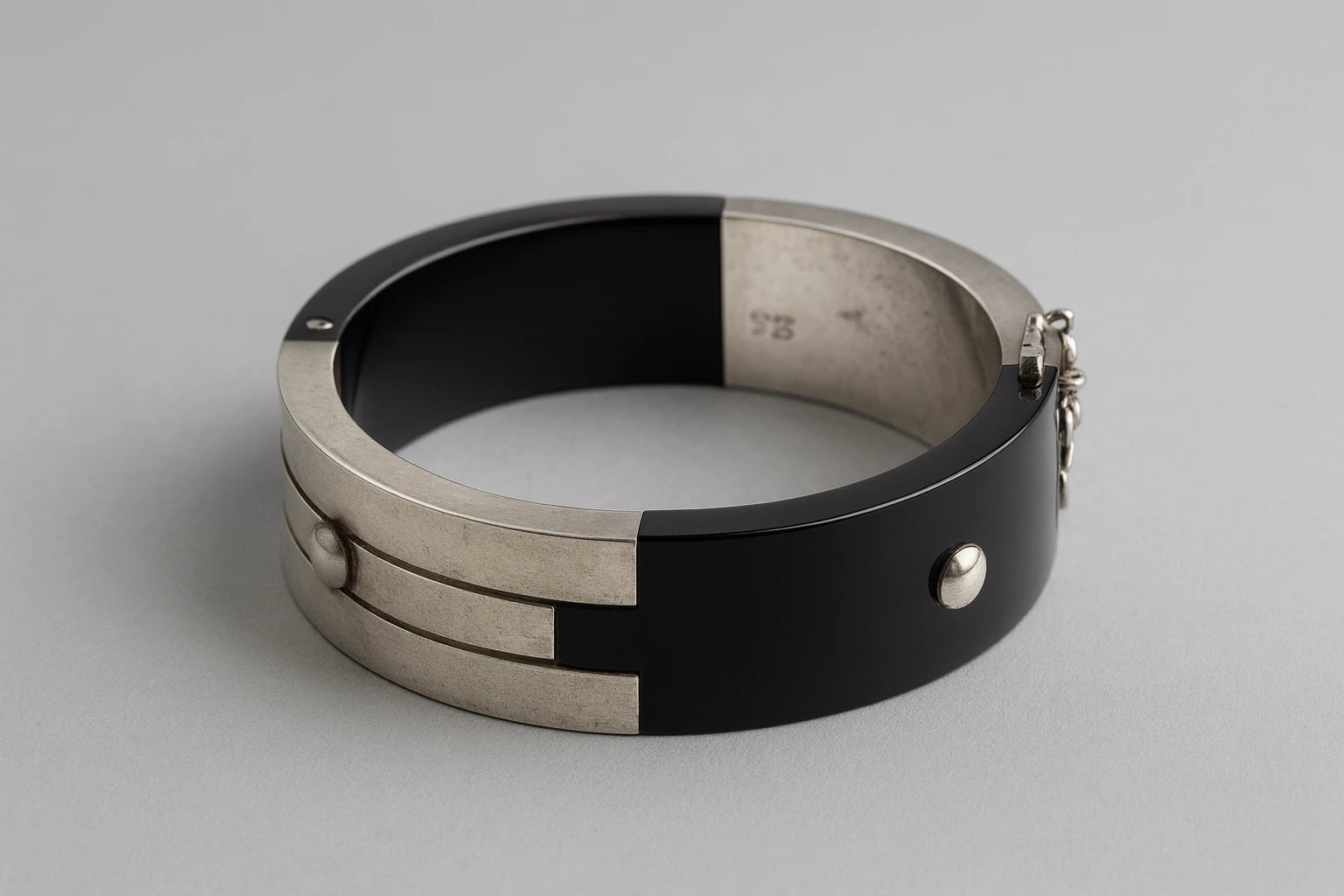
Rosewood and Silver Bangle
First Design Period: 1931 - 1946
Silver