Saves instantly, no account needed. Already a member? Sign in.
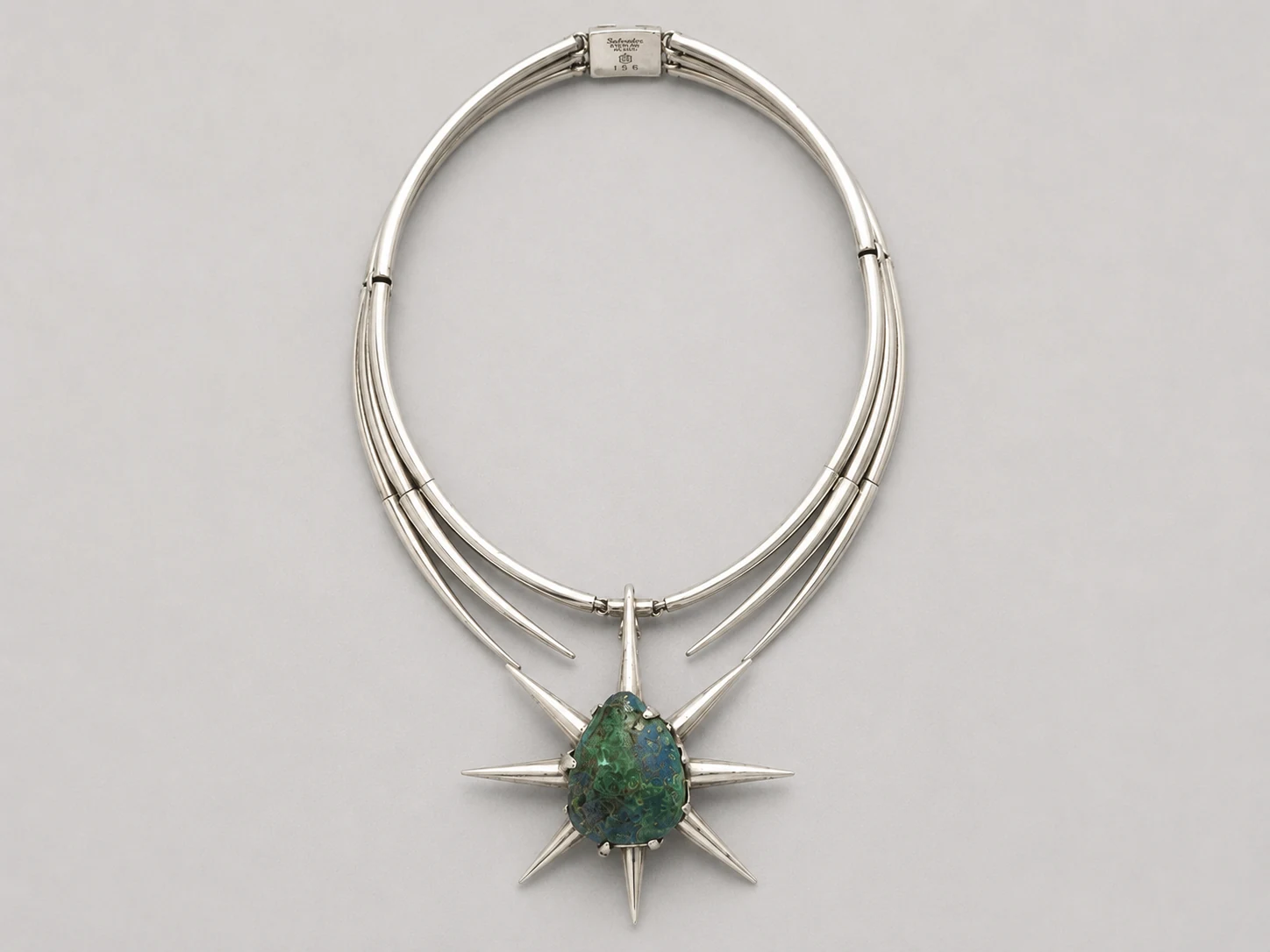
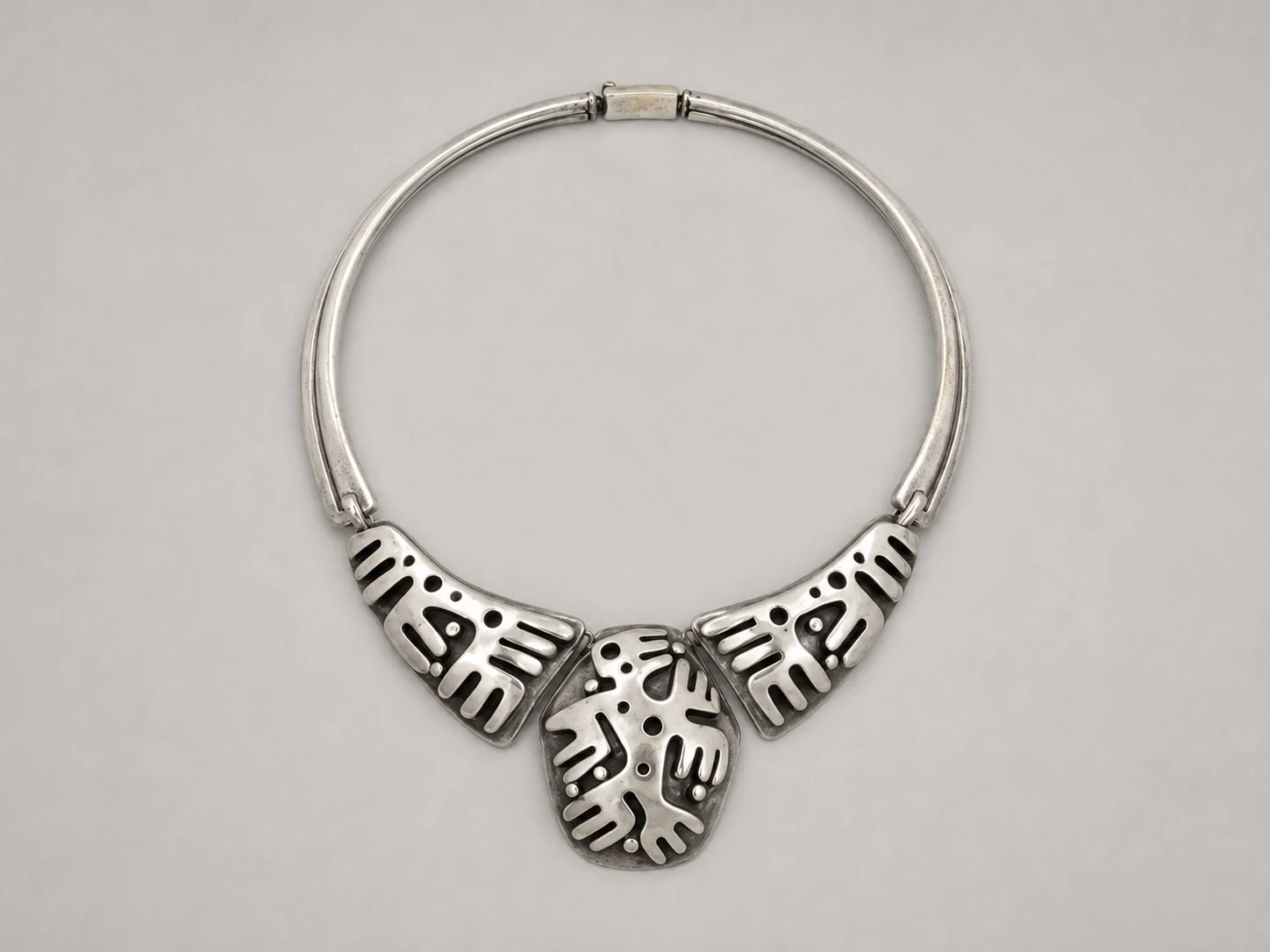
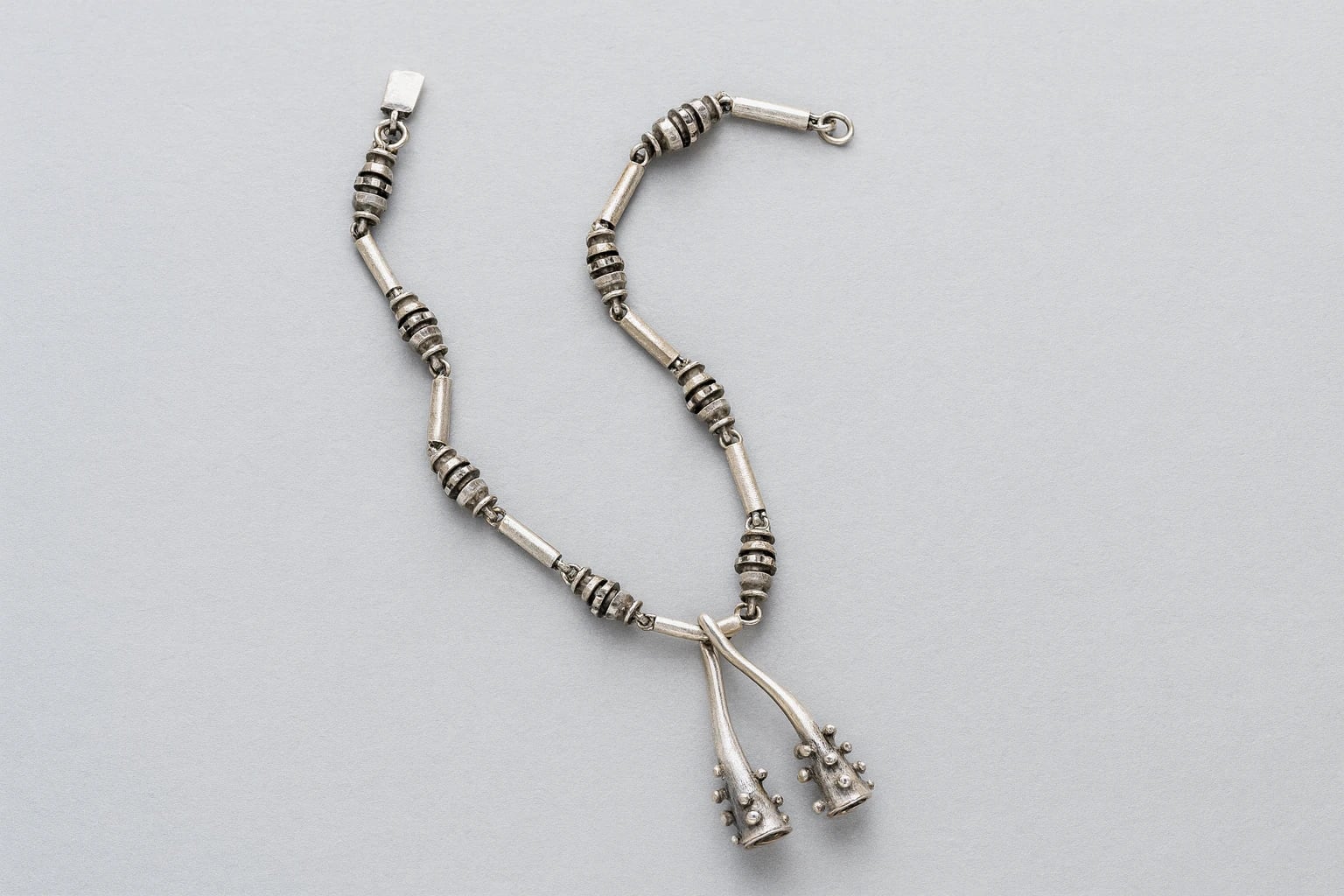
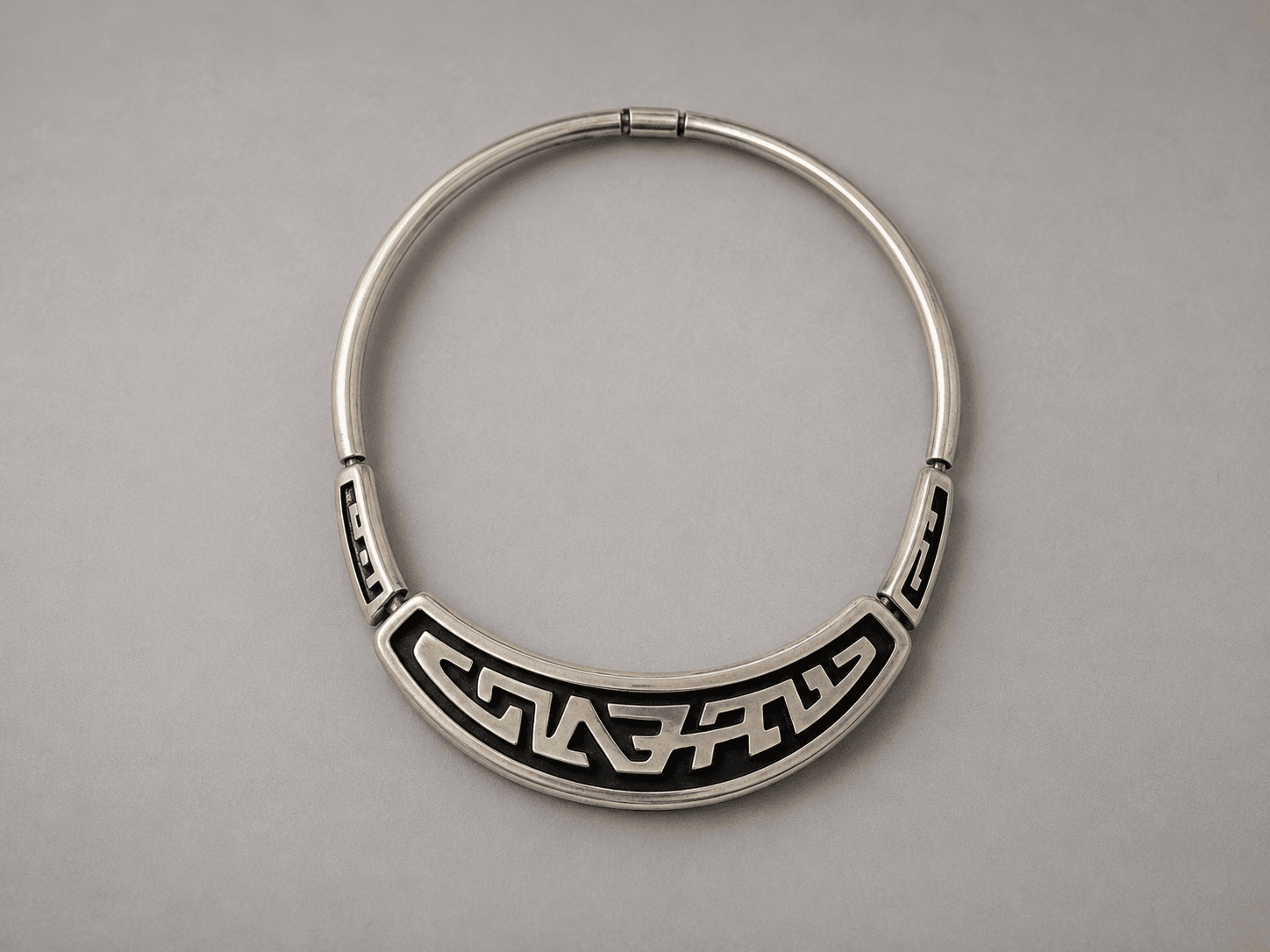
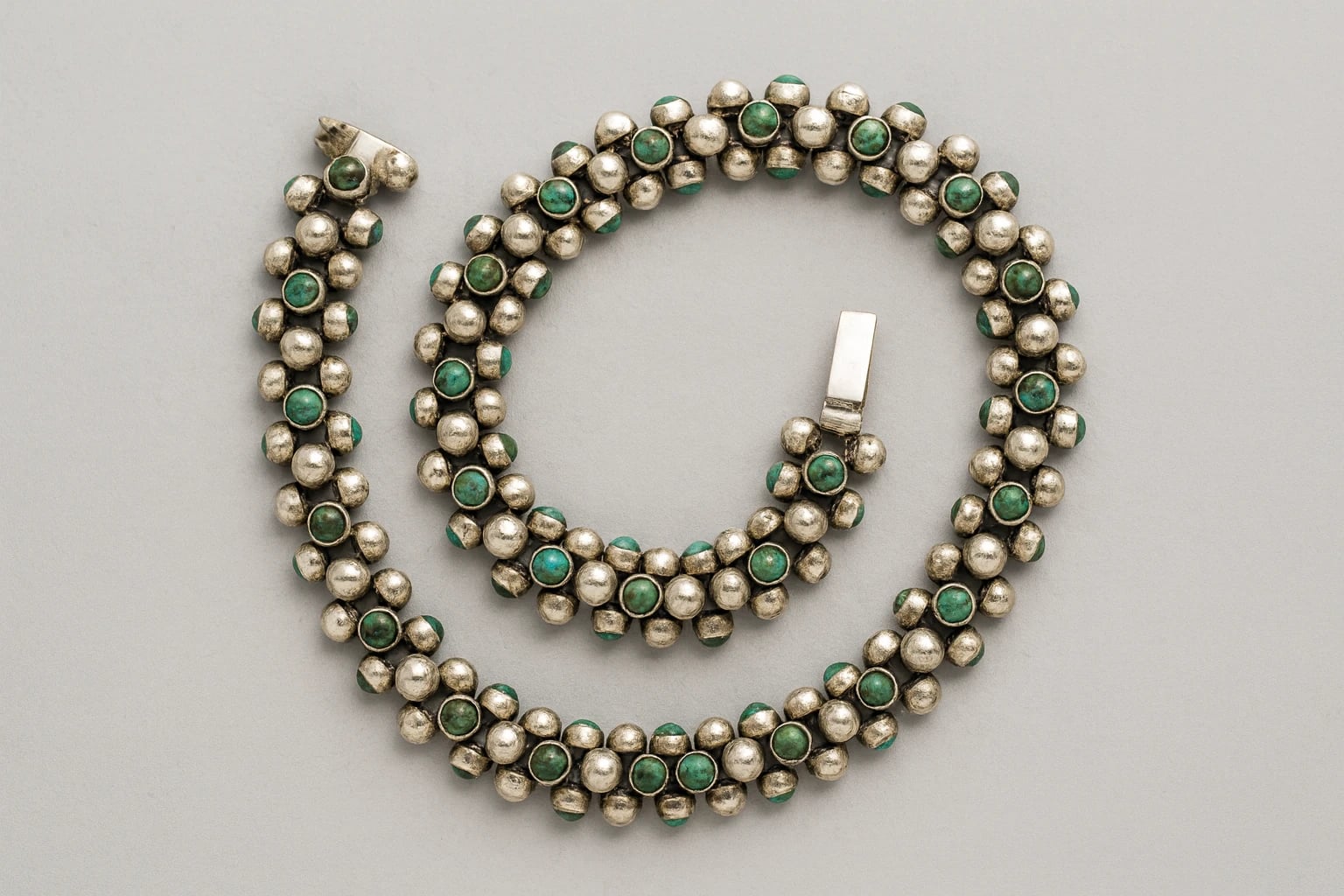
The choker organizes its silver into rows of small domed beads set close together, a granular field that catches light along the throat and gives the piece its collector name. Turquoise inlay interrupts the metal at measured intervals, so the eye moves from the cool blue stone to the reflective clusters of silver and back. The design draws its interest from repetition and density rather than a single dominant motif, and it reads as a continuous band rather than a sequence of discrete links.
The bead field is what gives the choker its tactile character. Massed rounded forms create a surface that reads as texture from a short distance and resolves into individual elements up close, a play of scale that rewards attention. The turquoise is used as inlay rather than as a suspended or bezel-set focal stone, which keeps the stone flush with the silver and preserves the unbroken curve of the band around the neck. Worn close to the throat, a choker of this construction sits as a defined collar, and the alternation of stone and metal establishes a steady visual rhythm along its length. The blue of the turquoise, opaque and matte against the polished silver, supplies the only color and does so without breaking the disciplined regularity of the whole.
William Spratling founded the Taller de Las Delicias in Taxco in 1931 and, through the years assigned here to his first design period, developed a vocabulary that drew on Mexican material and form while organizing production through a workshop of master smiths. The pairing of silver with turquoise reflects Spratling's sustained interest in native Mexican stones, and the reliance on a repeated small unit to build a larger form is consistent with the workshop's approach to design as controlled, rhythmic construction. Spratling belonged to the generation of Taxco designers, among them Antonio Pineda, Héctor Aguilar, and the Castillo brothers, whose talleres allowed the designer to concentrate on form while skilled smiths carried the work into production, as Gobi Stromberg and others have documented in the study of Taxco's silver age.
Within that history, the choker shows how Spratling built ornament from accumulation, using a modest repeated bead and an intermittent line of local stone to compose a piece that is severe in its logic and rich in its surface. It records a characteristic pairing of Taxco silver with Mexican turquoise and a preference for structure over singular incident, and it stands as a clear example of the design thinking that made the Taxco workshops central to modern Mexican silver.
Museum of Mexican Silver. “Turquoise Caviar Choker Necklace.” Catalog no. MoMS-000305. https://museumofmexicansilver.com/pieces/spratling-900
See something wrong with this record? Suggest a correction and the piece details fill in automatically.
William Spratling
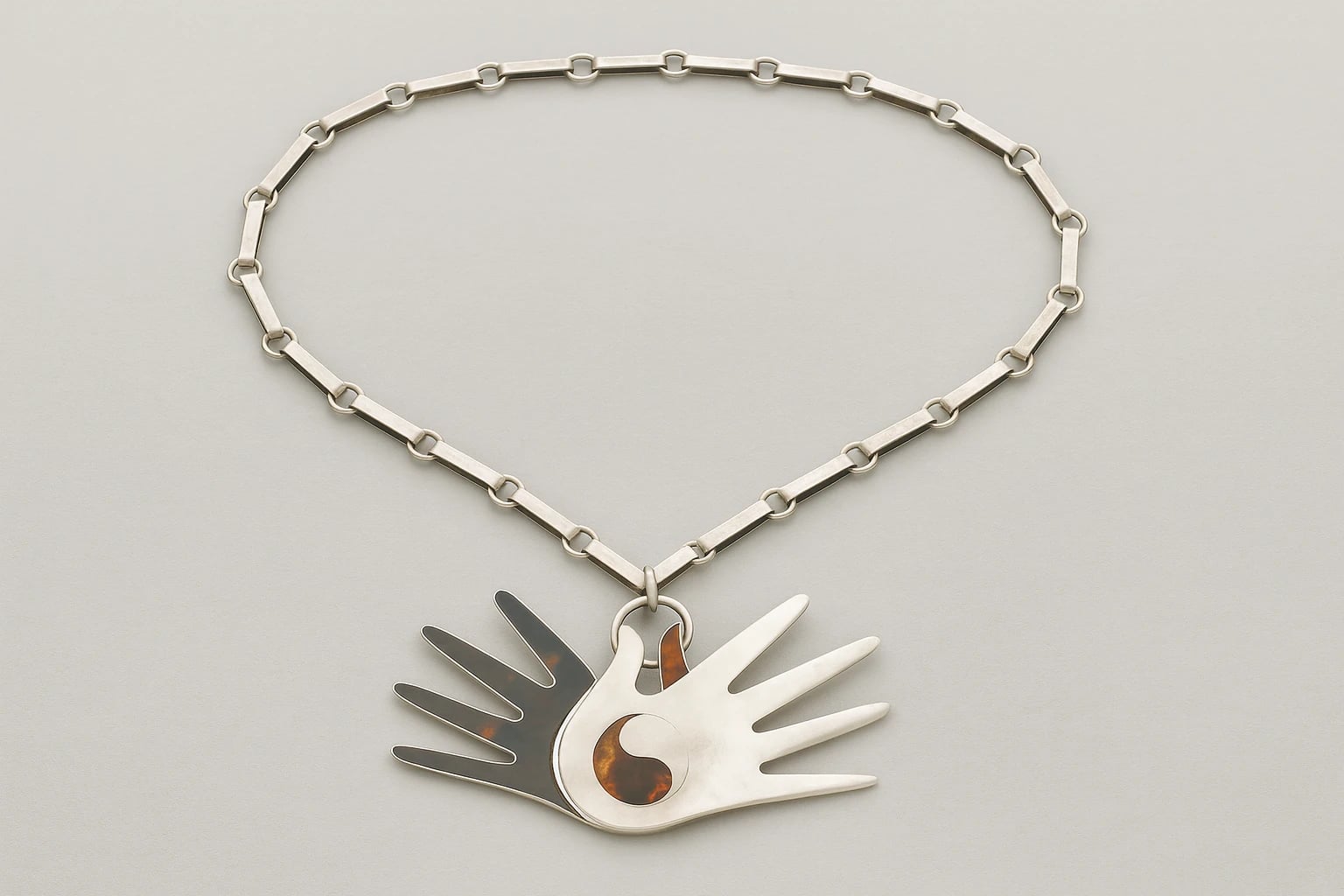
Crossed Hands Necklace
Silver