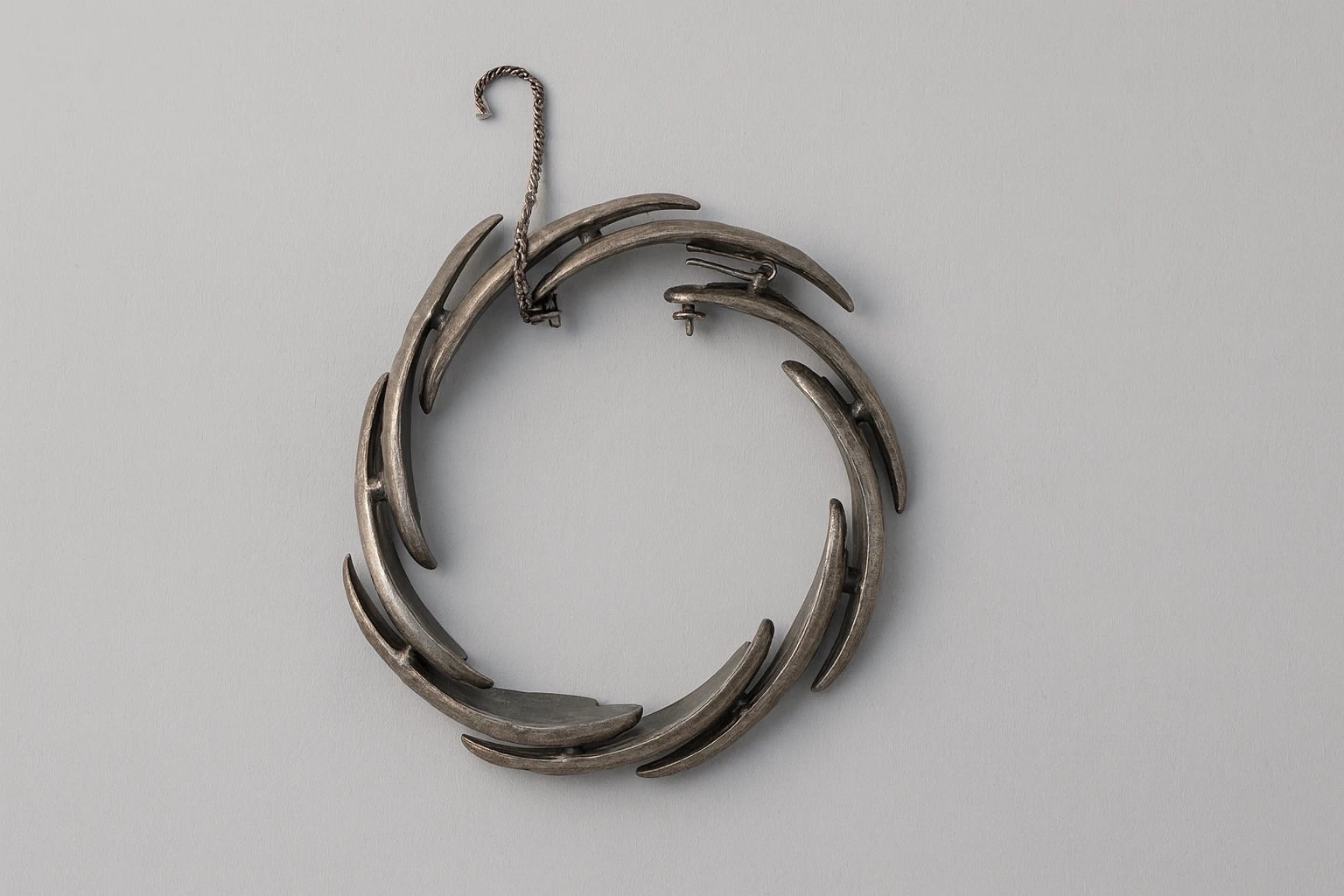
Pair of Feather Gauntlet Bracelets (two bracelets)
Saves instantly, no account needed. Already a member? Sign in.
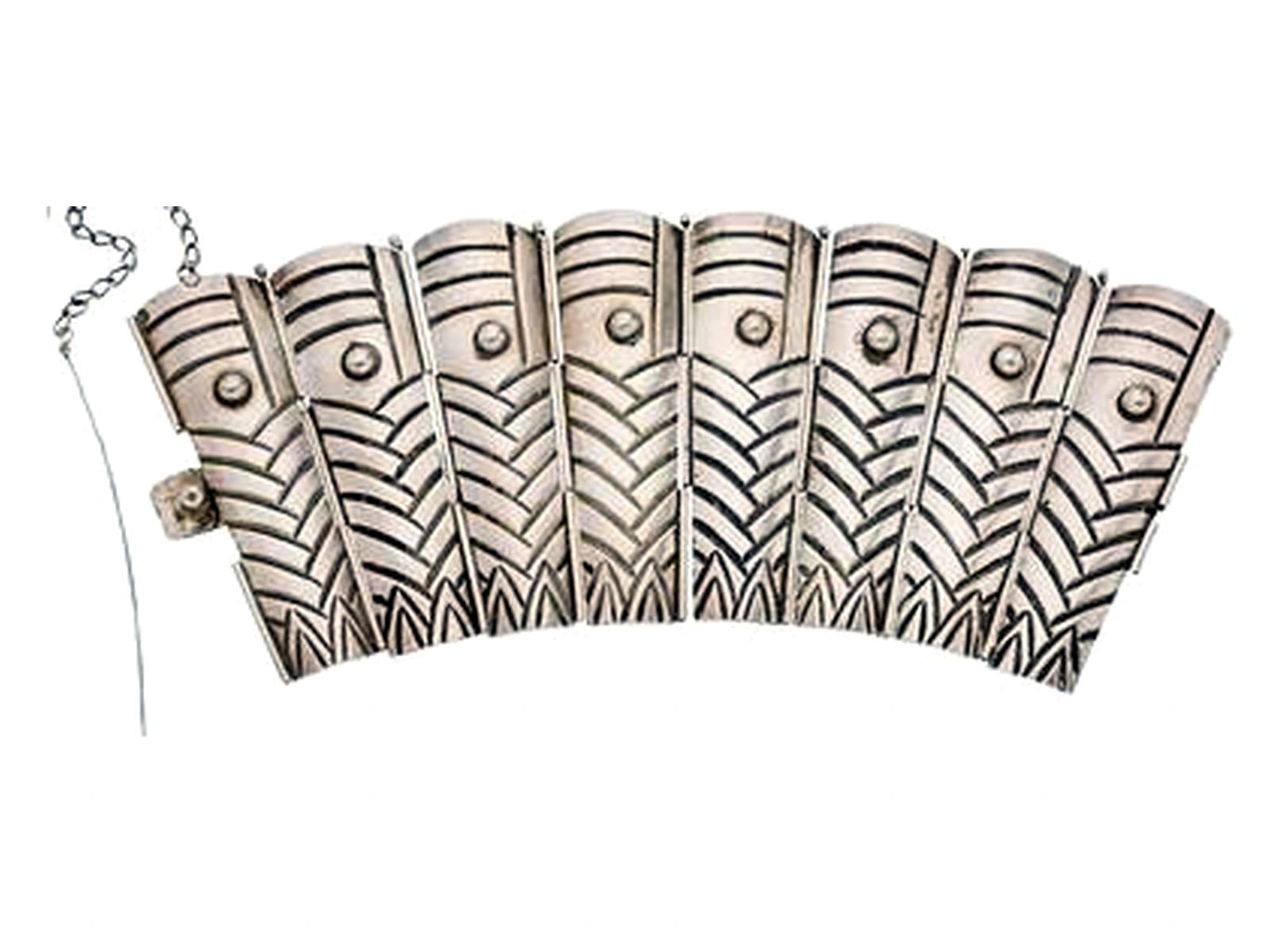
A gauntlet bracelet asks more of a workshop than a bangle does. It must sheathe the forearm rather than simply encircle the wrist, which means resolving a cone rather than a cylinder, and it must flex enough to be put on and worn. This Los Castillo feather gauntlet solves both problems with a ring of tapered sterling panels, each wider at the top than at the bottom, hinged edge to edge so that the closed band flares outward to follow the swell of the arm. The construction is the design: the taper of each panel produces the conical silhouette, and the hinges that make the cuff wearable double as the vertical seams that separate one feather from the next.
Each panel is worked as a single stylized plume. Ranks of chased chevrons descend the plaque like barbs along a quill, an applied domed boss sits within a stamped ring near the upper edge like the eye of a feather, and the lower portion breaks into arched, overlapping lines that resolve into pointed lanceolate tips at the hem. The chasing is cut deeply enough to hold shadow, so the recessed lines darken while the ridges between them stay bright, and the repeated pattern shifts in the light as the wrist turns. A pin threaded through the terminal hinge, secured by a fine safety chain, closes the circuit; once seated, it reads as one more seam in the rhythm of the panels rather than as a visible clasp. The result is a surface organized entirely by line and repetition, with no stone, no applique of contrasting metal, and no pictorial scene, only the abstracted logic of spine, barb, and tip carried around the full circumference.
The feather was a charged motif in postrevolutionary Mexico, bound to the memory of Mesoamerican featherwork and warrior regalia, and Los Castillo handles it here without archaeological quotation. There is no literal quetzal, only a disciplined geometry that any viewer of the 1940s would have recognized as Mexican in source and modern in execution. The bracelet belongs to the ambitious side of the workshop's early repertoire. Antonio Castillo, trained under William Spratling at the Taller de Las Delicias, founded Los Castillo in Taxco in 1939, and within a few years the taller was producing some of the boldest wrist ornaments in the town. Morrill's Silver Masters of Mexico illustrates the workshop's Female Dancers and Parrot Head bracelets of about 1940 to 1945, wide bands that show the same willingness to treat the bracelet as a field for sustained imagery rather than a strip of ornament. The gauntlet extends that ambition into the third dimension, turning the band into a form with real architectural presence on the arm.
Jill Crawford Collection
Museum of Mexican Silver. “Pair of Feather Gauntlet Bracelets (two bracelets).” Catalog no. MoMS-001139. https://museumofmexicansilver.com/pieces/los-castillo-bracelet-form-pair
See something wrong with this record? Suggest a correction and the piece details fill in automatically.
As a document of workshop practice, the piece is unusually legible. The hinged panel system shows how a Taxco taller reconciled sculptural scale with the mechanics of wear, dividing a monumental form into repeatable units that specialist smiths could chase, stamp, and assemble in sequence. Nothing about the object depends on rarity of material or elaborateness of technique; its authority comes from proportion, repetition, and the fit between structure and image. In the Museum's account of the silver renaissance, it stands for the moment when the second generation of Taxco workshops, led by smiths who had come up through Las Delicias, began designing at a scale and with a confidence that made Mexican jewelry a vehicle for national imagery rather than an accessory to it.
Los Castillo
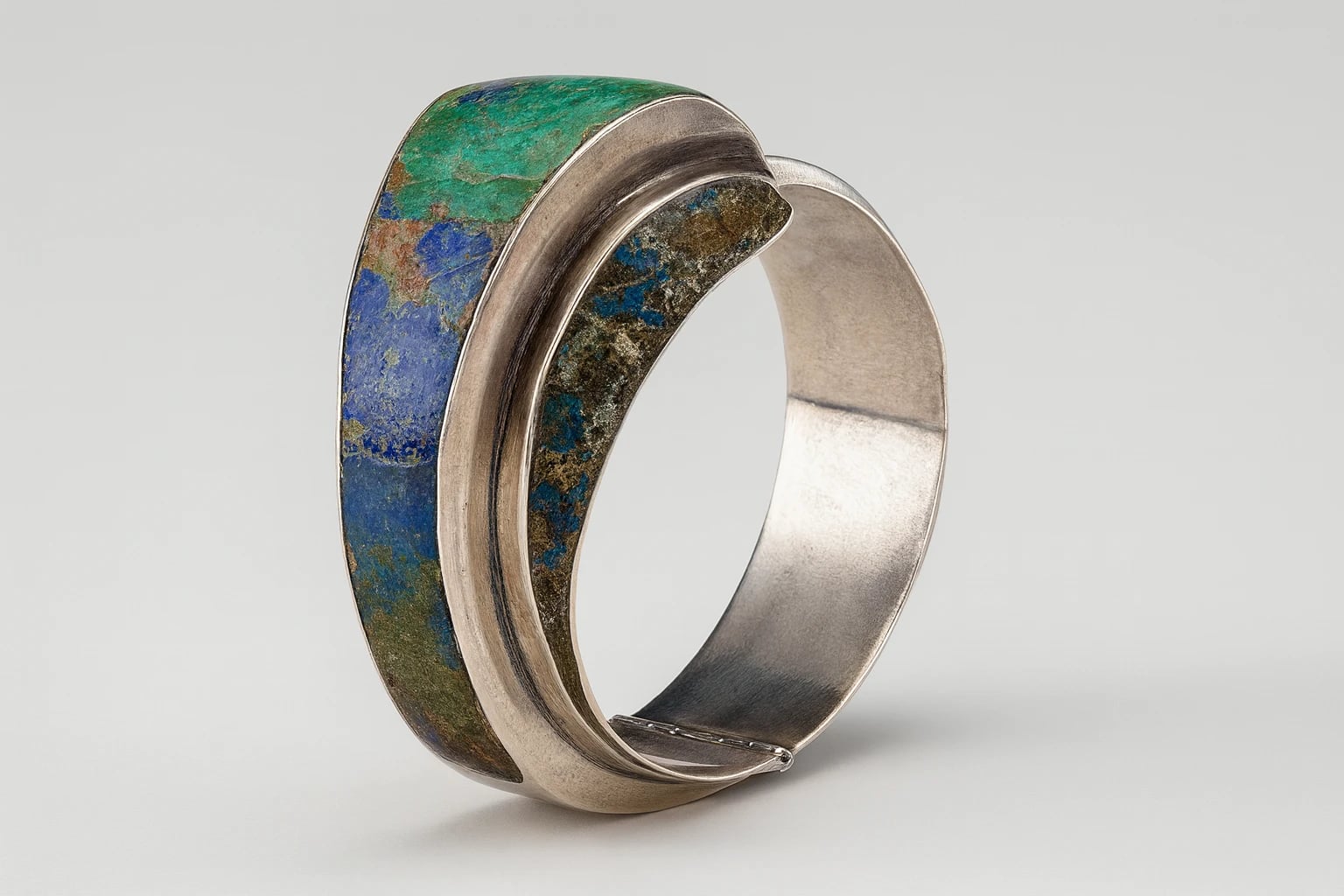
Stone-Mosaic Bracelet with Malachite
Malachite