Saves instantly, no account needed. Already a member? Sign in.
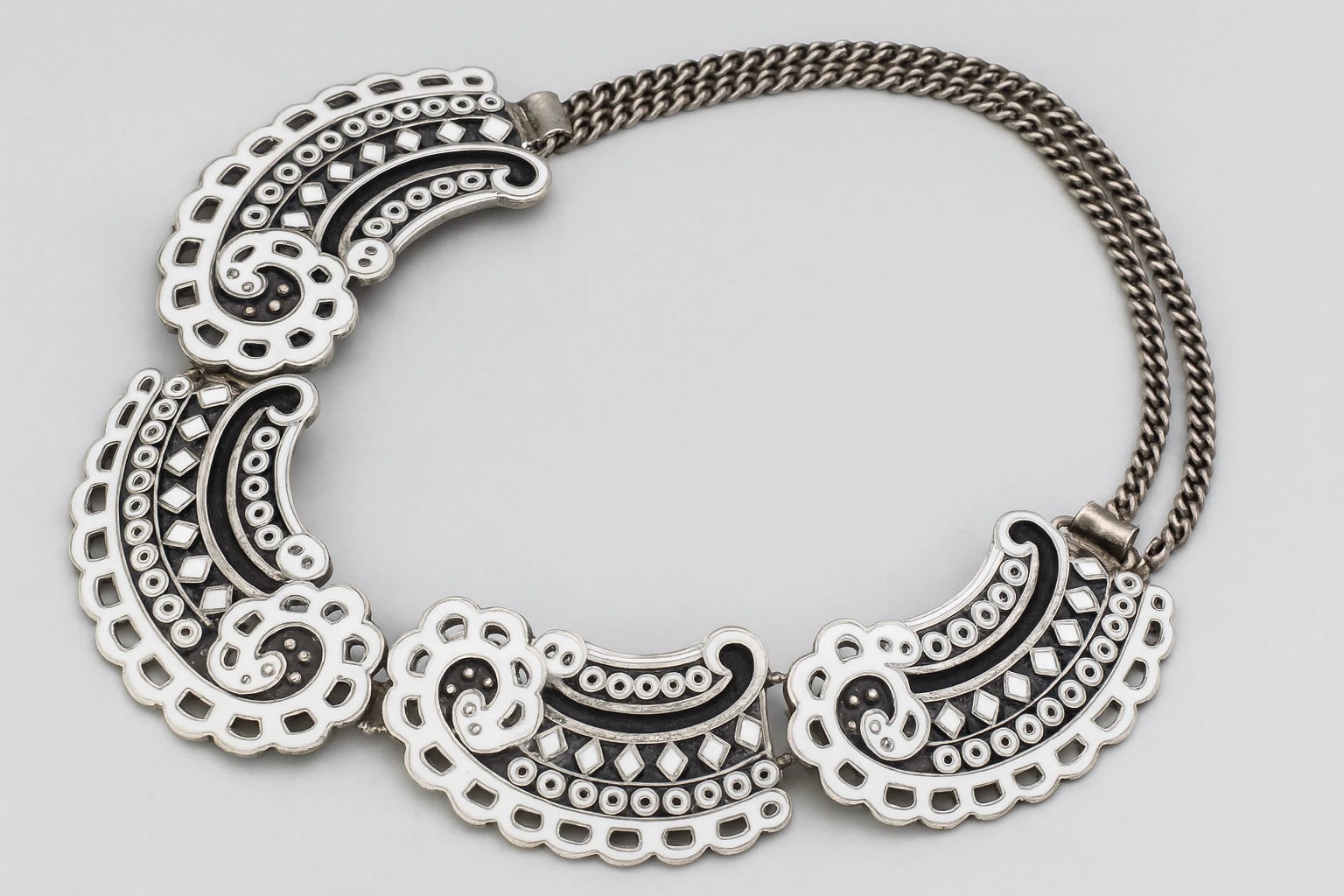
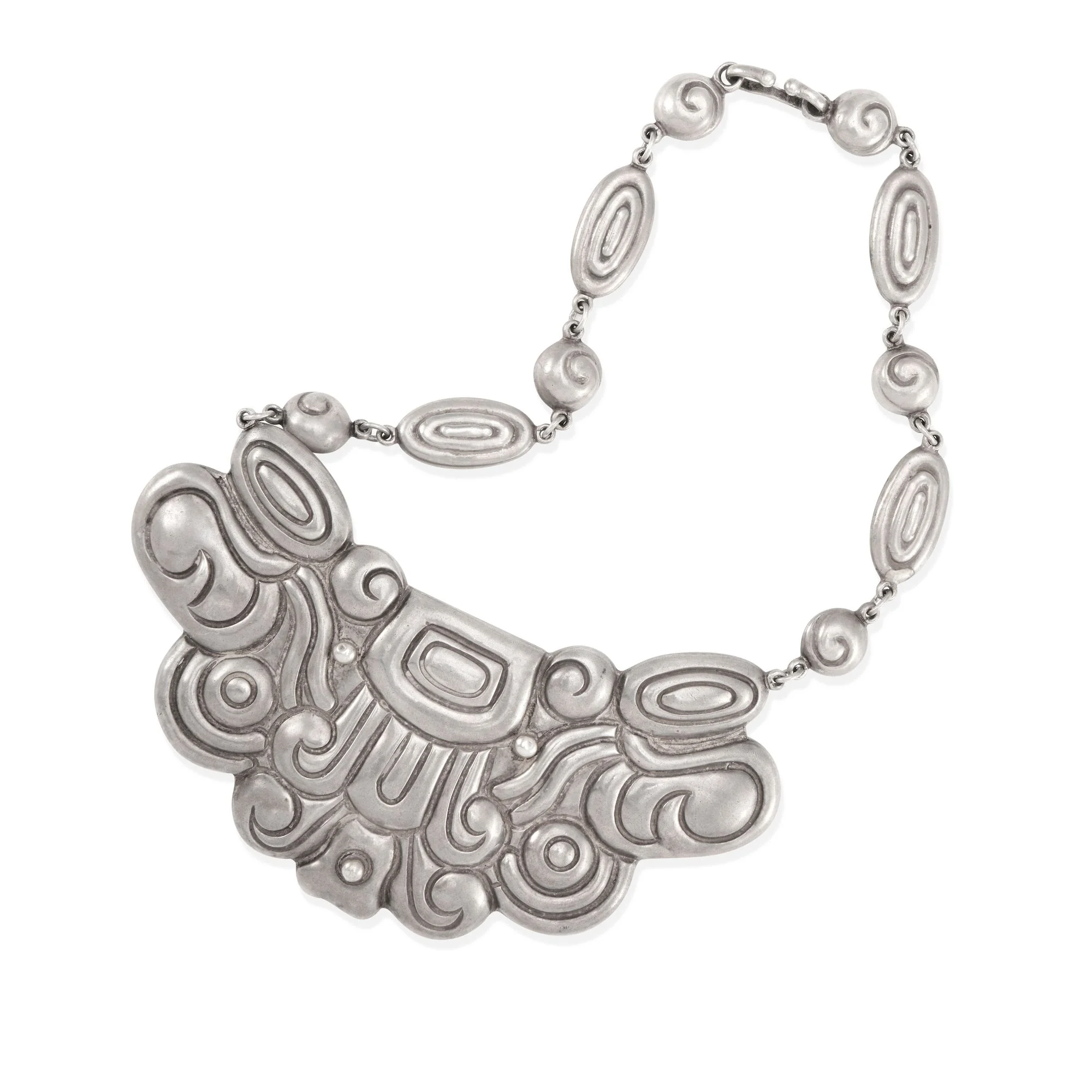
Known as The Glyph, this is one of the most sought after forms in the history of Taxco. Originally designed by Margot as one of the first Los Castillo forms, the necklace takes its name from the vocabulary it carries: scrolls, volutes, dotted circles, and framed cartouche forms that recall the rounded compartments of Maya glyphic writing. Rather than copying any single archaeological source, the design absorbs the logic of that script, in which curving elements are packed edge to edge inside a contained field, and turns it into a wearable relief. The result reads as a continuous surface of raised ornament with almost no empty ground, the kind of dense, ancient Mexican pattern language that the early Taxco workshops were then translating into modern jewelry.
The pectoral is executed in repoussé, the relief raised from behind so that each scroll and roundel swells softly from the surface rather than sitting on it as applied ornament. The motifs vary in scale and direction, large comma-shaped volutes at the outer edges, tighter spirals and beaded dots toward the center, a rectangular cartouche anchoring the composition at the top. This variation keeps the eye moving across the plaque while the overall crescent shape holds the design to the line of the collarbone. The chain extends the same vocabulary at smaller scale: domed round links chased with single spirals alternate with oval links carrying concentric channels, so that the necklace does not divide into a pendant and a strap but reads as one graduated system of motifs from clasp to center. That continuity between chain and pectoral is one of the more thoughtful decisions in the design, and it distinguishes the piece from the common formula of an elaborate plaque hung from a plain chain.
The necklace is Los Castillo design number 152, dated circa 1940, from the first years after the Castillo brothers left William Spratling's Taller de Las Delicias to establish their own workshop in 1939. The design is by Margot van Voorhies Carr, who was working with the brothers at the founding of Los Castillo and who would later establish her own celebrated shop as Margot de Taxco. The fluency of the curvilinear drawing is hers, a quality that would remain central to her independent work. The low design number places the necklace early in the workshop's output, consistent with the relative chronology of Los Castillo numbering, and it belongs to a documented family of ambitious repoussé pectorals from this moment: Penny Morrill's Silver Masters of Mexico illustrates a large Los Castillo repoussé pectoral necklace of circa 1940, design number 144, from the same J. Crawford Collection in which this example resides. That collection, drawn on repeatedly in Morrill's study of early Taxco silver, has preserved a concentrated record of the workshop's first design campaign, when Los Castillo was establishing an identity built on Mesoamerican relief sources handled at generous scale.
Property from the Collection of Jill and Byron Crawford.
Museum of Mexican Silver. “Glyph Necklace, Design No. 152.” Catalog no. MoMS-002289. https://museumofmexicansilver.com/pieces/los-castillo-glyph-necklace-152
See something wrong with this record? Suggest a correction and the piece details fill in automatically.
For the Museum, the necklace documents two things at once. It shows the young Los Castillo workshop staking out its own formal territory in the immediate wake of Las Delicias, favoring dense, all-over relief where Spratling's contemporary work often relied on isolated motifs against plain silver. And it preserves a trace of Margot van Voorhies Carr's contribution to the workshop's earliest designs, a collaboration that the later fame of both parties has tended to obscure. As an early, low-numbered design with a documented collection history, it anchors the beginning of one of the Taxco School's most productive lineages.
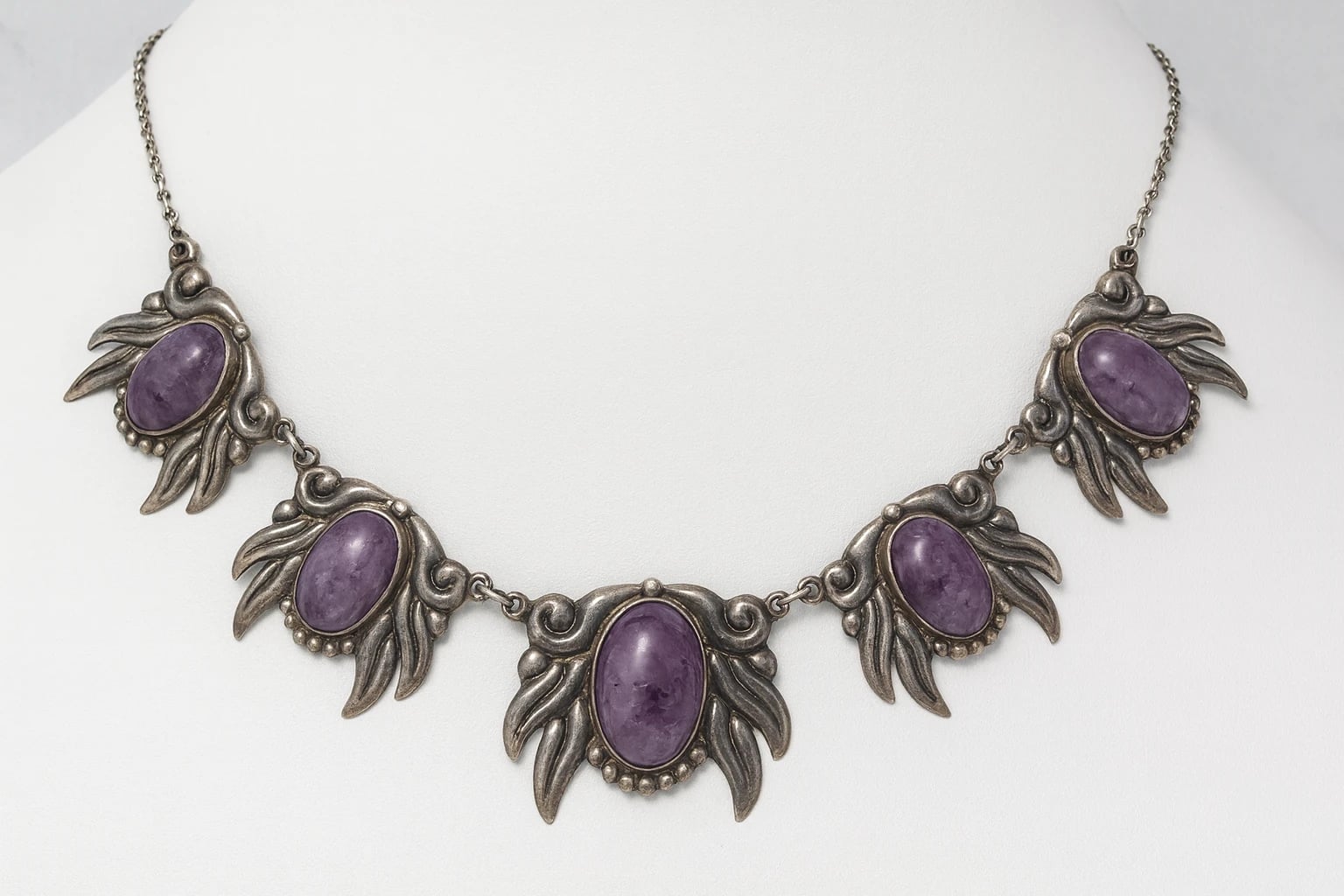
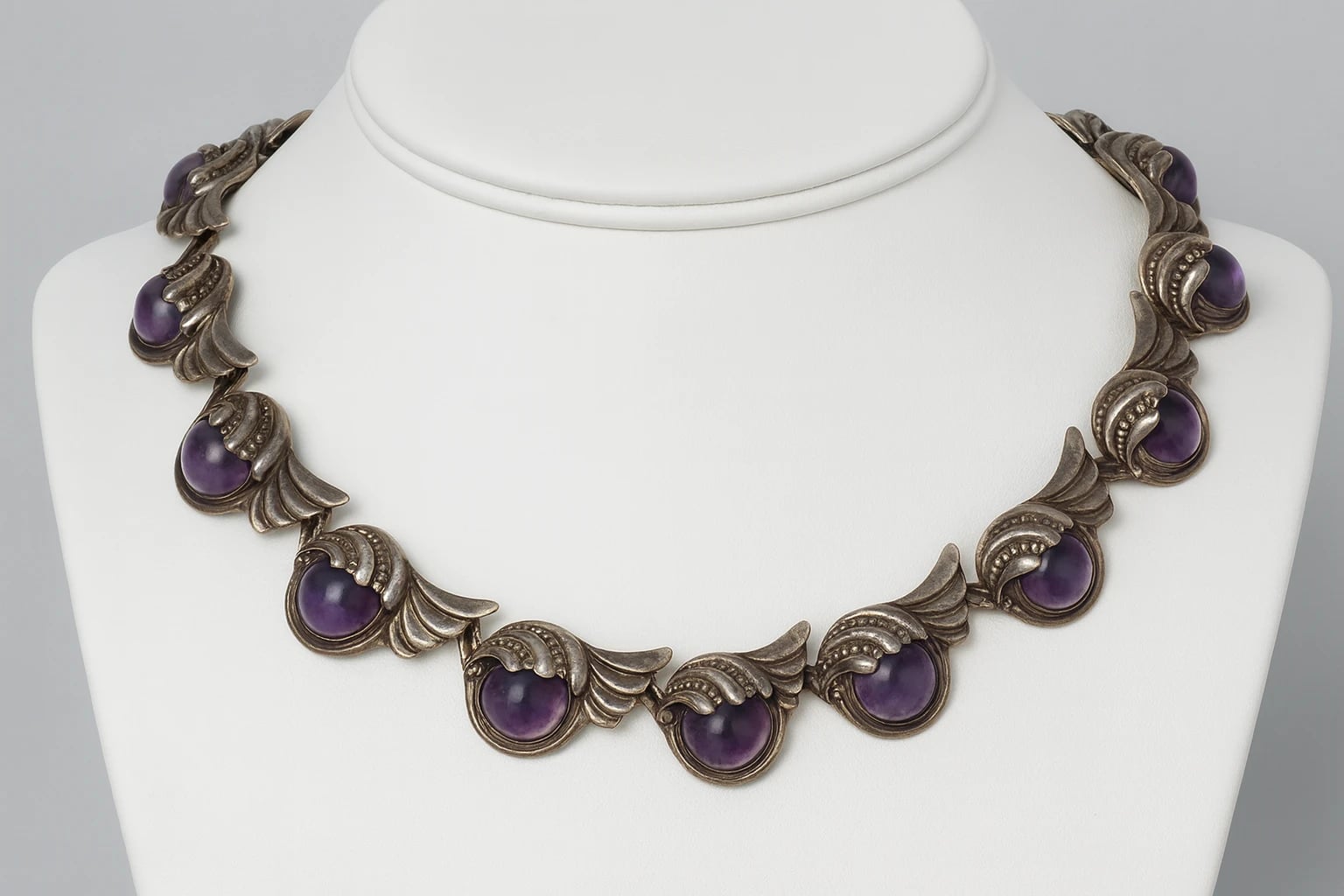
Wing Feather Necklace with Amethyst and Niello
Amethyst