Saves instantly, no account needed. Already a member? Sign in.
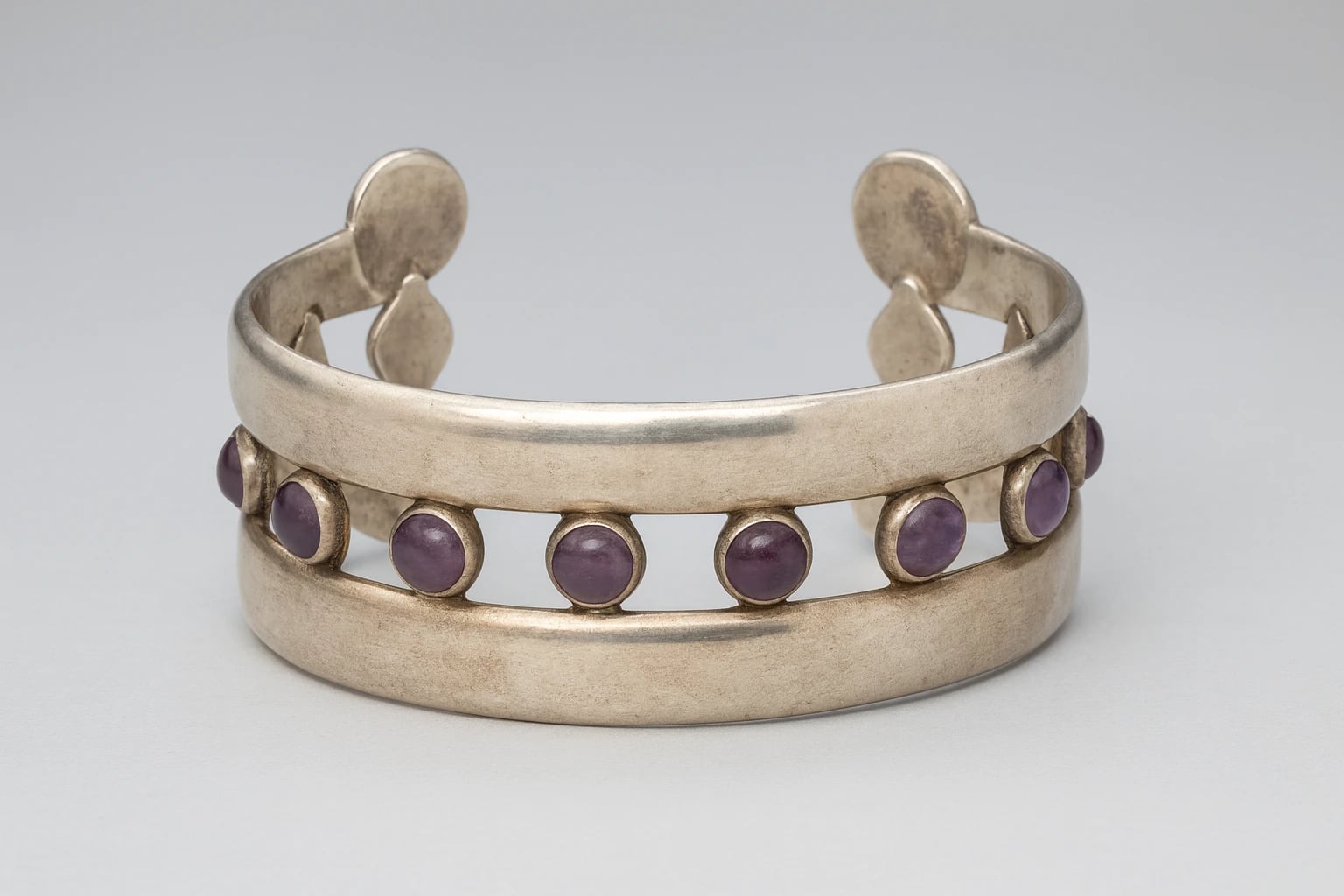
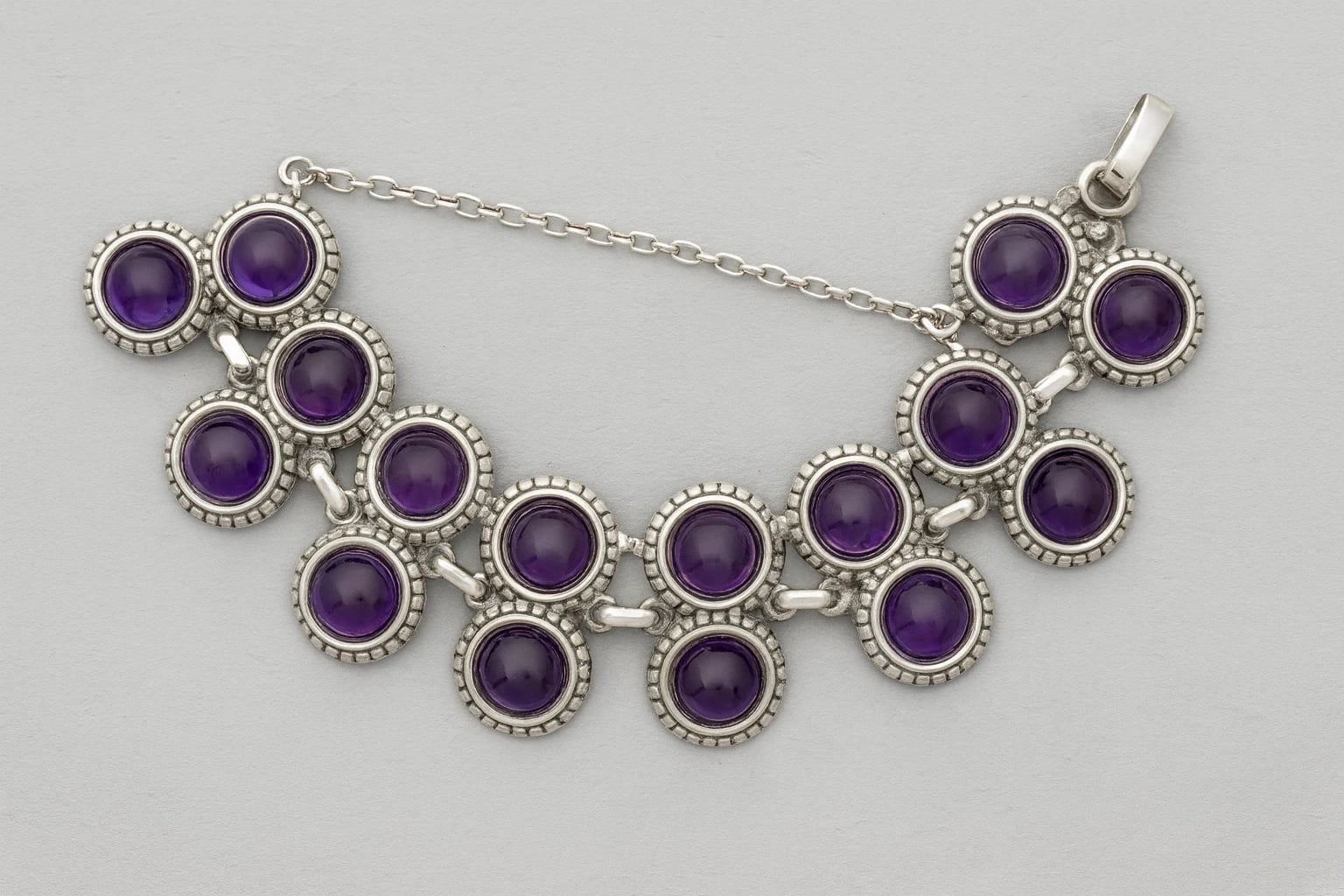
The owl seizes the wrist as a compact emblem, its body reduced to the essential silhouette of a perched night bird, its two amethyst eyes catching light against the matte and polished passages of silver. Rather than illustrate an owl in fussy detail, the bracelet distills it to posture and gaze. The result is an ornament that reads instantly as a creature yet holds together as disciplined form, the kind of controlled figuration that separates the Spratling workshop's animal designs from mere novelty.
Everything in the design serves that concentrated gaze. The amethyst eyes are the only color the bracelet permits, and their violet translucence pulls against the opacity of the surrounding metal, so that the stones seem lit from within while the silver stays cool and reflective. This is a deliberate use of material contrast: the stone is not a jewel added for luxury but the single point where the owl comes alive. The band carries the weight of the figure around the wrist, and the design asks the metal to do double duty, holding the sculptural head and body while remaining a wearable circle. Where the surface shifts between texture and shine, the change describes feathering and mass without descending into literal transcription of plumage.
The owl belongs to Spratling's first design period, the years following his founding of the Taller de Las Delicias in 1931, when the workshop was building the formal vocabulary that would define the Taxco renaissance. Spratling's importance in these years lay in reorganizing design and production and cultivating the markets that carried Taxco silver abroad, and in drawing repeatedly on Mexico's indigenous and ancient heritage for motifs he then subjected to modern simplification. The owl carried weight in that heritage, a bird associated across ancient Mesoamerican cultures with night and the underworld, and here it is pared to a modern silhouette rather than antiquarian quotation. The taller system that produced it allowed a designer to concentrate on that formal invention while master smiths translated the drawing into fabricated silver, the collaborative structure Gobi Stromberg has described as central to Taxco's Silver Age.
Within the broad output of animal and figural jewelry that came from Taxco, this bracelet shows how Spratling's workshop could compress a recognizable creature into an object that satisfies as pure design. It rewards the collector and the historian for the same reason: the economy of means, the confident reduction of a familiar bird to gaze and stance, and the single controlled note of amethyst that gives the silver its focus. Held beside the workshop's other early figurative work, the owl clarifies how figuration and modernist restraint coexisted in Spratling's first decade of production.
Museum of Mexican Silver. “Owl Bracelet with Amethyst Eyes.” Catalog no. MoMS-000290. https://museumofmexicansilver.com/pieces/spratling-820
See something wrong with this record? Suggest a correction and the piece details fill in automatically.
William Spratling
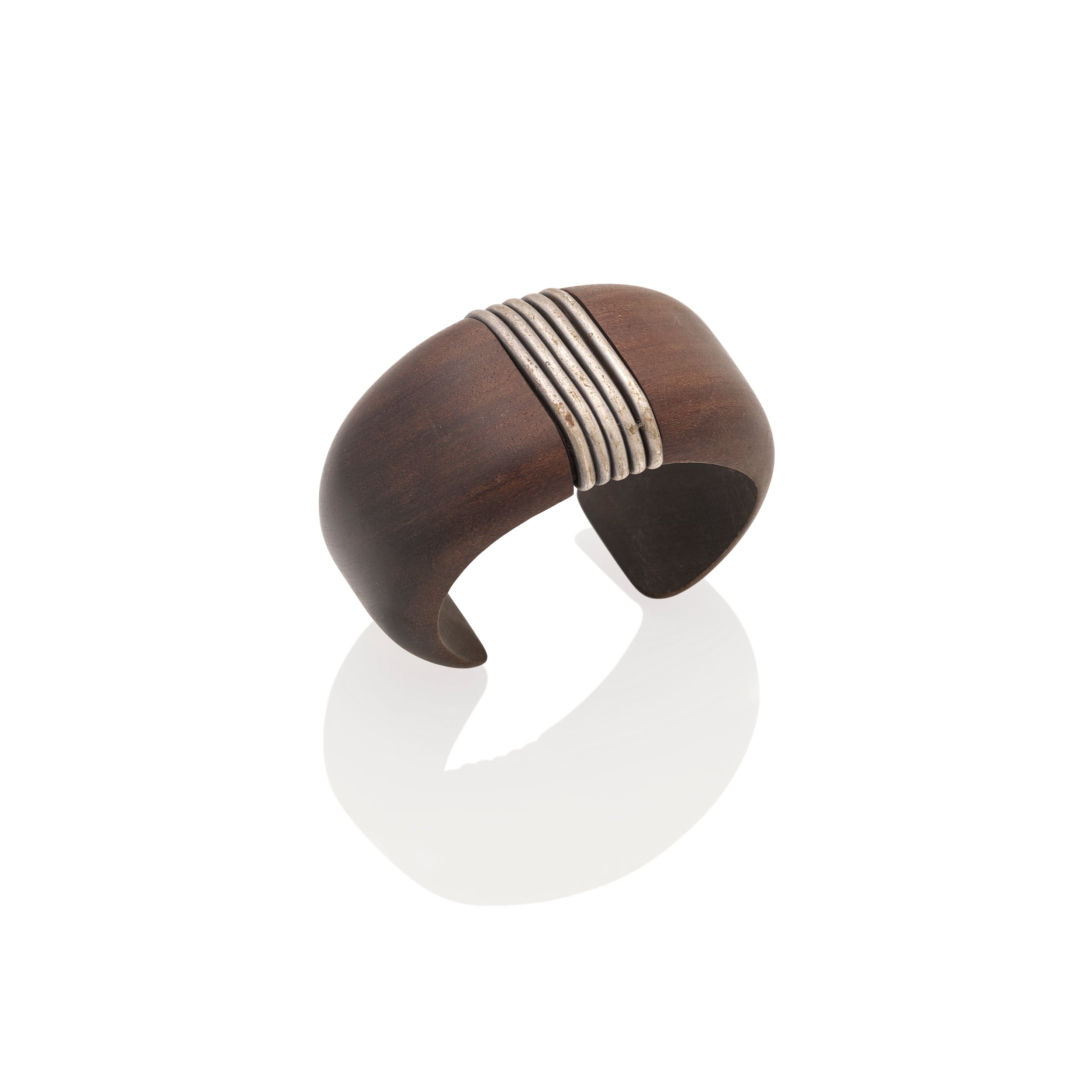
Wire Wrapped Rosewood Cuff
First Design Period: 1931 - 1946
Rosewood