

Museum of Mexican Silver · Guide
How to Tell If Mexican Silver Is Handmade: A Guide to Taxco Techniques
Before a mark tells you who made a piece, the metal tells you how it was made. Learn to recognize repoussé, chasing, champlevé enamel, stone mosaic and inlay, silver overlay, metales casados, and articulated construction in twentieth-century Taxco silver, through documented examples from the Museum's collection.
If you are holding a piece of Mexican silver, the hallmark is usually the first thing you check. The construction is the second. How a piece was formed, decorated, and assembled can tell you whether its relief was raised by hand or applied, whether its color is fired enamel or paint, and whether a two-tone surface is silver overlay, married metals, or plating. Those observations will not identify a maker on their own. They tell you what kind of object you have, and whether its workmanship is consistent with the workshop its marks name.
What should you look at first on a piece of Mexican silver?
Start with what you can see. Each technique below links to its full section, with documented examples from the Museum's collection.
| Technique | What to look for | Often confused with |
|---|---|---|
| Repoussé | Smooth, continuous raised forms; corresponding hollows on the reverse when accessible. | Applied or cast ornament soldered onto a surface. |
| Chasing | Crisp grooves, defined ridges, textured surfaces, and carefully modeled details. | Engraving, die stamping, or cast decoration. |
| Champlevé enamel | Colored fields separated by integral raised silver walls. | Cloisonné enamel, painted surfaces, or resin. |
| Stone mosaic | Individual tesserae, visible joints, and carefully arranged fields of color. | Single-stone inlay or composite stone materials. |
| Stone inlay | Stone plaques or bands integrated into the silver, often flush with its surface. | Raised cabochons or applied stone ornaments. |
| Silver overlay | Raised silver ornament against a contrasting metal ground; visible boundaries between layers. | Metales casados or silver plating. |
| Metales casados | Silver, copper, or brass meeting along closely fitted boundaries, usually in one plane. | Silver overlay or generic mixed-metal decoration. |
| Articulated construction | Carefully engineered joints that allow substantial jewelry to flex and move. | Cast chains or rigid one-piece construction. |
These techniques frequently appear together. A single necklace might combine repoussé, chasing, stone setting, and articulated construction.
Then read the mark. The Museum's guide to Taxco silver hallmarks explains maker, fineness, and eagle registration stamps, and the hallmark reference lets you look a mark up. Marks and construction read together are stronger evidence than either alone.
Who actually made Taxco silver?
The history of Mexican silver is often told through a handful of celebrated names: William Spratling, Antonio Pineda, Héctor Aguilar, Margot de Taxco, and Los Castillo. But the great Taxco workshops, known as talleres, brought those designers together with highly trained artisans whose skills were often remarkably specialized. A designer might imagine an ambitious necklace or sculptural vessel. Realizing it required silversmiths who understood how metal behaved under the hammer, how to fit stone precisely, or how to construct a hinge that would survive decades of use.
Apprentices spent years progressing from basic cutting and assembly to increasingly demanding work. The most accomplished became maestros, or master silversmiths, sometimes specializing in repoussé, chasing, stone setting, or other techniques. In Antonio Pineda's workshop, for example, his brother Bruno supervised production and quality control, while master silversmith Rafael "El Chino" Ruiz became central to the workshop's increasingly ambitious hollowware and sculptural production.
How did Taxco silversmiths use repoussé?
What is repoussé?
Repoussé is a metalworking technique in which a silversmith creates raised relief by working a sheet of metal from behind. Using hammers and specially shaped punches, the smith gradually pushes the metal outward, transforming a flat surface into sculptural forms. Scrolls, flowers, figures, and geometric designs emerge directly from the sheet.
Unlike separately applied ornament, the raised form is created by displacing the original metal. Where the reverse remains visible, the raised relief often corresponds to a hollow on the back. This allows substantial three-dimensional forms without adding equivalent masses of solid metal, which made repoussé particularly suited to the bold organic forms of the early Mexican Silver Renaissance.
How did Los Castillo use repoussé in the Glyph Necklace?
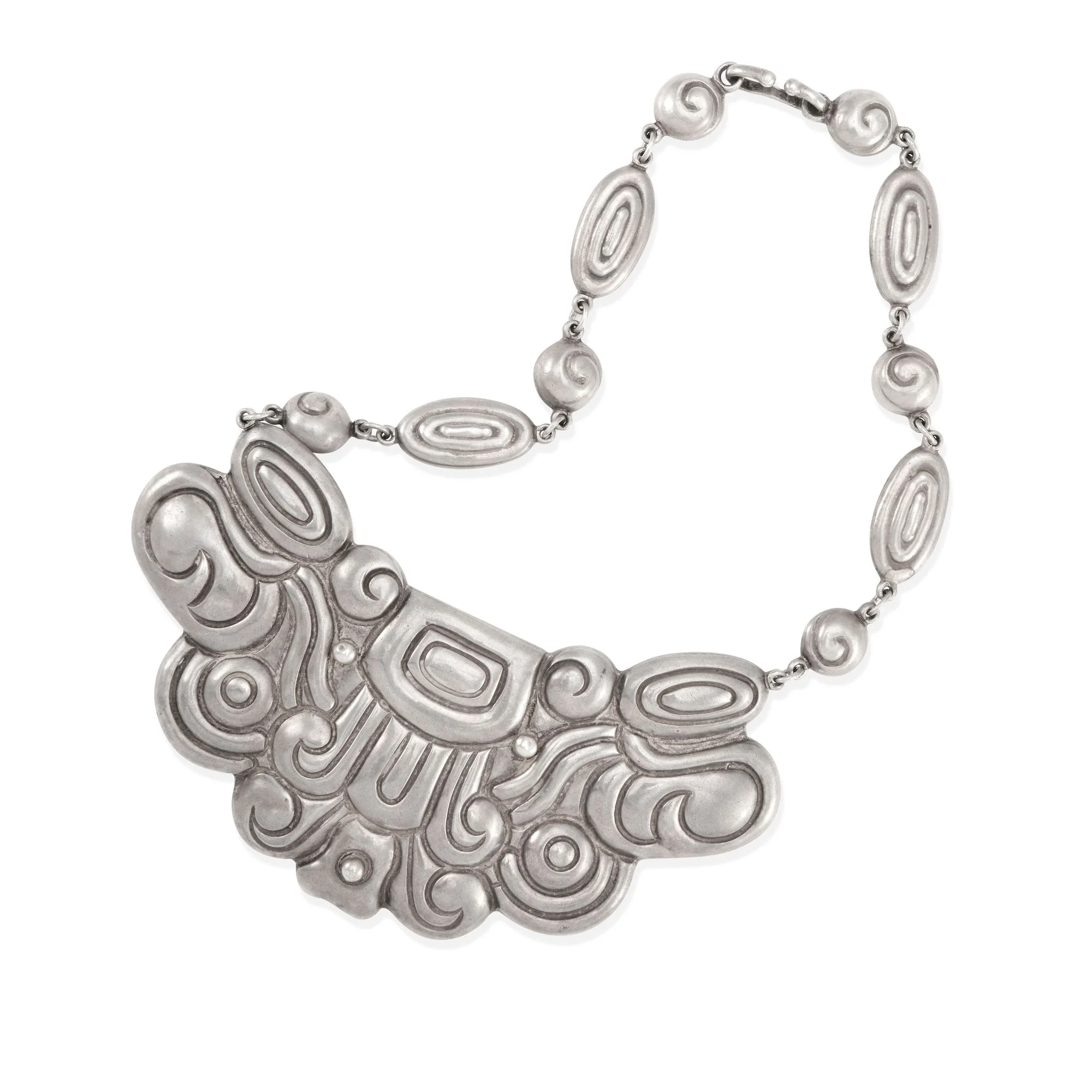
The Museum's Los Castillo Glyph Necklace, Design No. 152, circa 1940, demonstrates how repoussé could transform jewelry into wearable sculpture. Its large pectoral is worked in sweeping raised scrolls and rounded forms. Broad, comma-shaped volutes frame the composition, while smaller spirals and beaded details introduce rhythm and texture.
The design continues into the chain itself. Domed round links decorated with spirals alternate with oval links carrying concentric channels, so the necklace reads as a unified sculptural composition rather than a pendant on an ordinary chain. The design is attributed to Margot van Voorhies Carr during her early association with the Castillo brothers, whose Los Castillo workshop was founded in 1939.
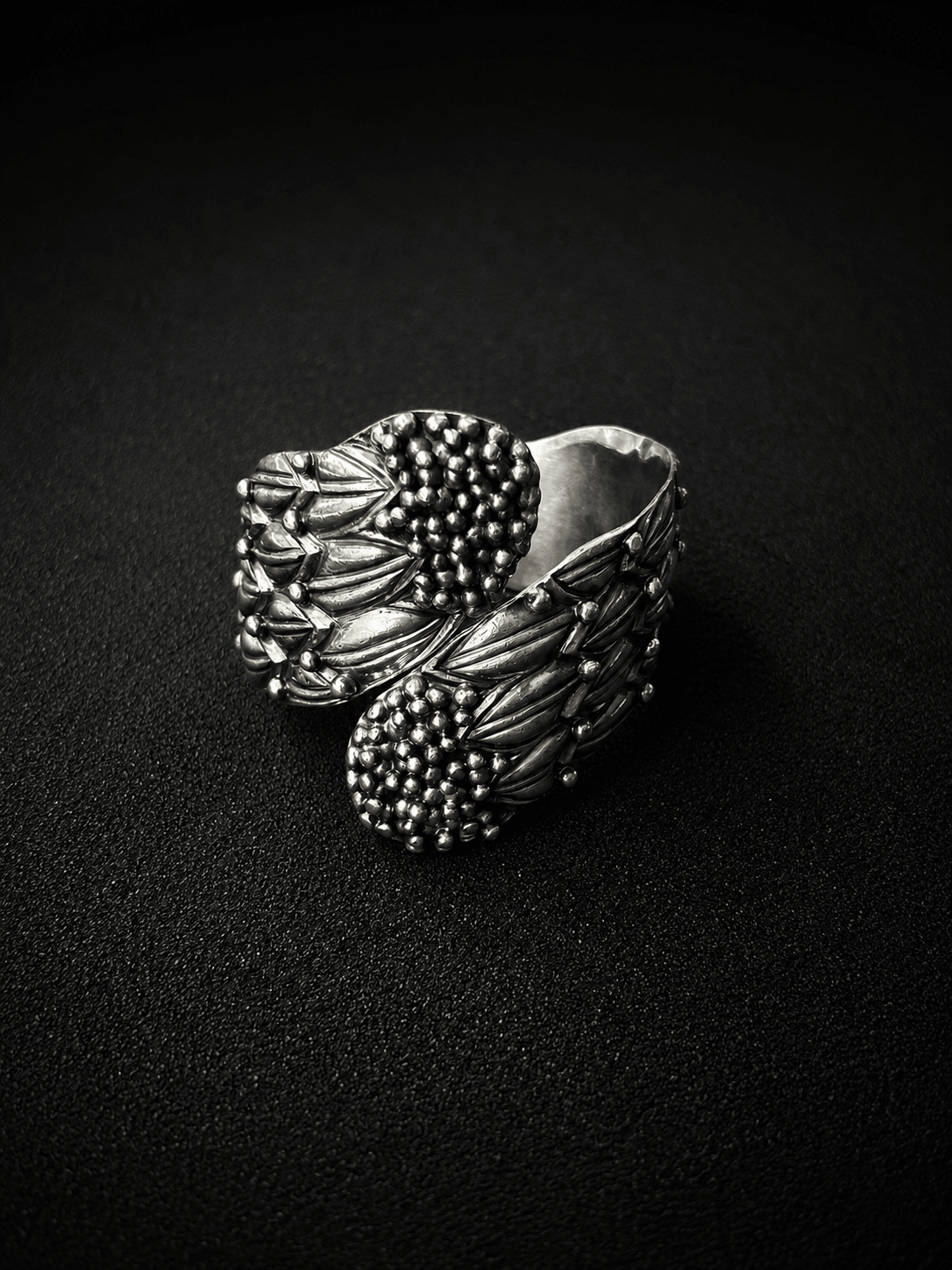
The Margot de Taxco Cornflower Clamper Cuff shows the technique's versatility. Two oversized flower heads overlap around the wrist, their petals raised in repoussé and further defined by chased ribs. Small applied silver beads form the flower centers, and darkened recesses between the petals contrast with polished high points. Although Margot later became celebrated for her enamel designs, this bracelet achieves its effect entirely through metalwork.
How can you tell if a piece is repoussé?
How did Taxco silversmiths use chasing?
What is chasing?
Chasing is the process of working the front surface of metal with specialized tools to create or refine lines, contours, and textures. The silversmith uses small steel punches, often driven by a chasing hammer, to displace and shape the metal. Unlike engraving, which removes material, conventional chasing primarily reshapes the existing surface.
Repoussé and chasing are frequently used together. Repoussé establishes the underlying volume; chasing refines its contours, sharpens details, and adds texture. Chasing can define a feather, suggest the veins of a leaf, or create the illusion of movement. Recessed lines collect shadow, while raised areas reflect light.
How was chasing used on Los Castillo's Feather Gauntlet Bracelets?
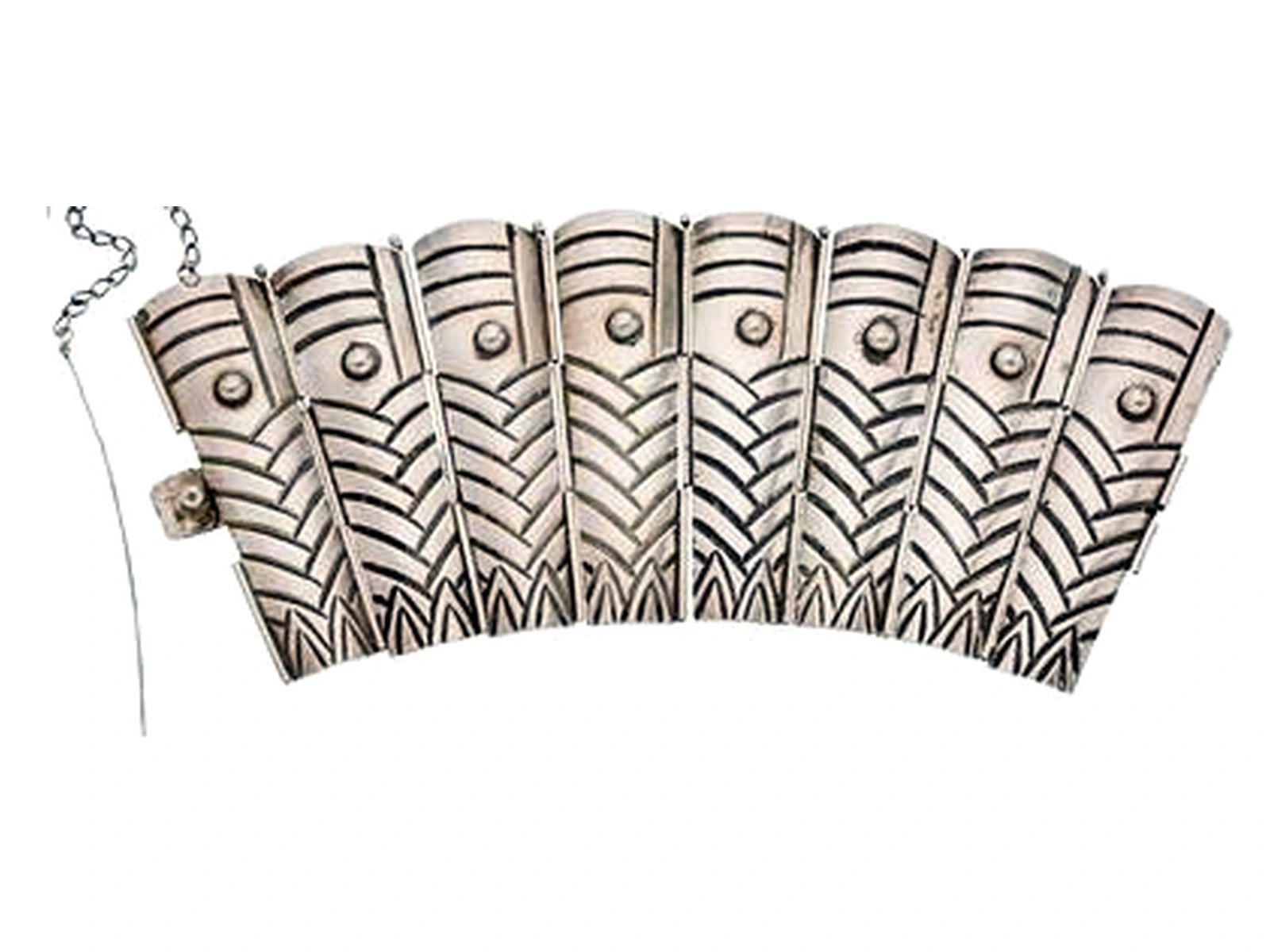
The Museum's Pair of Feather Gauntlet Bracelets demonstrates how chasing can define the character of an entire object. Each tapered silver panel is conceived as a stylized feather. Rows of chased chevrons descend across the surface, suggesting the structure of a plume, while a raised silver boss near the upper edge creates a focal point.
The chasing is pronounced enough to produce dramatic contrasts between polished ridges and darkened recesses. As the bracelets move, light travels across the pattern. The hinges joining the panels also contribute: their vertical seams set a rhythm that complements the feather motifs while allowing the bracelets to open and conform to the arm.
How can you tell if silver is chased?
How was champlevé enamel used in Taxco silver?
What is champlevé enamel?
Champlevé is an enameling technique in which recesses are formed in a metal surface and filled with powdered glass. The piece is heated until the glass fuses into a durable, colored enamel, and the surrounding metal remains visible as boundaries between the fields of color. Unlike enamel painted over a finished surface, champlevé integrates color into the structure of the object.
The technique let Taxco's silversmiths introduce vivid, lasting color into a material celebrated for its reflective surface. It was also demanding: the metal had to be prepared to receive the enamel, and firing required control of temperature and materials. Poor execution could produce cracking, uneven surfaces, or imperfect color.
Why is Margot de Taxco known for enamel?
Among Taxco's great designers, Margot van Voorhies Carr became particularly associated with enamel jewelry. Beginning in the mid-1950s, enamel became central to the production of her workshop, Margot de Taxco. Her achievement was not simply adding color to silver. She developed compositions in which color, pattern, and metalwork were conceived together.
The Museum's Margot de Taxco Design 5832 Necklace illustrates this approach. Enamel is distributed across linked silver elements, with the metal dividing the colored fields into deliberate geometric and decorative patterns.
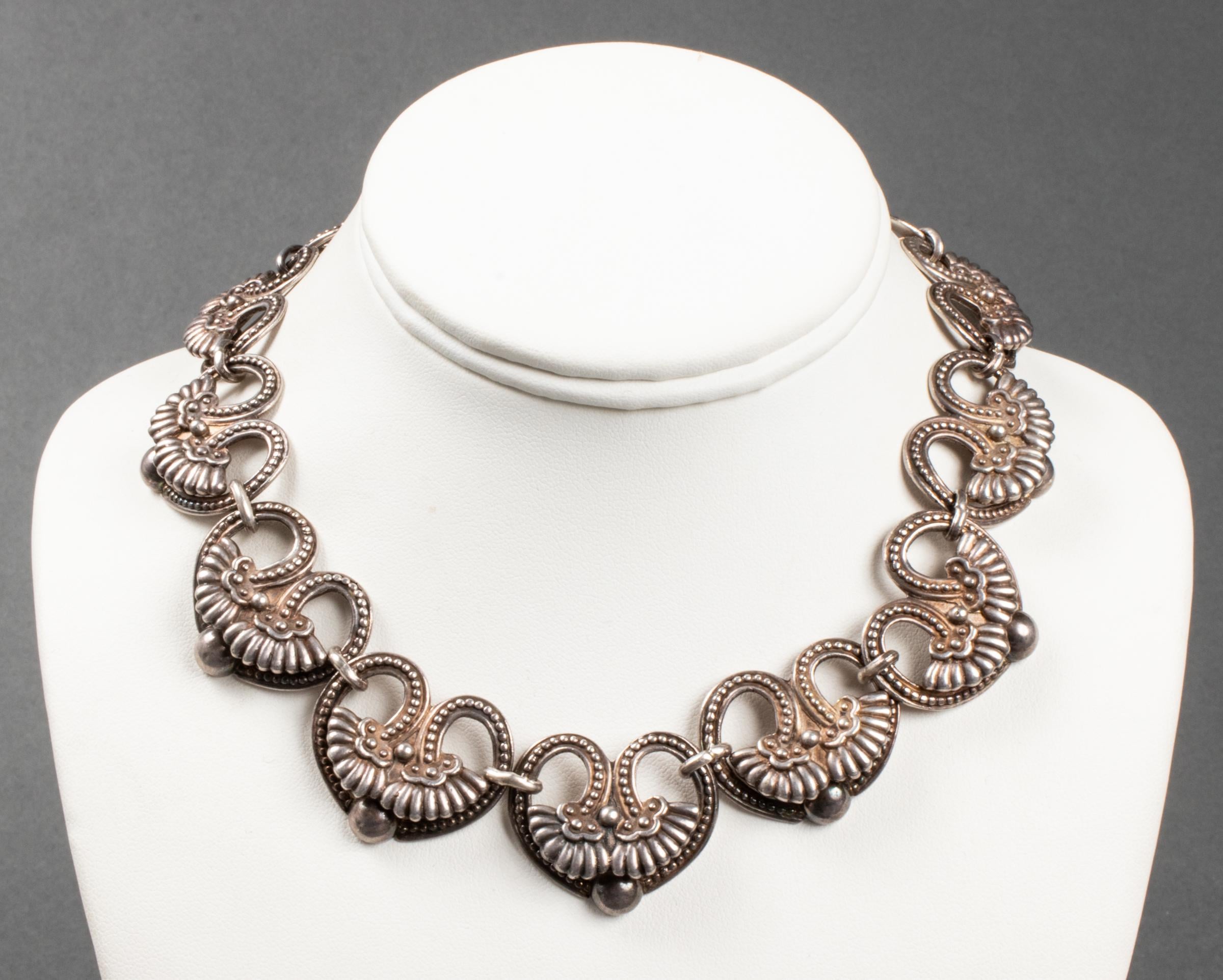
Margot's enamel work is represented in major museum collections, including the Los Angeles County Museum of Art. Pieces bearing her Eagle 16 registration mark are associated with the period beginning in 1955. A design number or hallmark generally establishes a production period rather than an exact year, since successful designs could remain in production.
How can you tell champlevé from paint or resin?
How were stone mosaic and inlay used in Taxco silver?
What is the difference between stone mosaic and stone inlay?
Taxco's artists drew on Mexico's long traditions of lapidary work, stone ornament, and pre-Columbian mosaic, incorporating these visual languages into distinctly modern objects.
Stone inlay generally involves shaping stone to fit a prepared recess or setting. A single carefully cut stone might form a geometric plaque, a band, or a decorative element within a larger silver composition. Stone mosaic creates a surface or image from numerous smaller pieces of stone, known as tesserae, individually arranged and fitted. Mosaic is itself a form of inlay in many applications, and the terminology can overlap. What matters most is how the stones have been prepared, arranged, and incorporated into the object.
What does stone mosaic look like on Los Castillo's Parrot-Handled Pitcher?
The Museum's Los Castillo Parrot-Handled Pitcher with Stone Mosaic demonstrates the sculptural possibilities of the technique. A parrot leans over the rim of the vessel, forming its handle. Rather than being modeled entirely in silver, the bird is covered with small, irregular pieces of colored stone that follow its form, contrasting with the smooth, reflective body of the pitcher. A polished metal beak completes the composition.
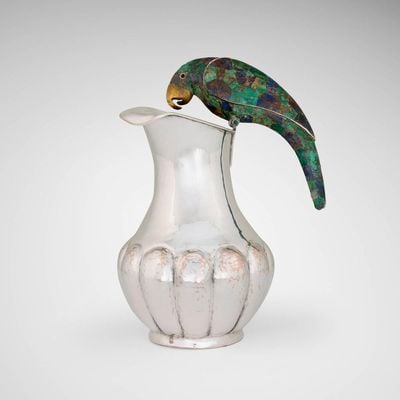
The body bears the workshop's plateado mark, indicating silver plating over a base metal rather than solid sterling silver. The workshop used different materials for different purposes while preserving the elaborate mosaic work that gives the object its character.
How did Antonio Pineda inlay onyx in silver?
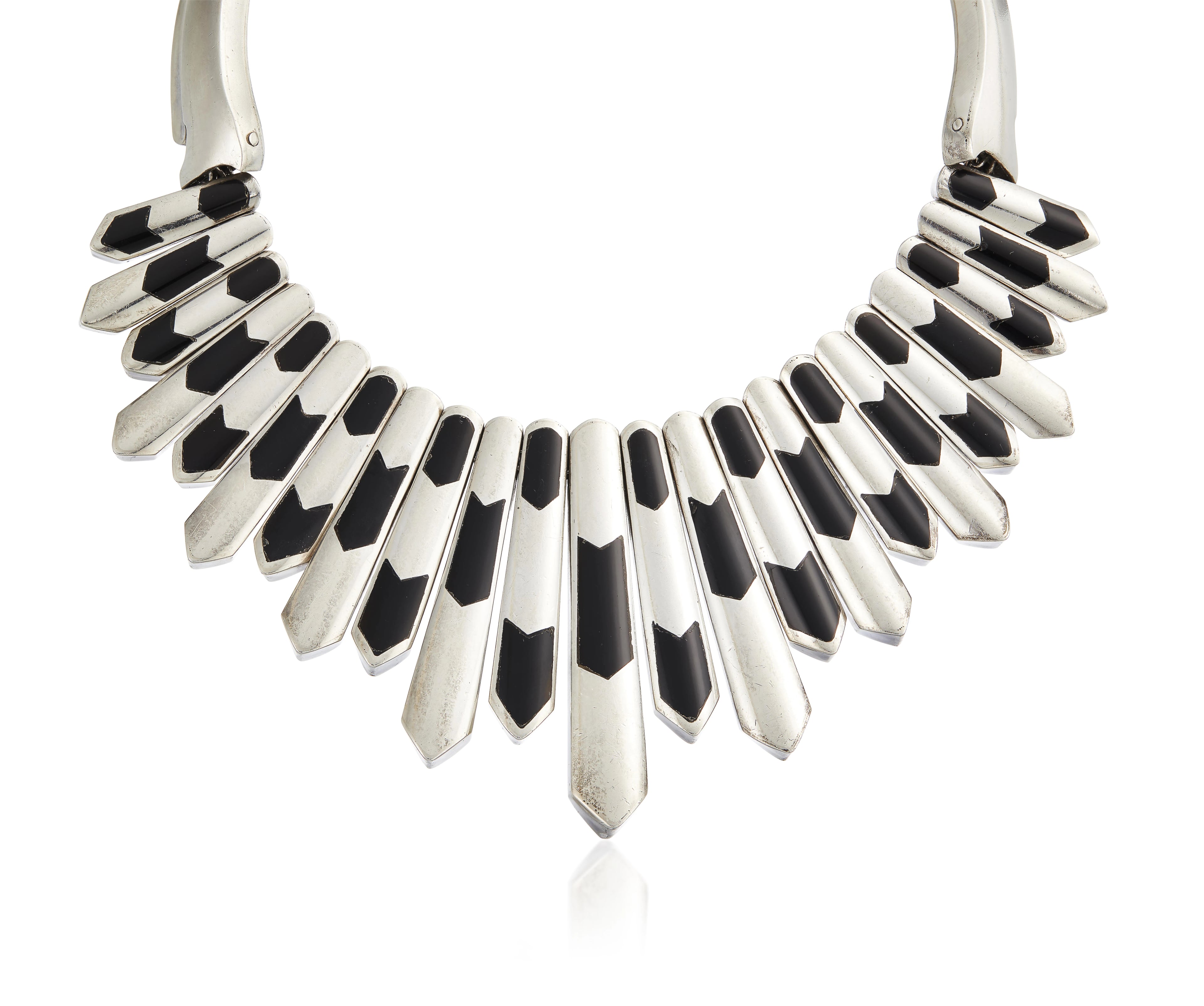
Antonio Pineda approached stone and silver with a different aesthetic. His Onyx-Inlaid Fringe Collar Necklace combines a substantial silver collar with a graduated fringe of geometric plaques. Black onyx is cut into precisely shaped bands and chevrons that sit flush within the silver, so the dark stone reads almost like a drawing made within the metal. Unlike a raised cabochon, which projects above its setting, flush inlay lets stone and silver read as one surface.
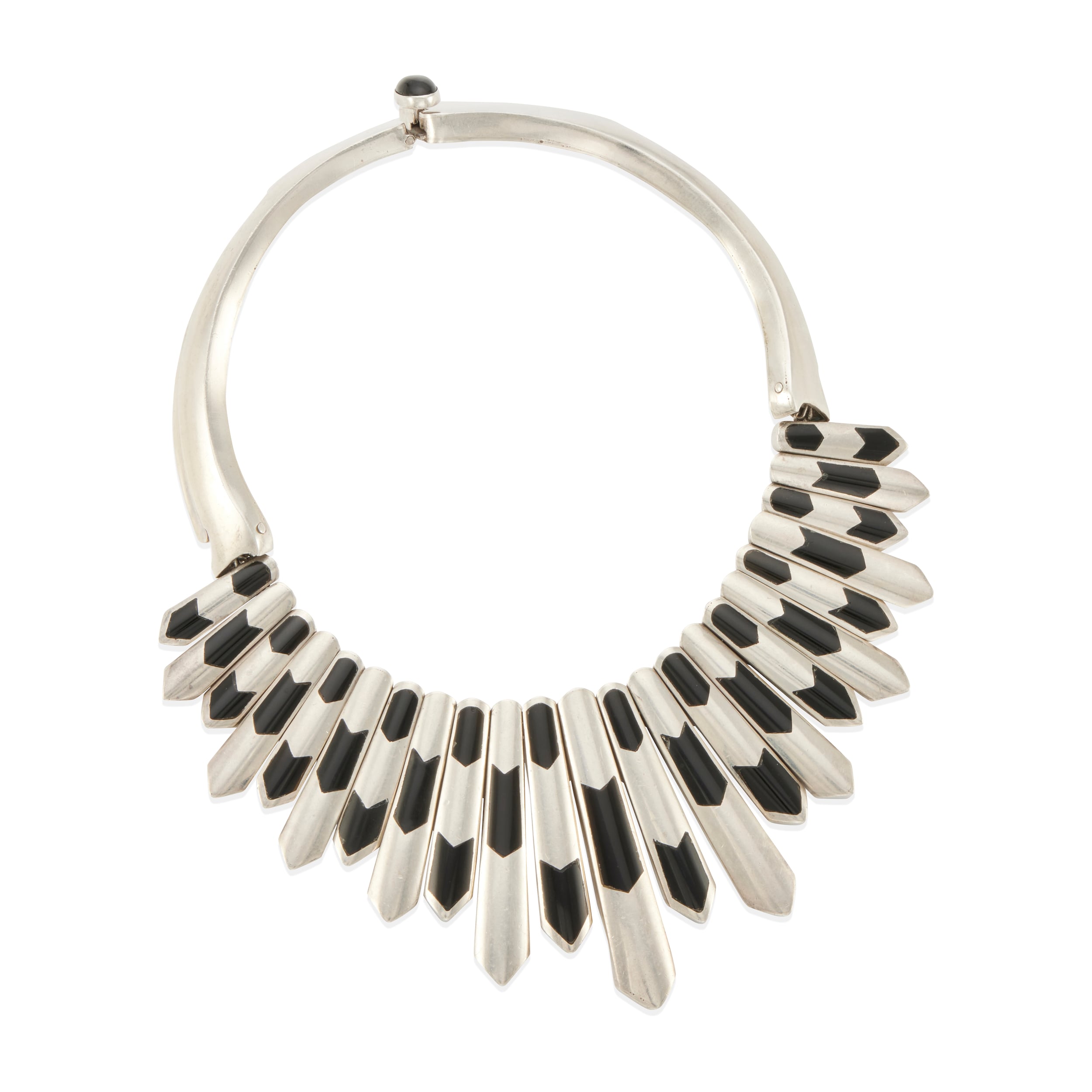
The necklace carries Pineda's ANTONIO crown signature, HECHO EN MEXICO, an eagle registration mark, and a 970 silver fineness mark. Those markings support its workshop attribution. The construction reveals something different: Pineda's ability to integrate contrasting materials into an exceptionally disciplined design.
What should you look for in stone mosaic and inlay?
What are silver overlay and metales casados?
One of the most distinctive developments in Taxco silver was the creative use of contrasting metals. Silver, copper, and brass could be combined to produce effects that were almost painterly, and different workshops developed their own approaches. Two important methods were silver overlay and metales casados, or "married metals." They can look superficially similar, but their construction is fundamentally different.
What is silver overlay?
Silver overlay, as discussed here, involves applying solid decorative silver elements over a surface made from another metal, commonly copper. The silver sits above the underlying material, and its raised edges and contrasting color become part of the design. This should not be confused with silver plating, in which a relatively thin coating of silver is deposited over another material.
How did Victoria de Taxco set silver against copper?
The Museum's Victoria de Taxco Bowl with Pre-Columbian Mask, Model No. 109, from the workshop of Ana Núñez Brilanti, is an exceptional example of contrasting metals used with restraint. The shallow copper bowl provides a warm, hammered background for a raised silver mask inspired by pre-Columbian imagery. The entire composition depends on the relationship between the two metals.
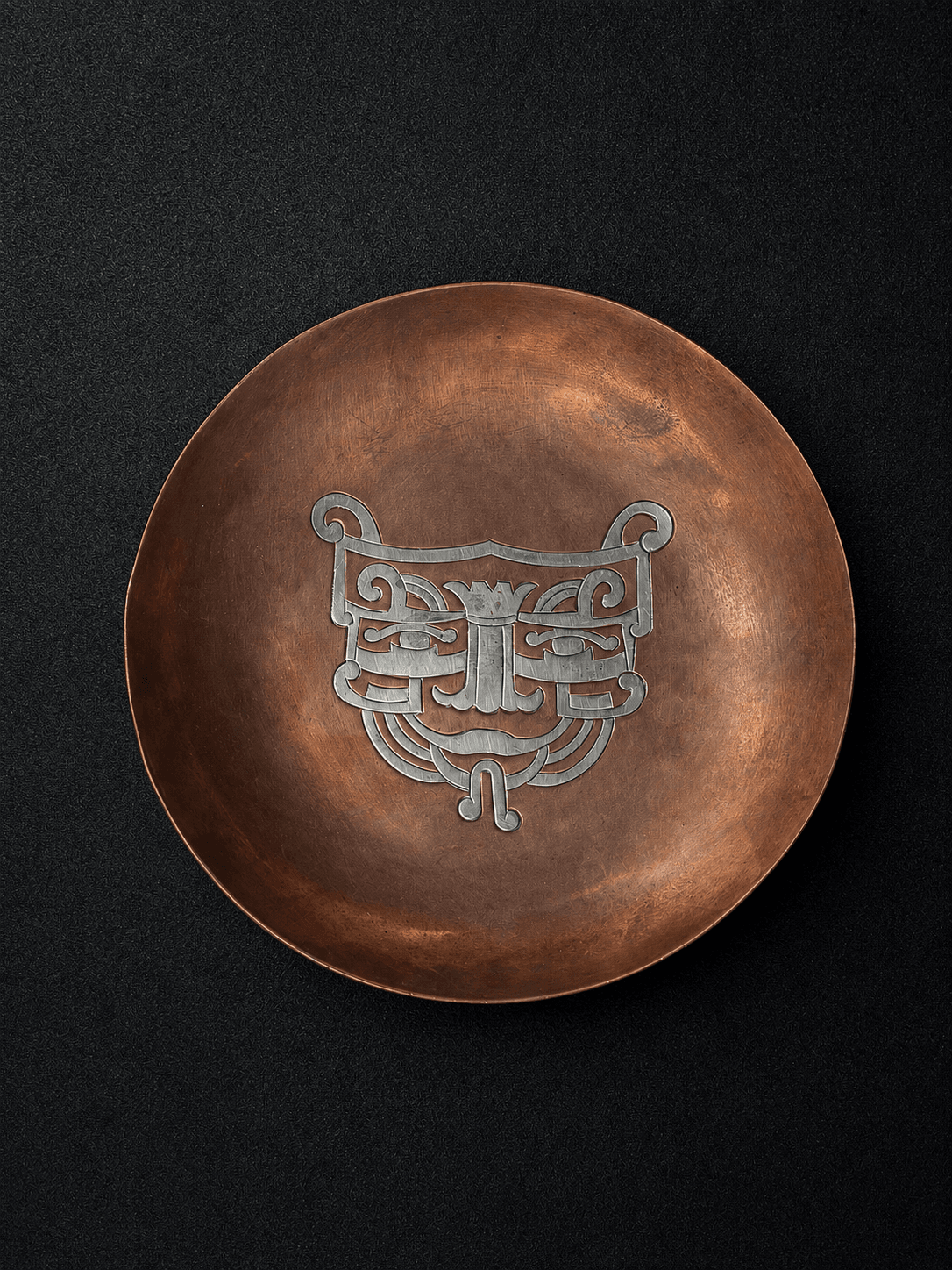
The bowl is marked VICTORIA / MEXICO, METALES, and the model number 109. The METALES mark identifies a mixed-metal production line. It does not, by itself, identify the construction method.
What are married metals (metales casados)?
Metales casados takes contrasting metals in a different direction. Rather than placing one metal over another, pieces of silver, copper, and brass are individually cut, fitted, and joined so that their surfaces meet along carefully worked boundaries. The metals can form a nearly continuous plane, with their natural colors creating patterns or figurative compositions.
The technique is particularly associated with Jorge "Chato" Castillo and the Los Castillo workshop. Chato and his silversmiths approached metal almost as a painter might approach color. But the effect depended on exceptionally demanding craftsmanship: every boundary required careful preparation and fitting, and the precision of the joins could determine whether the finished image appeared unified or fragmented.
How did Los Castillo marry metals in the Aztec Warrior Box?
The Museum's Los Castillo Aztec Warrior Box with Metales Casados and Stone Mosaic, Design No. 931 combines contrasting metals with stone mosaic. An Aztec warrior appears against a field of blue stone, with silver, copper, and brass used to distinguish elements of the figure and its decoration. The metals function almost like pigments, while the mosaic provides a contrasting field of color and texture.
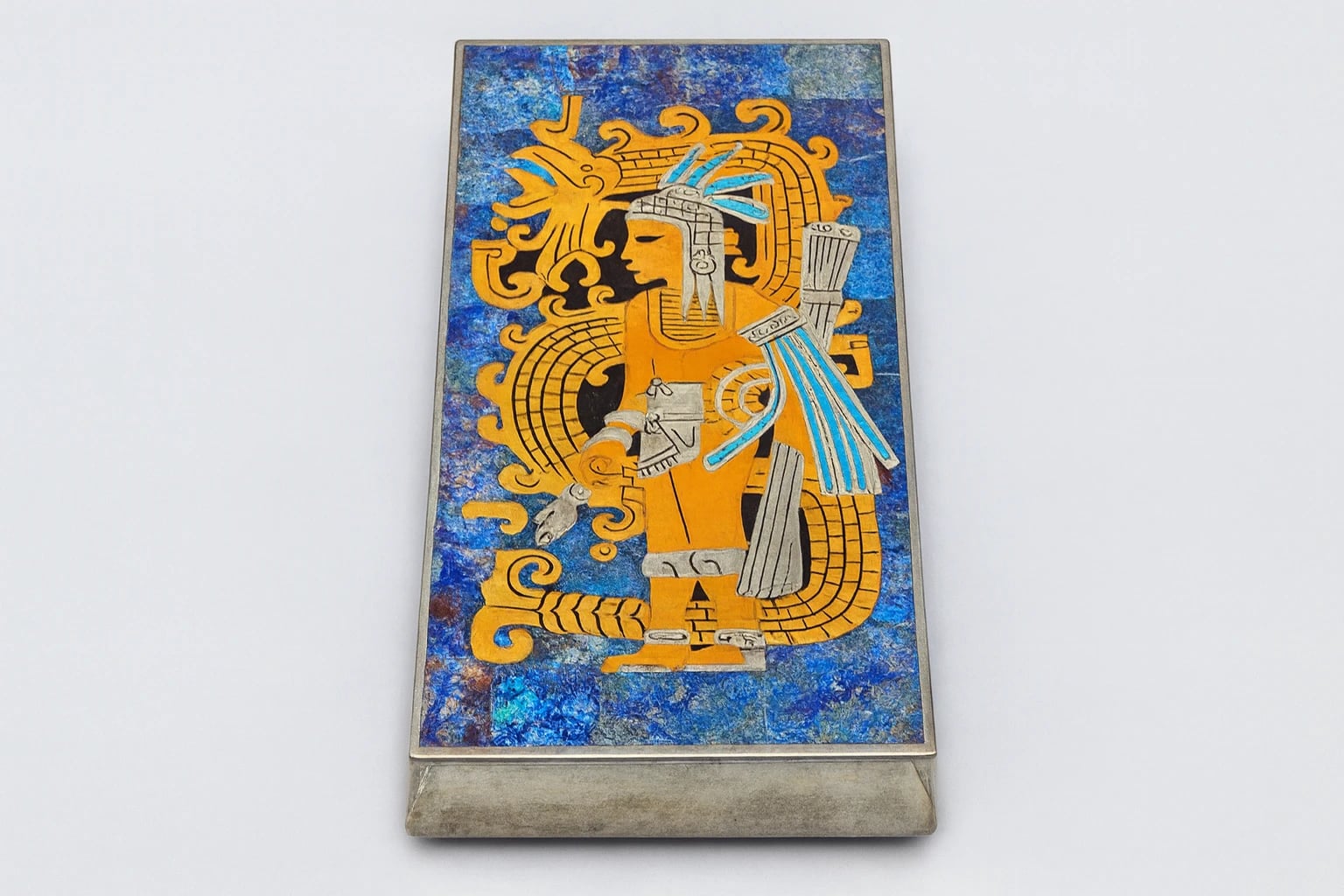
The blue stone has not been conclusively identified; its color suggests several possible minerals, but photographs alone cannot establish the material. The box carries a Los Castillo hallmark and the design number 931, which help identify the workshop and design. The visible construction, considered alongside documented workshop techniques, helps explain how the composition was achieved.
How do you tell overlay from metales casados?
What is articulated construction in Mexican silver jewelry?
How can heavy silver jewelry move so naturally?
Some of the Mexican Silver Renaissance's most ambitious jewelry looks monumental, substantial, and sometimes almost architectural. Yet many of these pieces are remarkably wearable. Rather than constructing a necklace or bracelet as a single rigid form, silversmiths assembled individually shaped elements using hinges, pins, links, and overlapping joints, so substantial pieces could flex, curve, and move with the body. In the best examples, the engineering was not concealed as a necessity. It became part of the design.
How does Antonio Pineda's Roof-Tile Amethyst Necklace move?
The Museum's Antonio Pineda Roof-Tile Amethyst and Silver Necklace is an outstanding example. It consists of graduated, overlapping silver elements that resemble the curved tiles of a traditional roof. Each fluted link contains a cylindrical amethyst element, and the repeated forms broaden into a dramatic fan-like collar. The links are individually formed and connected so the necklace can follow the contours of the neck, and as it moves, light catches the ridges of the silver and falls into the spaces between them.
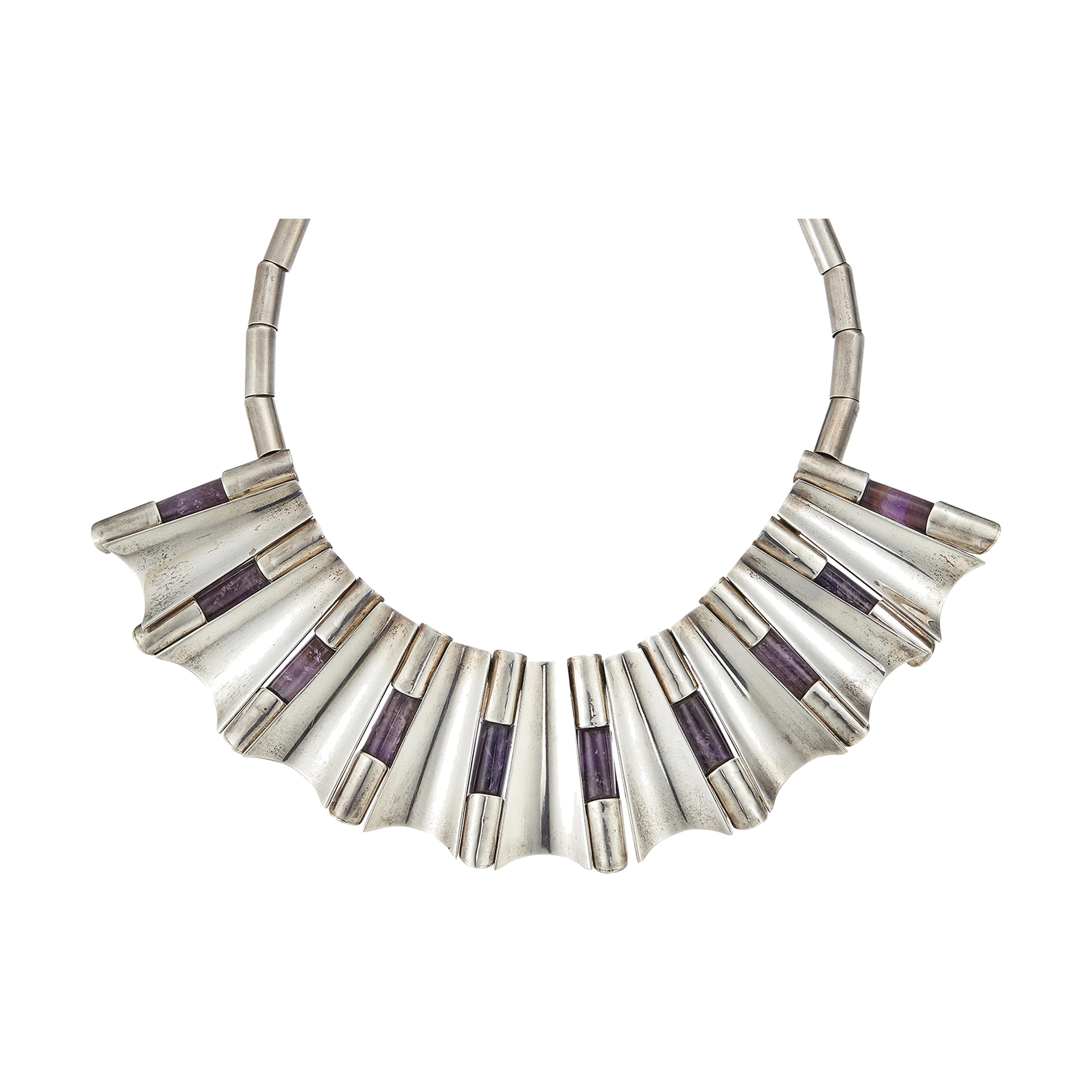
The necklace is documented by Gobi Stromberg in Silver Seduction: The Art of Mexican Modernist Antonio Pineda as design YY546, executed in 970 silver and associated with the period beginning in 1953. Pineda's achievement was not simply making jewelry larger. It was understanding how substantial forms could be divided, connected, and balanced to remain wearable.
How do Los Castillo's Feather Gauntlets turn structure into design?
The Feather Gauntlet Bracelets discussed under chasing solve a related challenge. A gauntlet must follow the taper of the forearm rather than encircle the wrist. The workshop built each bracelet from tapered panels joined by vertical hinges: the taper creates the conical silhouette, and the hinges let the bracelet open around the arm. Each panel also forms part of the feather composition, so the engineering and the ornament are inseparable.
How do you recognize articulated construction?
What can construction tell you about a piece?
A hallmark may identify a workshop, establish a likely period of production, and indicate the stated fineness of the silver. Construction offers a different kind of information: how an object was made, and whether its workmanship is consistent with documented examples from a particular workshop.
Champlevé enamel on a piece bearing Margot de Taxco's Eagle 16 mark is consistent with her documented production beginning in the mid-1950s. A precisely fitted mixed-metal composition on a piece bearing a Los Castillo hallmark is consistent with techniques associated with that workshop. A substantially constructed necklace with complex articulated links may be consistent with Antonio Pineda's documented approach. Observations like these can strengthen an attribution or identify a reason for further investigation.
For maker identification and dating, see the Museum's guide to Taxco silver hallmarks and browse the hallmark reference.
Why does craftsmanship still matter to collectors?
The Mexican Silver Renaissance produced objects that remain strikingly modern decades after they were made. Their appeal reflects not only the originality of their designs but the craftsmanship that made those designs possible. Look closely at a Taxco piece and you begin to see the decisions behind it: where a silversmith raised a curve, how two metals were joined, why a hinge was hidden or deliberately made part of the design.
Designers and master silversmiths worked together, combining artistic imagination with generations of accumulated technical knowledge. The greatest achievement of the Mexican Silver Renaissance was not any single technique. It was the way these methods were brought together to create a new artistic language.
Frequently Asked Questions
How can you tell if Mexican silver is handmade?
Look at how the piece was built. Relief raised from behind leaves corresponding hollows on the reverse. Chased lines have modeled depth. Stones in mosaic and inlay are cut and fitted individually. Articulated pieces have hinges and links engineered to move. These signs describe how an object was made, not who made it or when, so read them alongside the hallmark.
What is the difference between repoussé and chasing?
Repoussé creates raised relief by working a sheet of metal from behind. Chasing works the front surface with specialized tools to refine contours, add texture, or define details. The techniques are often used together, with repoussé establishing the underlying form and chasing completing its surface.
What is champlevé enamel?
Champlevé is a technique in which powdered glass is fired into recesses formed in metal. The surrounding metal remains visible, separating the colored fields. Margot de Taxco became particularly associated with champlevé enamel jewelry beginning in the mid-1950s.
What is the difference between stone mosaic and stone inlay?
Stone inlay involves fitting shaped stones into prepared recesses or settings. Stone mosaic is a form of inlay that uses numerous smaller pieces to create a surface, pattern, or image. The terms overlap, and describing the visible construction is often more useful than relying on the label alone.
What is metales casados?
Metales casados, or "married metals," is a technique in which contrasting metals such as silver, copper, and brass are precisely cut, fitted, and joined into a composition. The technique is particularly associated with Jorge "Chato" Castillo and the Los Castillo workshop.
Is silver overlay the same as metales casados?
No. In decorative silver overlay, silver elements are applied over another metal, creating distinct layers. In metales casados, contrasting metals are fitted together along adjoining boundaries, generally forming a shared surface.
What does handwrought mean in Mexican silver?
Handwrought refers to metalwork shaped and constructed primarily through manual processes rather than produced entirely through mechanized manufacturing. Taxco's larger workshops often employed teams of specialized artisans, so handwrought does not necessarily mean that one person made an entire object.
Why is handwrought Taxco silver considered important?
During the Mexican Silver Renaissance, skilled silversmiths combined traditional techniques with innovative modernist design. Their craftsmanship made possible complex sculptural relief, intricate inlay, sophisticated mixed-metal compositions, and highly engineered jewelry. The resulting objects are appreciated for both their artistic originality and the technical skill required to create them.
Can a technique identify who made a Taxco silver piece?
No single technique establishes a maker or proves authenticity. However, construction can provide useful supporting evidence when compared with documented workshop examples, hallmarks, materials, and historical records.
Which artists and workshops used these techniques?
Each major workshop developed its own artistic identity, combining familiar methods with distinctive approaches to design and construction. Explore the artists and workshops represented in this guide:
- Los Castillo: sculptural silverwork, mixed metals, stone mosaic, and inventive decorative techniques.
- Margot de Taxco: expressive silver designs and exceptional champlevé enamel.
- Antonio Pineda: architectural modernism, precise stone settings, and sophisticated articulated construction.
- Victoria de Taxco: distinctive mixed-metal compositions and the creative integration of silver with other materials.
Browse the Museum's complete directory of artists and workshops to discover more of the people behind the Mexican Silver Renaissance.
Sources and Further Reading
Sources
- Gobi Stromberg, Silver Seduction: The Art of Mexican Modernist Antonio Pineda (Fowler Museum at UCLA, 2008). Particularly the discussion of the grand talleres, specialized silversmiths, the collaborative production process, and technical innovations of the Taxco School. The Roof-Tile Amethyst Necklace is documented on p. 119, fig. 139, as design YY546 in 970 silver.
- Penny Chittim Morrill and Carole A. Berk, Mexican Silver: 20th Century Handwrought Jewelry & Metalwork (Schiffer Publishing). Historical and technical reference for the major Taxco workshops, including Victoria de Taxco's mixed-metal production, Los Castillo's decorative techniques, and the terminology used by practicing silversmiths.
- Penny C. Morrill, Silver Masters of Mexico (1996). Reference for early Los Castillo repoussé pectorals and the workshop's bracelet designs of the 1940s.
- The Metropolitan Museum of Art, "Regal Repoussé," Perspectives. Technical explanation of repoussé as a process in which metal is worked from behind to create raised relief on the front. https://www.metmuseum.org/perspectives/regal-repousse
- The Metropolitan Museum of Art, "Metalworking: Champlevé Enameling," Perspectives. Explanation of vitreous enamel fused into recesses formed in metal. https://www.metmuseum.org/perspectives/metalworking-champleve-enameling
- Los Angeles County Museum of Art, collection records for Margot de Taxco enamel work, objects 181357 and 198113. Collection references only; images not reproduced. https://collections.lacma.org/object/181357 and https://collections.lacma.org/object/198113
- Fowler Museum at UCLA, Silver Seduction: The Art of Mexican Modernist Antonio Pineda (2008), exhibition description. Discussion of Pineda's innovative construction methods, including the use of faceted, hinged, and hollowed elements to create substantial but wearable jewelry. https://fowler.ucla.edu/exhibitions/silver-seduction-the-art-of-mexican-modernist-antonio-pineda/
- Museum of Mexican Silver collection records: MoMS-002289 (Los Castillo Glyph Necklace, Design No. 152); MoMS-001089 (Margot de Taxco Cornflower Clamper Cuff); MoMS-001139 (Los Castillo Feather Gauntlet Bracelets); MoMS-001054 (Margot de Taxco Design 5832 Necklace); MoMS-001125 (Los Castillo Parrot-Handled Pitcher); MoMS-002054 (Antonio Pineda Onyx-Inlaid Fringe Collar Necklace); MoMS-002047 (Victoria de Taxco Bowl, Model No. 109); MoMS-002046 (Los Castillo Aztec Warrior Box, Design No. 931); and MoMS-002121 (Antonio Pineda Roof-Tile Amethyst and Silver Necklace).
More in Guides
Reading Margot de Taxco's design numbers
A 5xxx number on a Margot piece identifies a design, not a specific item. Here's what the stamp actually tells you, and what to watch for when it doesn't.
Mexican Silver Hallmarks: How to Read Taxco Marks, Eagles and Numbers
Mexican silver hallmarks provide clues to a maker, a stated fineness, a place of origin and a registration era. Learn to interpret combinations without mistaking a stamp for proof of authenticity.