Saves instantly, no account needed. Already a member? Sign in.
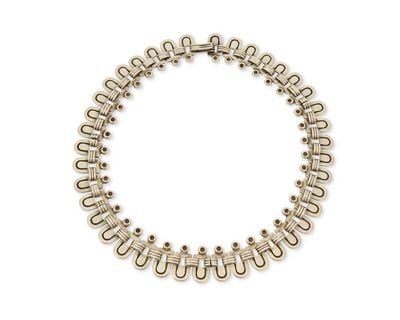
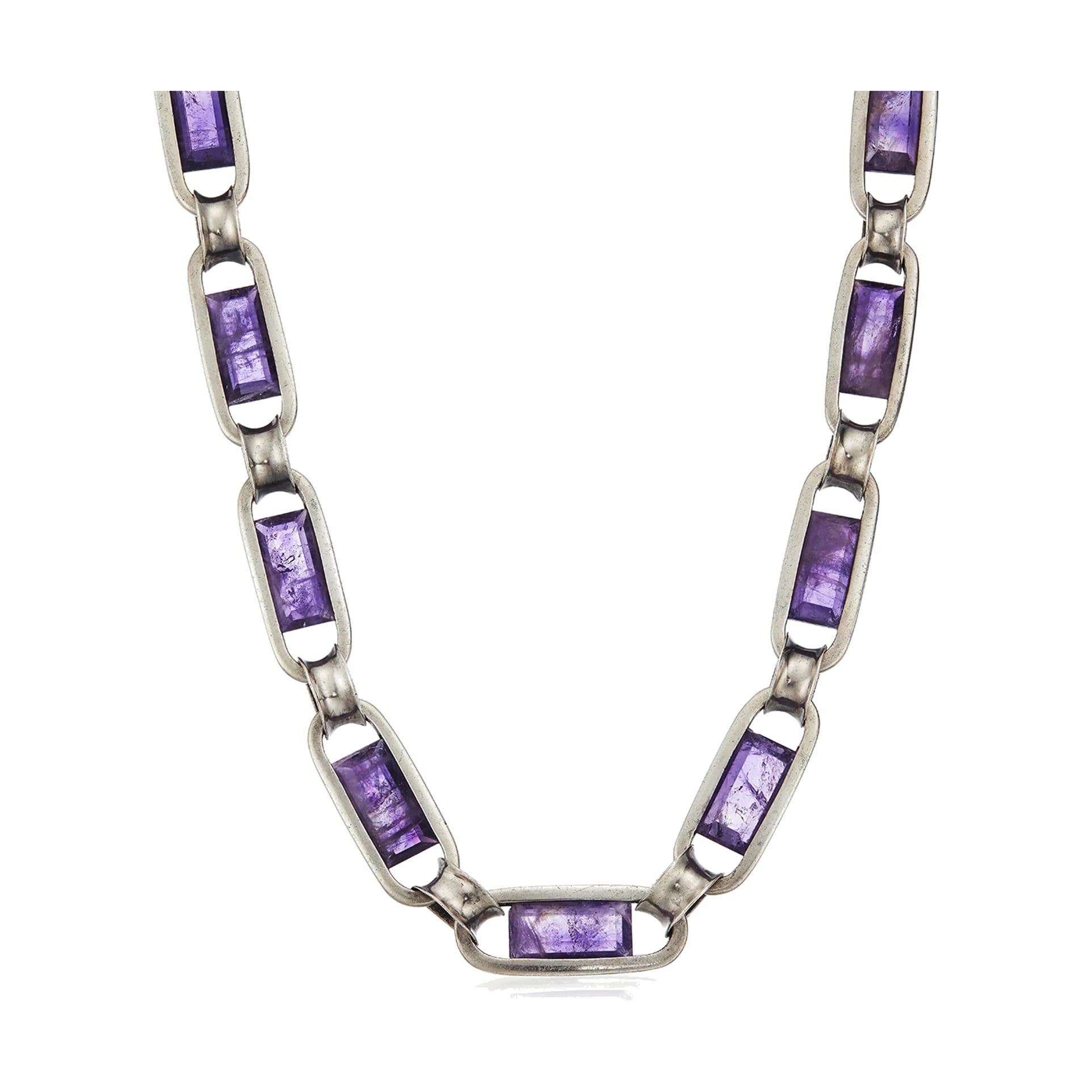
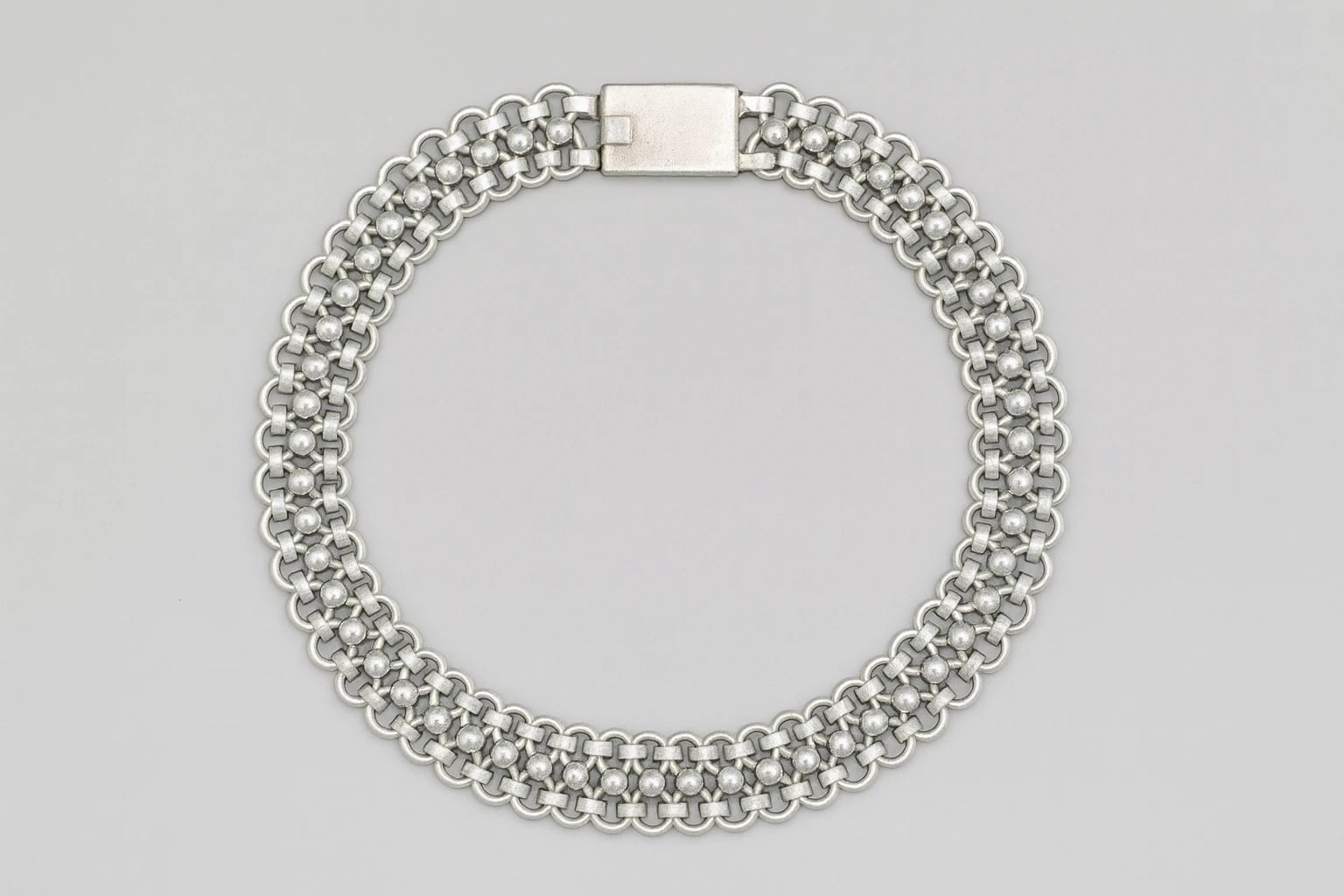
The strength of this necklace lies in the weight and cadence of its links. Each element is a substantial loop of sterling, joined so that the chain falls in a continuous, even rhythm around the neck. There is no pendant, no central ornament, no applied decoration to distract from the sequence itself. The design is organized entirely around the repetition and articulation of the link, which gives the piece its mass, its movement, and its play of reflected light as the silver turns against itself.
Héctor Aguilar worked in a vocabulary of forged and assembled silver in which the joint was often the subject rather than a means to an end. Here the links interlock without visible solder seams on their outer faces, and the chain flexes freely along its length, draping close to the body rather than standing away from it. The polished surfaces of the loops catch light at different angles as they shift, so that the necklace reads as a moving band of broken reflection rather than a fixed line. Aguilar frequently returned to chain construction across bracelets and necklaces during the 1940s, and Morrill's survey of his work records related chain and dome bracelets from this decade, executed in the 925 and 940 silver he favored. The design period of roughly 1940 to 1950 places this necklace within that sustained investigation of the link as a structural and ornamental unit.
Aguilar founded the Taller Borda in Taxco in 1939, and his workshop developed a manner distinct from the finely detailed, stone-set jewelry associated with other Taxco makers of the period. His silver tends toward the architectural: heavier gauges, forged forms, and an emphasis on volume and construction over surface incident. A plain chain of this kind depends on the confidence of that approach. Its interest comes not from any narrative or symbolic motif but from proportion, the scale of the individual link relative to the whole, and the tactile fact of substantial metal in motion. Within the broader Mexican silver renaissance, this reflects one of its more austere modernist tendencies, in which the material and its assembly carry the design without recourse to figuration or applied ornament.
Chain necklaces of this type document a characteristic aspect of Aguilar's production, where the same structural ideas moved fluidly between bracelets, belts, and neck pieces. The link that appears in his chain bracelets recurs, enlarged and multiplied, in a necklace like this one. Understood alongside the forged cuffs and chain bracelets recorded in the literature, the piece clarifies how Aguilar built variety from a small set of construction principles, and how a workshop known for weight and directness translated those qualities into something meant to be worn close against the neck.
Verified against each institution's own collection records. All museum collections
Museum of Mexican Silver. “Chain Link Necklace.” Catalog no. MoMS-001921. https://museumofmexicansilver.com/pieces/aguilar-necklace-2024-428
See something wrong with this record? Suggest a correction and the piece details fill in automatically.
Héctor Aguilar
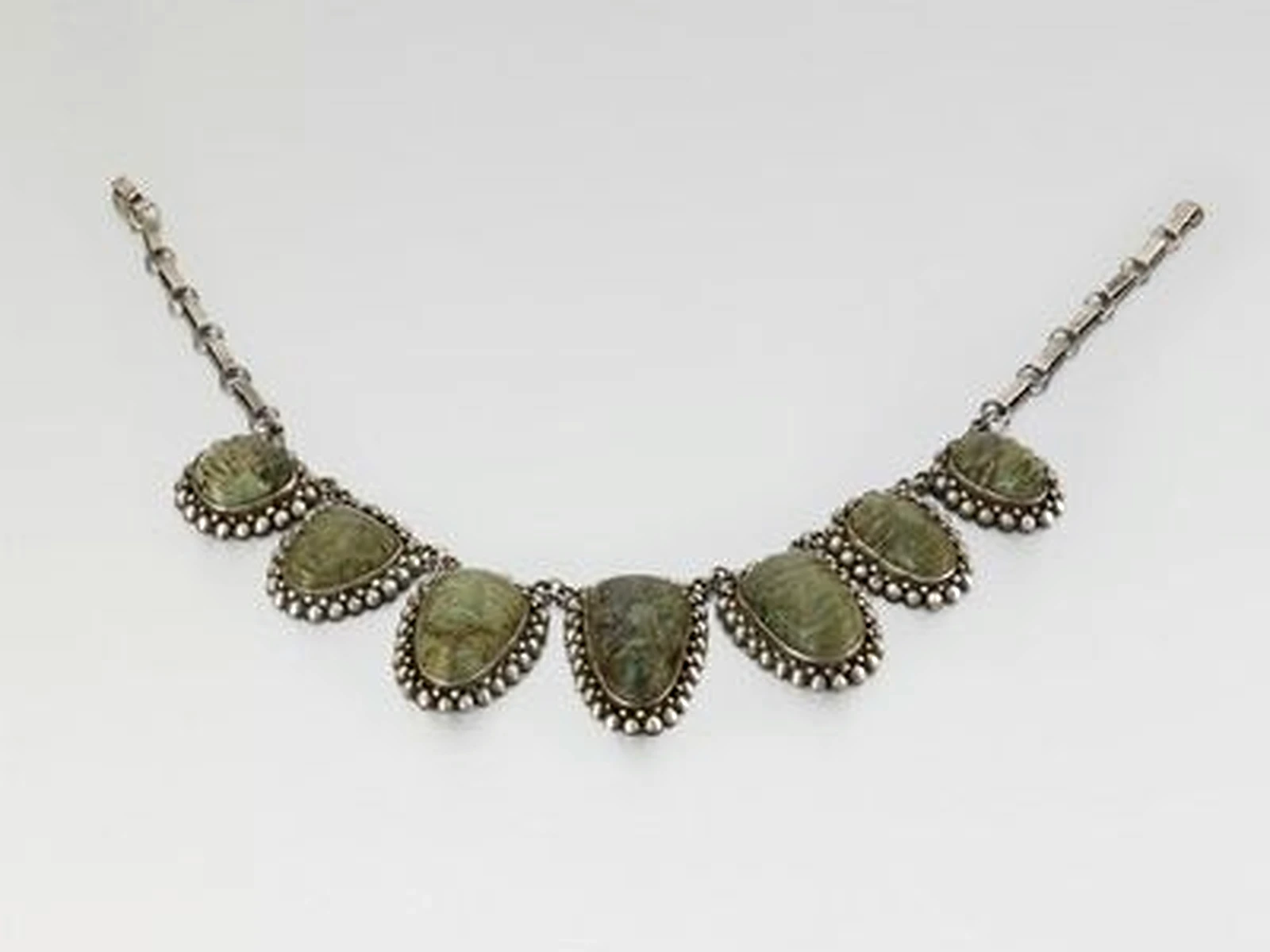
Hardstone Necklace
1939-1962
Hardstone