Saves instantly, no account needed. Already a member? Sign in.
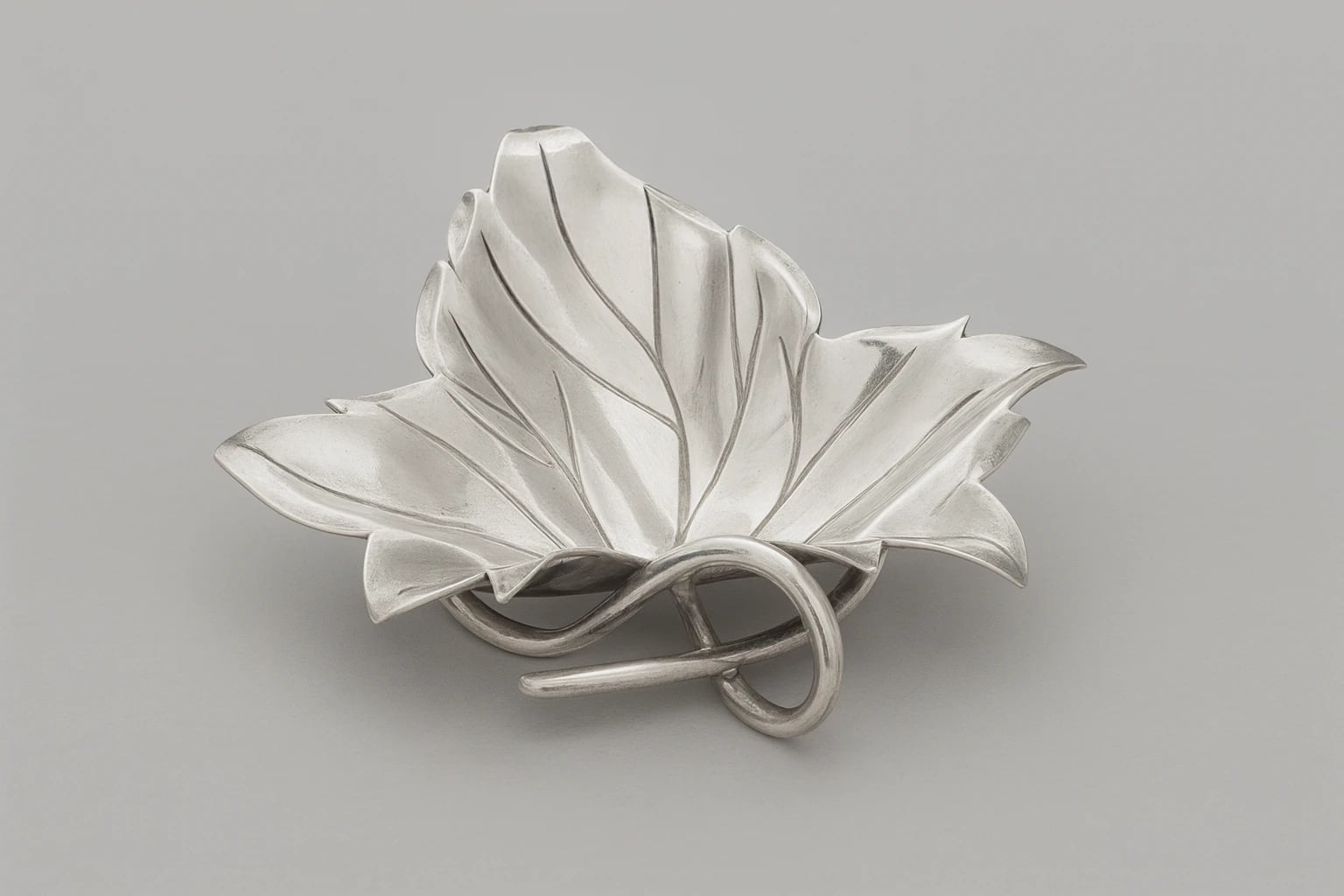
A silver leaf turned into a working dish, its stem coiled back on itself to form a handle, condenses Héctor Aguilar's design vocabulary into one of the Taller Borda's smallest tabletop objects. The five-lobed leaf, close in silhouette to ivy or maple, has been shaped so that its raised veins and gently cupped lobes create a shallow basin, while the points of the leaf themselves serve as the rim. Nothing has been added that the botanical form did not already supply: the stem becomes the handle, the veining becomes the surface ornament, and the natural curl of a drying leaf becomes the structural lift that lets the dish hold its contents.
The most telling detail is that coiled stem. Penny Morrill, in Silver Masters of Mexico, traces the spiral or coil through Aguilar's work as one of his most persistent motifs, from the coils applied to copper sconces to the coiled handle of a silver gravy boat and the goblets whose stems pool into spirals at the base. The tendril handle on this dish belongs to that family. It rises above the leaf in an open loop, giving the low, spreading form a vertical accent and a point of grasp, and it ties a modest serving piece to the same design thinking that shaped the workshop's ambitious holloware. The chasing of the veins is confident rather than fussy: the central rib runs the length of the leaf and the secondary veins branch from it in shallow relief, catching light along their ridges while the fields between them stay smooth and reflective.
The dish dates to the Taller Borda years, 1939 to 1962, when Aguilar built one of Taxco's most complete workshops. Morrill documents that the taller produced a full range of table silver alongside its jewelry, including bread and butter plates, salad sets, candlesticks, and serving pieces from around 1940 onward, and that during the fifties Aguilar expanded holloware and flatware production considerably. A small leaf dish of this kind sits naturally within that program: a design resolved enough to be made in quantity by the workshop's silversmiths, yet individual enough in its forming and chasing that no two examples read identically. The Museum's records include multiple examples of the model, which confirms it as a production design rather than a singular commission, and that is part of its interest. It shows how the taller carried a designer's idea through repeated fabrication without flattening it.
What the dish contributes to the larger picture is a view of Aguilar at domestic scale. His reputation rests heavily on massive jewelry and monumental holloware, but the Taller Borda also furnished tables, and objects like this one demonstrate that the workshop's naturalism and its signature coil traveled intact into everyday silver. It is a useful, unforced example of how the Mexican silver renaissance reached ordinary settings: not through manifesto pieces, but through well-made objects that put a coherent design language into daily use.
Museum of Mexican Silver. “Sterling Leaf Dish.” Catalog no. MoMS-001410. https://museumofmexicansilver.com/pieces/aguilar-plate-sterling-dish
See something wrong with this record? Suggest a correction and the piece details fill in automatically.
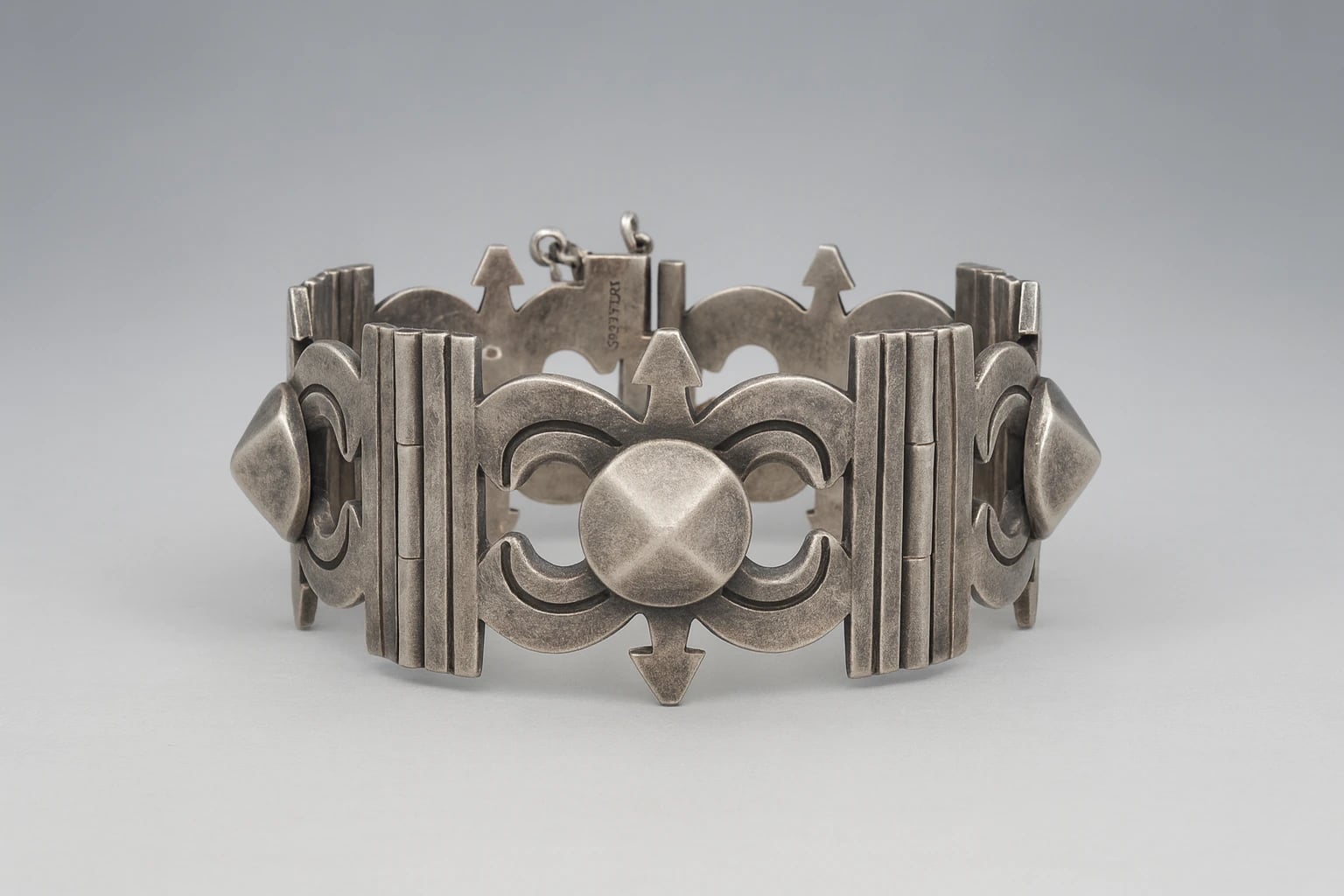
Héctor Aguilar
Pyramidal-and-Silver-Ball Link Bracelet
Sterling silver