Saves instantly, no account needed. Already a member? Sign in.
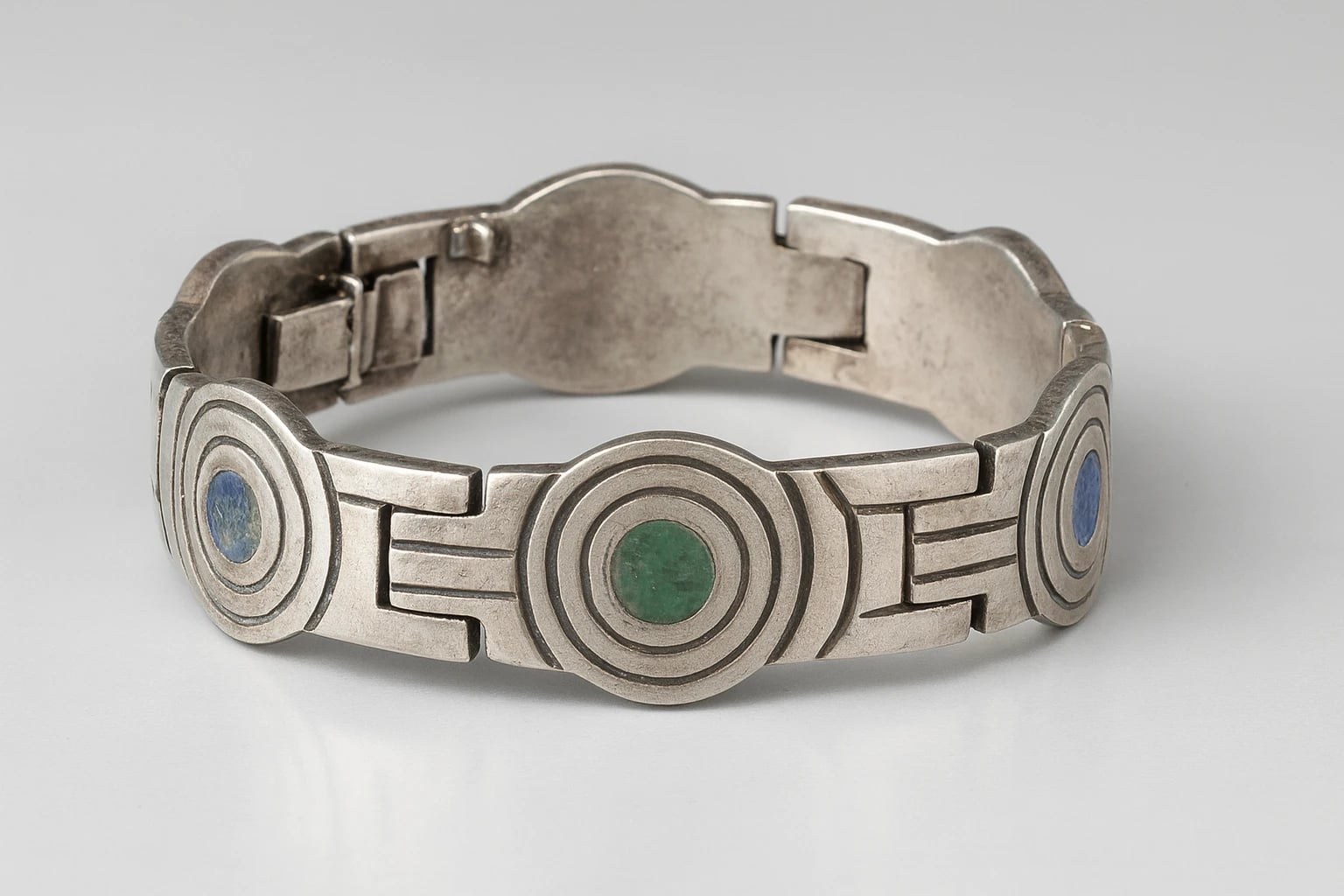
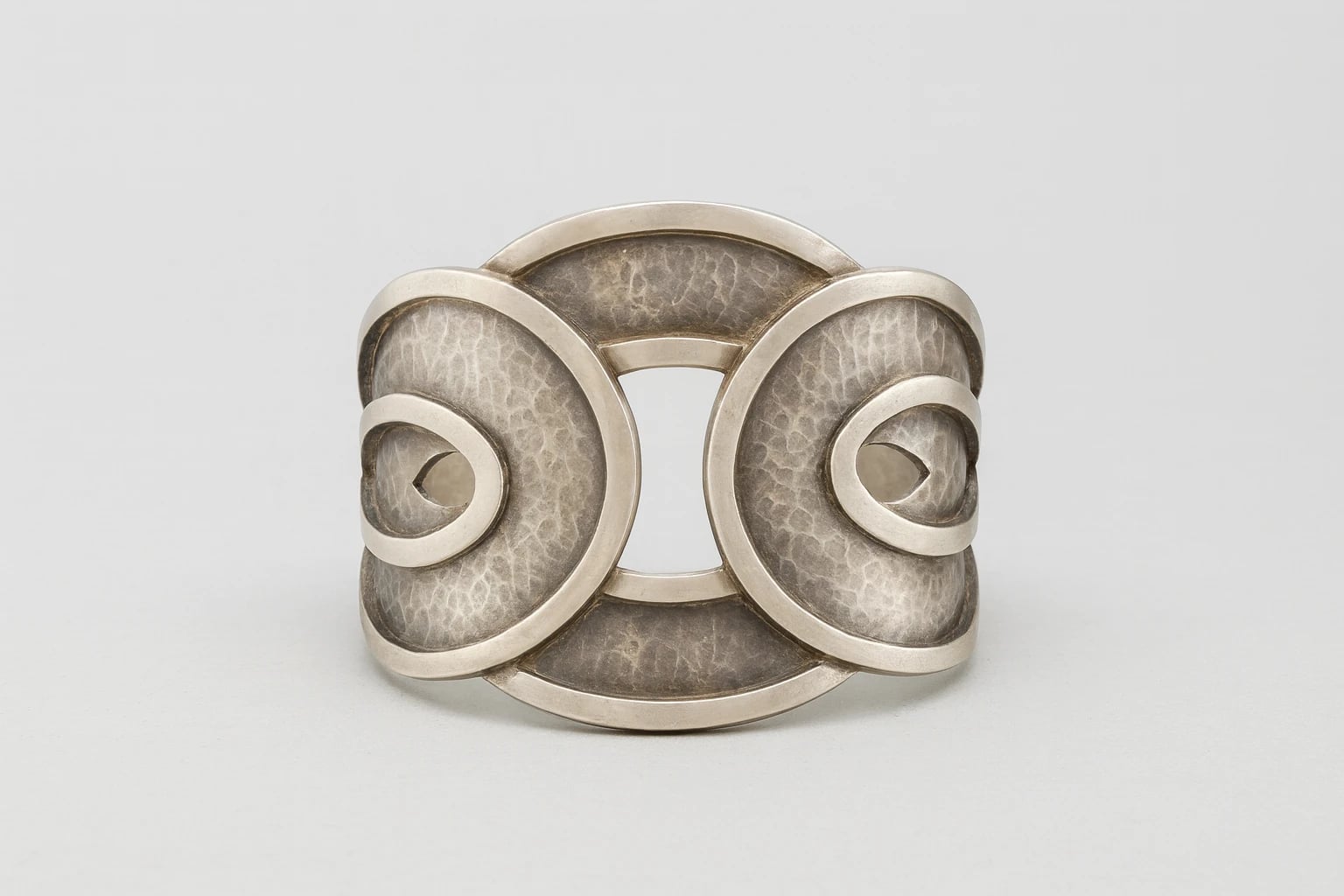
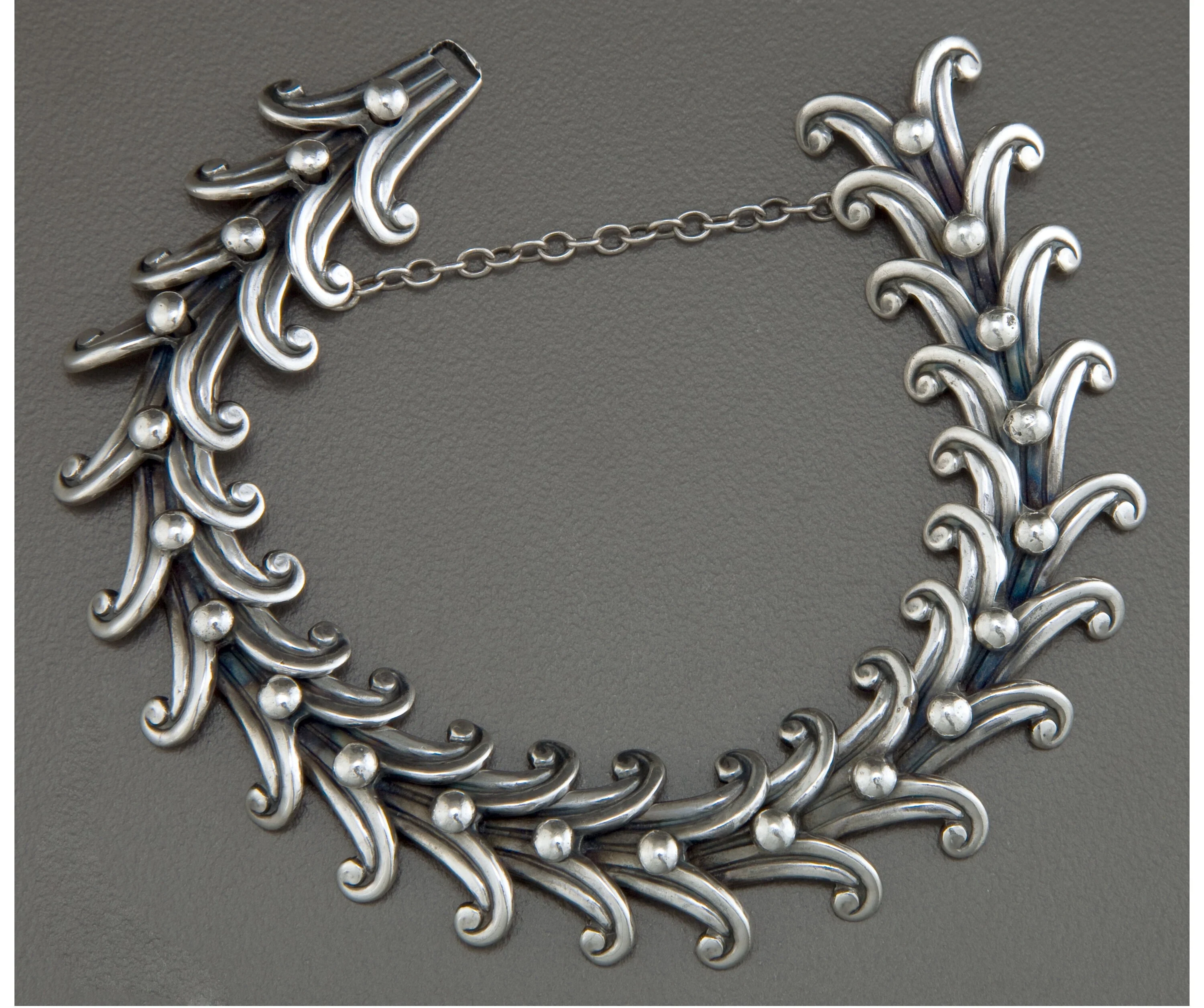
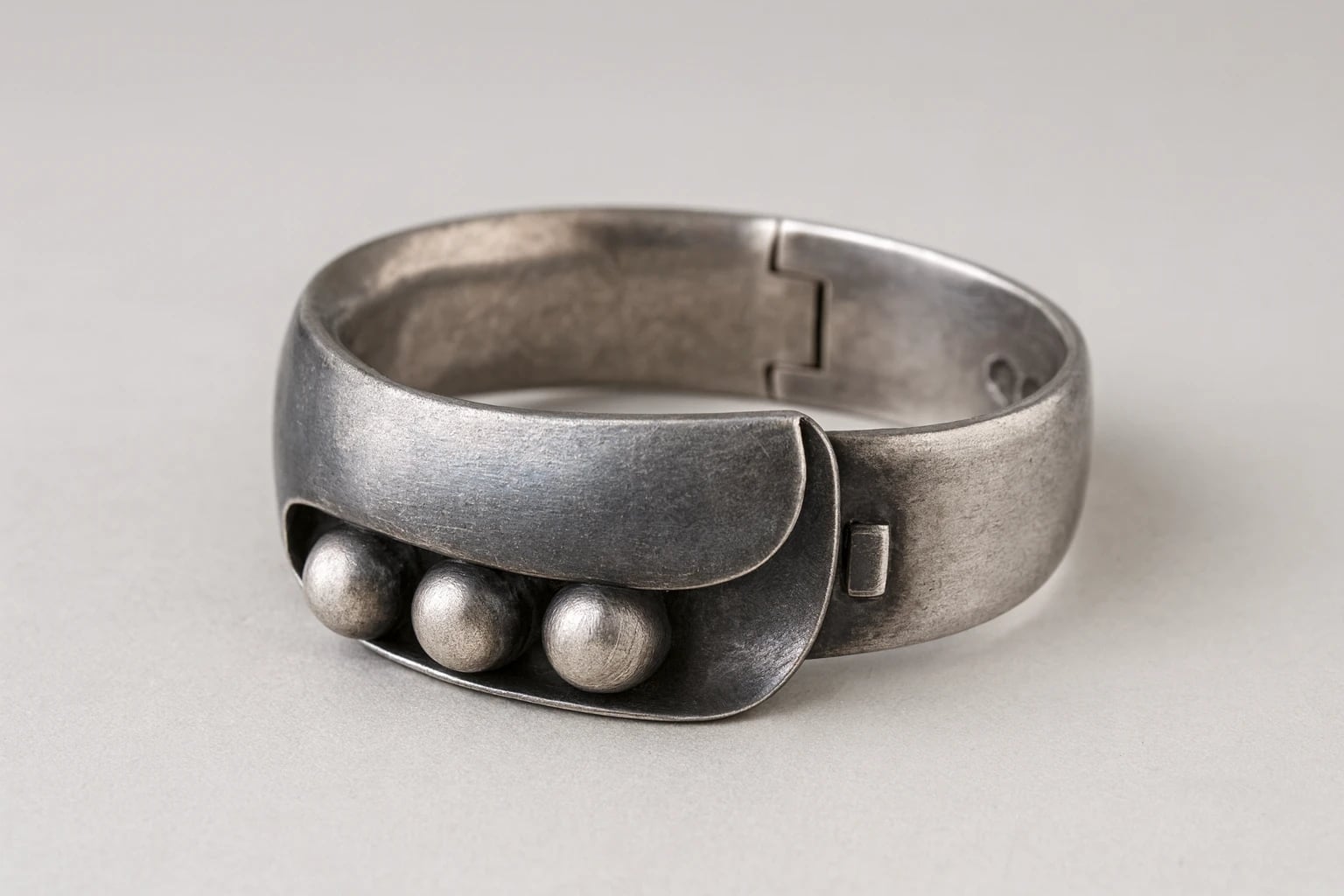
A band of linked panels carries the stepped and angular vocabulary of ancient Mexican relief into a bracelet meant for the wrist. Los Castillo called this pattern the Aztec service design, and its interest lies in how the workshop reduced a complex visual tradition to a repeating unit of sterling that can flex around the arm. The panels join edge to edge so the ornament runs continuously, without a single dominant clasp or center to interrupt the sequence. What might have been a static frieze becomes a moving surface that follows the body.
The design depends on the alternation of raised and recessed forms within each panel. Stepped frets and blocked geometry catch light along their upper edges while the depressed channels hold shadow, so the bracelet reads as a rhythm of bright and dark before any single motif is legible. Sterling suits this handling well: its reflectivity sharpens the contrast between polished faces and shaded grooves, and its weight gives the linked band a settled presence on the wrist. The articulation between panels is structural as well as decorative. Each hinge allows the rigid units to pivot, so the ornament curves without buckling and the pattern stays continuous through the flex.
Los Castillo was founded in 1939 by Antonio Castillo with his brothers Justo and Jorge and their cousin Salvador Terán. Antonio had worked for William Spratling at the Taller de Las Delicias before opening the taller, and in the early years many designs came from his wife Margot van Voorhies, before their divorce in 1946. The workshop became known for both sterling jewelry and for its experiments in married metals, joining silver with copper and brass. The Aztec service bracelet belongs to the sterling side of that practice and to the workshop's engagement with ancient Mexican sources, a current within postrevolutionary Mexican design that looked to indigenous relief and glyphic form for a modern national vocabulary. Rather than copy a specific monument, the workshop distilled the stepped fret and blocked massing that recur across Mesoamerican architecture and carving into a modular ornament suited to production.
Within the Los Castillo range, this bracelet represents the workshop's disciplined handling of a repeated hard-edged unit, a contrast to the fluid, sculptural pieces such as the swirling silver fish sets the firm also produced. It shows how a taller organized around specialization and controlled production could translate a demanding relief idiom into a wearable band without losing the crispness of the source. For a collection tracing the Mexican silver renaissance, it documents both Los Castillo's use of ancient Mexican geometry and the technical means, hinged sterling panels, by which that geometry was made to move.
Museum of Mexican Silver. “Aztec Service Bracelet.” Catalog no. MoMS-001131. https://museumofmexicansilver.com/pieces/los-castillo-bracelet-aztec-service
See something wrong with this record? Suggest a correction and the piece details fill in automatically.
Los Castillo
Eagle Malachite Bracelet
Malachite