Saves instantly, no account needed. Already a member? Sign in.
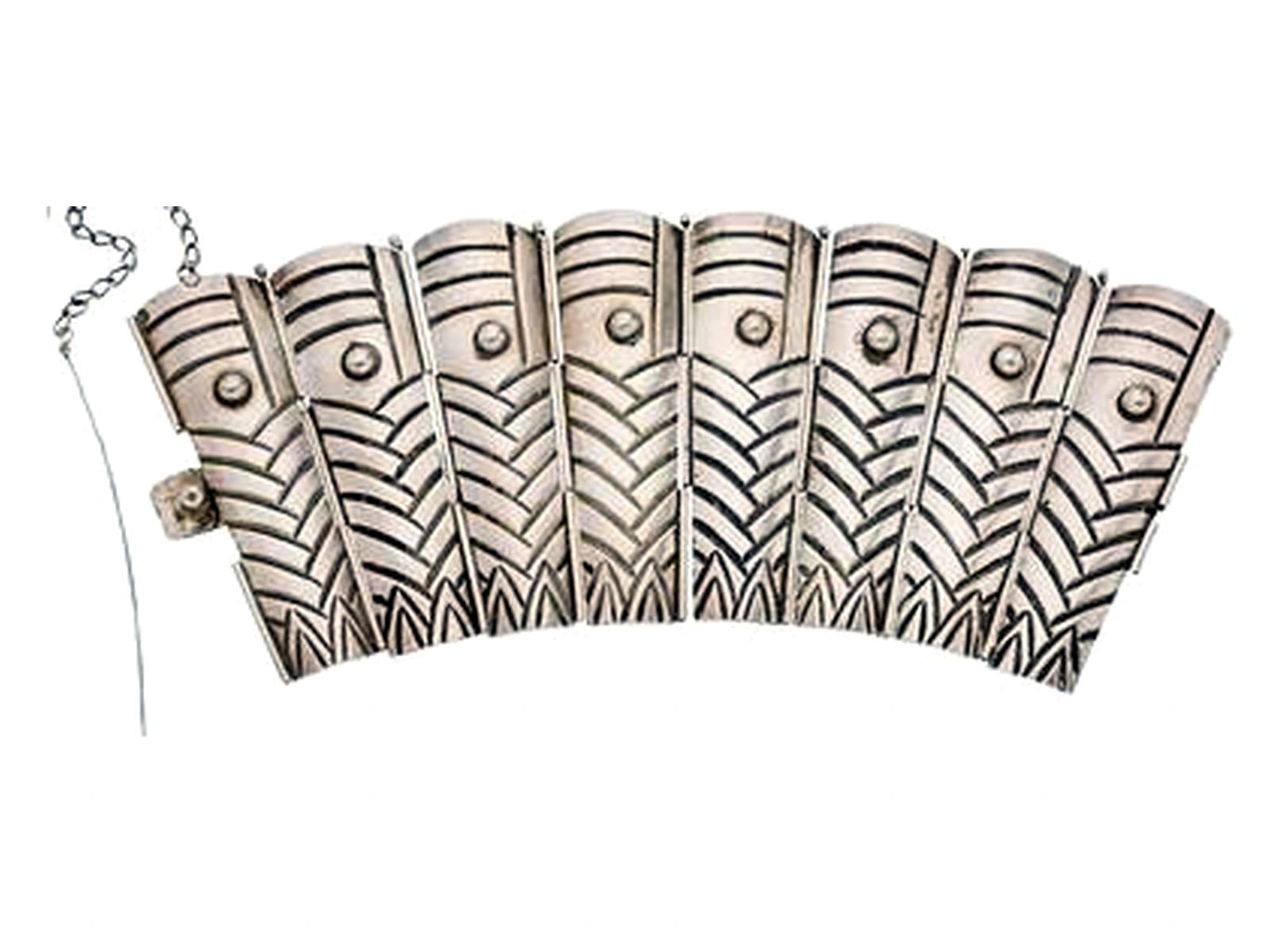
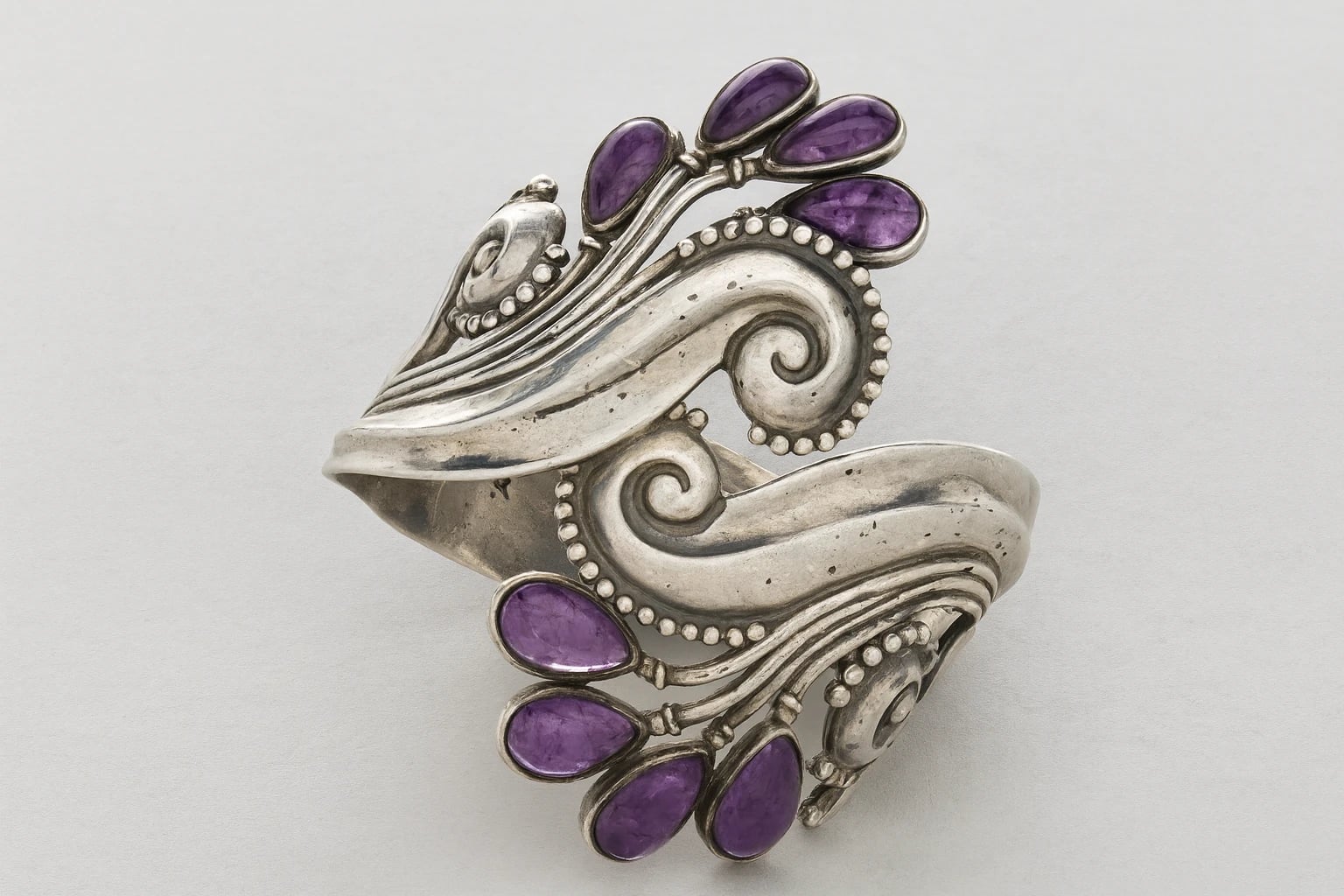
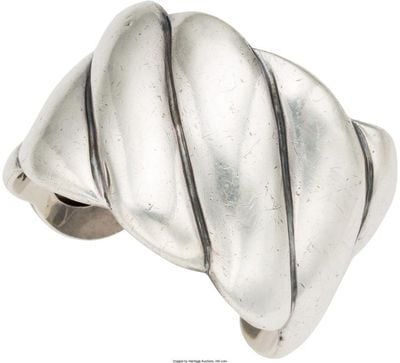
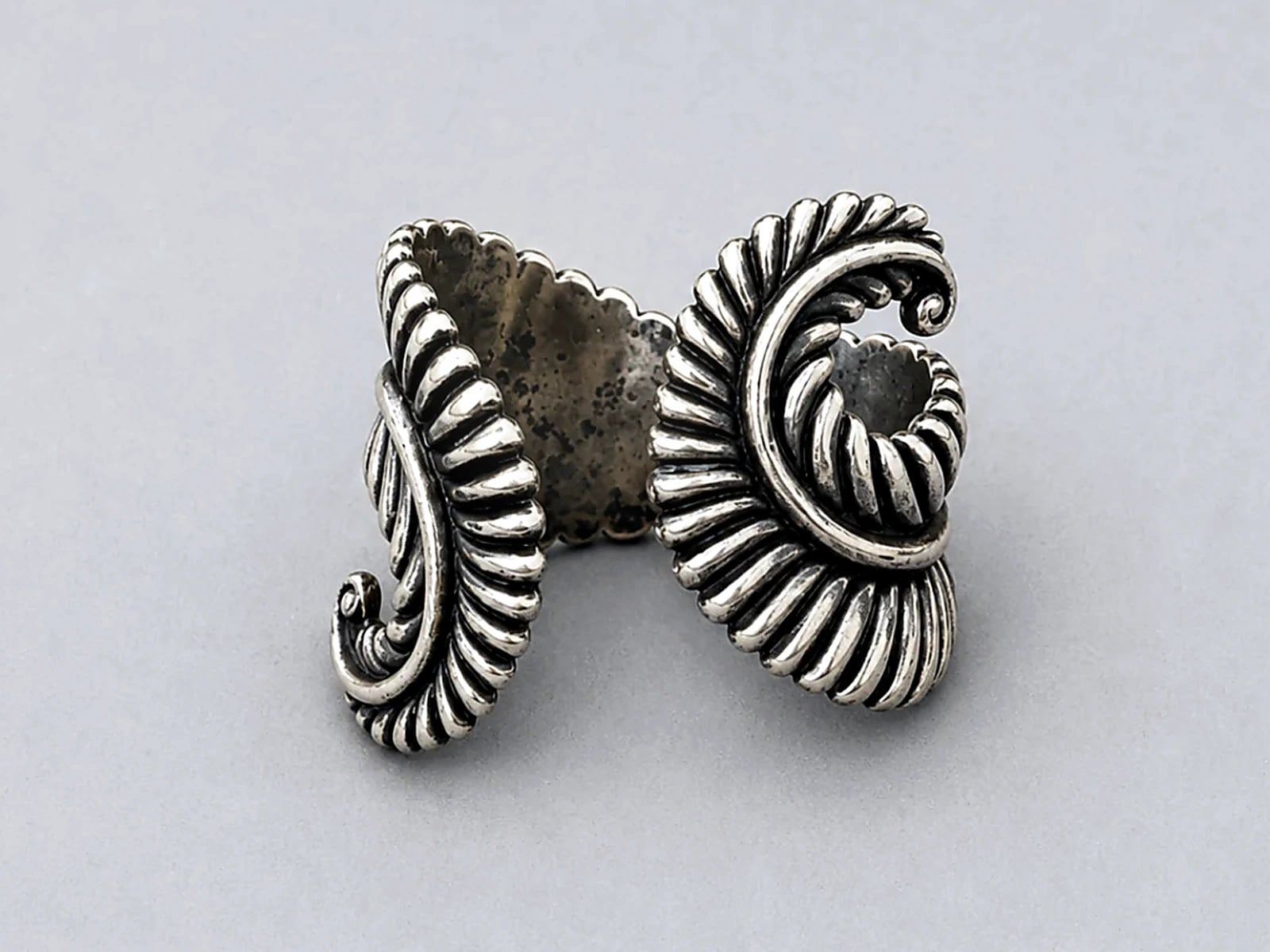
This clamper cuff turns a single sculptural gesture into the whole of its design. Each half of the hinged band terminates in a bold, deeply ribbed scroll that coils in on itself like a breaking wave or a furled feather, the fluting fanning out from a tight central curl and then relaxing into the body of the cuff. The two scrolls face one another across the opening of the clamper, so that the piece reads as a pair of matched spirals meeting at the wrist. The reverse, glimpsed in the hallmark view, carries a scalloped, shell-like fluting that answers the front, confirming that the ribbing is worked through the form rather than merely applied to its face. It is a design of controlled energy: everything is motion, but the motion is bound into a tight, wearable arc.
The scrolled, ribbed vocabulary places the cuff within a current the Taxco workshops shared with international Art Deco and with the streamlined, organic modernism of the 1940s, in which natural forms, waves, feathers, plumes, were abstracted into rhythmic, machined-looking repetition. In Los Castillo's hands that current met a distinctly Mexican taste for weight and for boldly modeled silver. The house was founded in Taxco in 1939 by Antonio Castillo Terán with his brothers Justo and Jorge and cousin Salvador Terán, and Antonio's formation under William Spratling at the Taller de Las Delicias gave the workshop its lifelong preference for substantial, hand-raised forms over delicate filigree (Morrill & Berk, Mexican Silver). This cuff is squarely in that tradition: the fluting is deep enough to catch and hold light along every rib, and the clamper construction, a sprung, hinged cuff that grips the wrist, is a piece of engineering the workshop deployed to let a rigid, heavy ornament open and close cleanly.
What distinguishes the piece against the workshop's plainer bands is precisely this insistence on movement. Where a smooth or beaded Los Castillo cuff lets the silver sit quiet, here the surface is all directional line, drawing the eye around the coil and back. The design belongs to the more overtly decorative side of the workshop's range, closer to its sculptural brooches and repoussé work than to its austere modernist bangles, and it demonstrates the same command of chased, three-dimensional relief that runs through the house's figural pieces.
Set against the workshop's stone-inlaid and married-metal showpieces, this cuff makes its case through modeling alone, which places a heavy demand on the chasing: the ribs must hold their crispness through the full sweep of each scroll, and the two coils must answer one another across the clamper's opening. Richly modeled clamper cuffs of this kind reached the market less frequently than the workshop's simpler bands, and a well-preserved example, with the fluting crisp and the hinge sound, is the more rewarding for it. The piece earns museum consideration as a compact demonstration of Los Castillo's decorative intelligence: a single motif, the coiled feather-wave, developed with enough conviction to carry an entire object, and executed with the chasing and construction that made the workshop one of the defining names of the Taxco silver renaissance.
Museum of Mexican Silver. “Feather Clamper Bracelet.” Catalog no. MoMS-001188. https://museumofmexicansilver.com/pieces/los-castillo-bracelet-cuff-pair
See something wrong with this record? Suggest a correction and the piece details fill in automatically.
Los Castillo
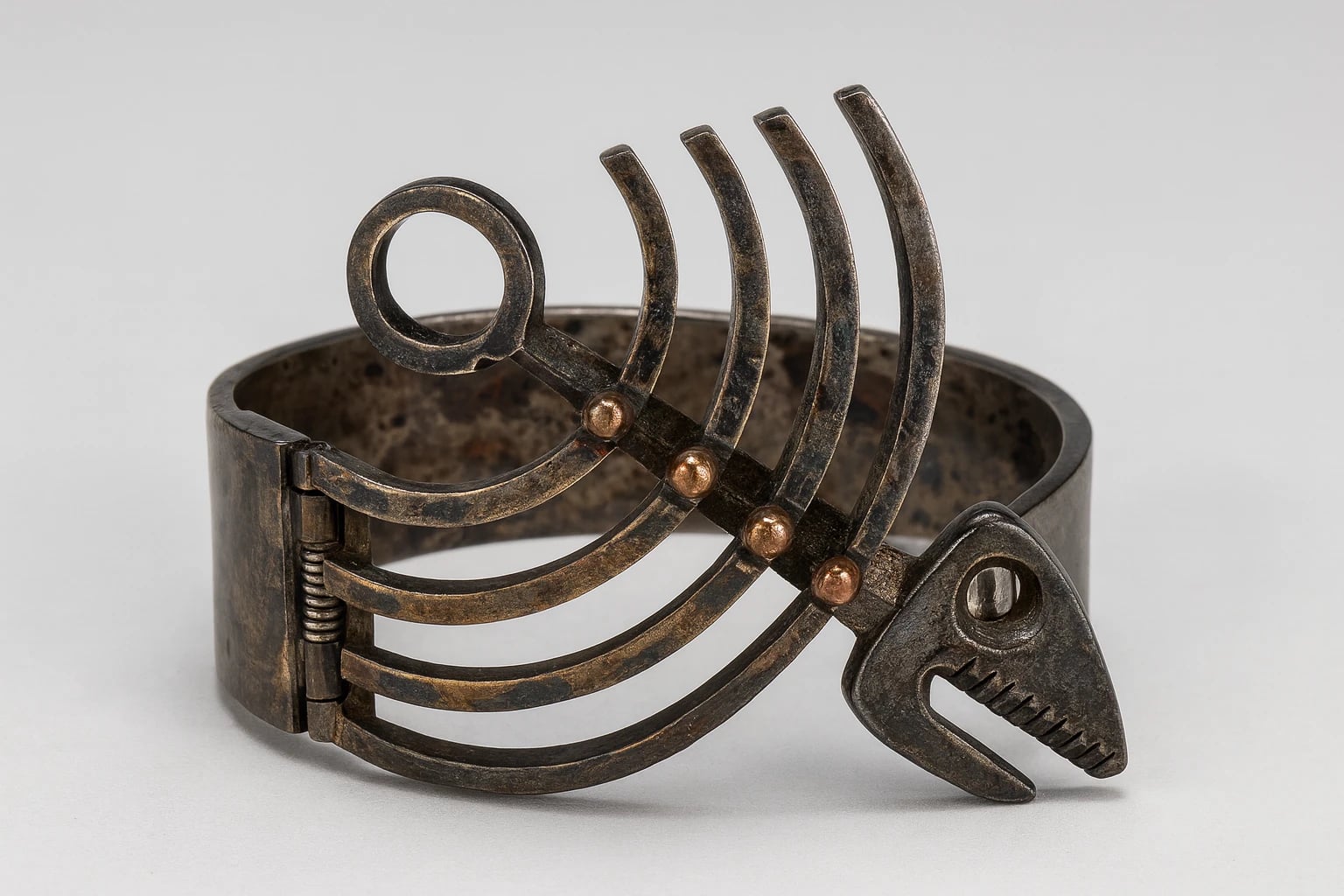
Fish Bracelet
Sterling silver