Saves instantly, no account needed. Already a member? Sign in.
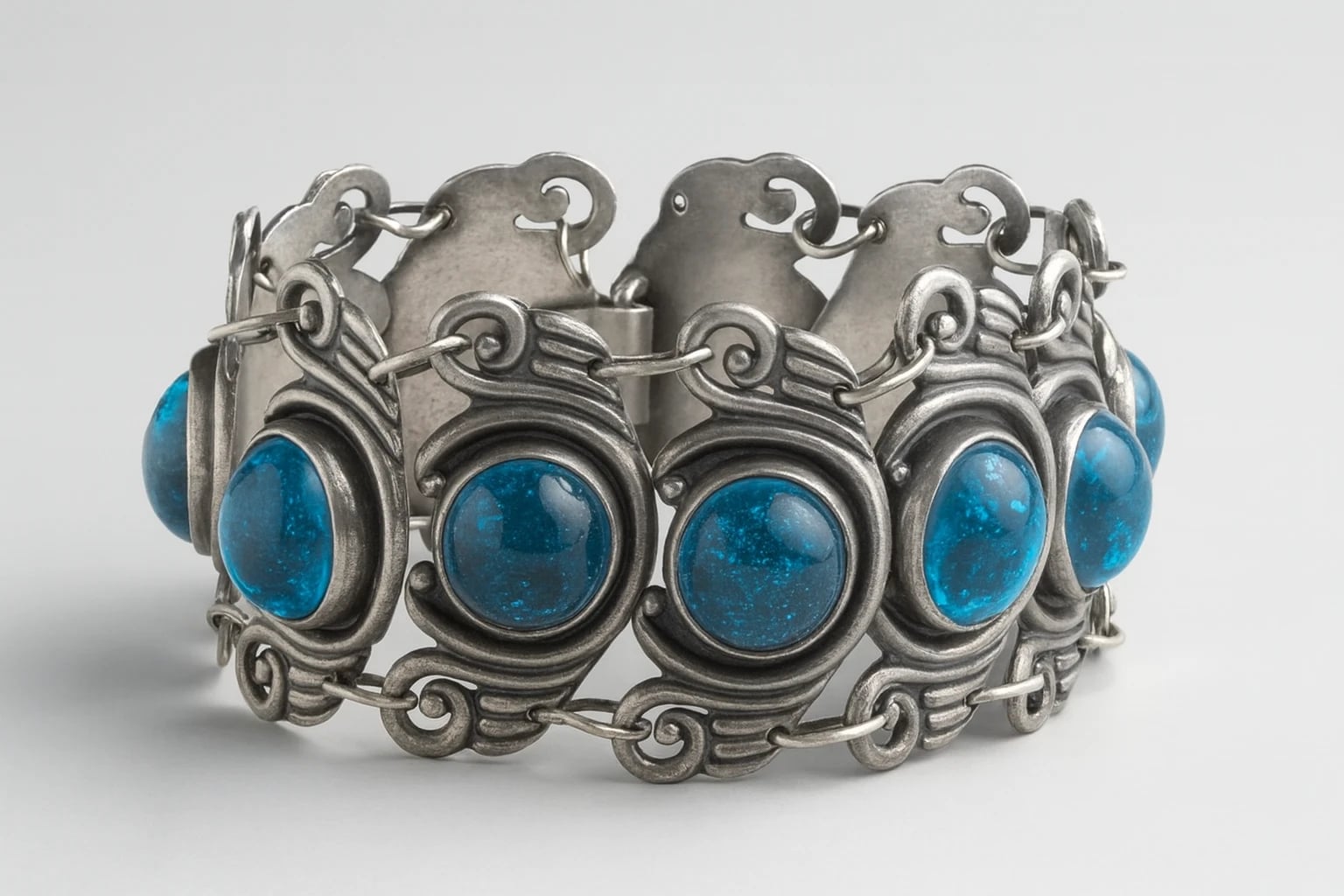
Large blue cabochons give this Los Castillo bracelet its rhythm, but the design is not organized around color alone. Each stone sits inside a round bezel framed by swelling scrolls, small pierced curls, and broad vertical link plates that rise behind the setting like hinged shields. The bracelet measures 7 3/8 inches by 1 3/8 inches, a scale that allows the links to read almost architecturally on the wrist. Its block Los Castillo signature, design number 222, and pre-eagle dating place it within the workshop’s early 1940s production, before the postwar Mexican assay system regularized the eagle stamps that later became familiar on Taxco silver.
The bracelet depends on a disciplined alternation of opacity and brightness. The blue glass cabochons are domed and saturated, catching light in a way that differs from turquoise or hardstone. Their color appears suspended inside the smooth surface rather than resting on it. Around them, the silver framework is dense but open: raised borders contain the cabochons, while smaller scroll elements soften the transitions from one link to the next. The result is a linked bracelet with real flexibility, yet each unit retains the presence of an individual ornament. The back plates visible above the settings show that the bracelet was conceived as a sequence of articulated sections rather than as a simple chain carrying repeated bezels.
Los Castillo was founded in Taxco in 1939 by Antonio Castillo with his brothers Jorge “Chato” Castillo and Justo “Coco” Castillo, his wife Margot van Voorhies Carr, and his cousin Salvador Terán. The workshop quickly became one of the major laboratories of the Mexican silver renaissance, known not only for silver jewelry but for experimentation with materials, inlay, married metals, enamel, feather work, and related surface techniques. This bracelet belongs to the earlier side of that history. It does not yet display the later technical flamboyance for which Los Castillo became famous, but it already shows the workshop’s willingness to enlarge the vocabulary of silver jewelry through color, repetition, and carefully engineered link construction.
The design’s publication on the Los Castillo title page of Morrill and Berk’s Mexican Silver helps explain its standing among informed collectors, but its importance is visible without that external confirmation. Design number 222 condenses several qualities that made early Los Castillo jewelry so persuasive: generous scale, strong profile, ornamental movement, and a modern use of nonprecious color within a substantial silver structure. The bracelet is historically revealing because it shows the workshop at a point when Taxco jewelry could be decorative, commercially viable, and formally ambitious at the same time. Its blue cabochons are not simply accents. They organize the bracelet’s sequence of circular forms and give its early modern Taxco scrollwork a distinct optical charge.
Museum of Mexican Silver. “Scroll Link Bracelet with Blue Glass Cabochons.” Catalog no. MoMS-002303. https://museumofmexicansilver.com/pieces/los-castillo-bracelet-2
See something wrong with this record? Suggest a correction and the piece details fill in automatically.
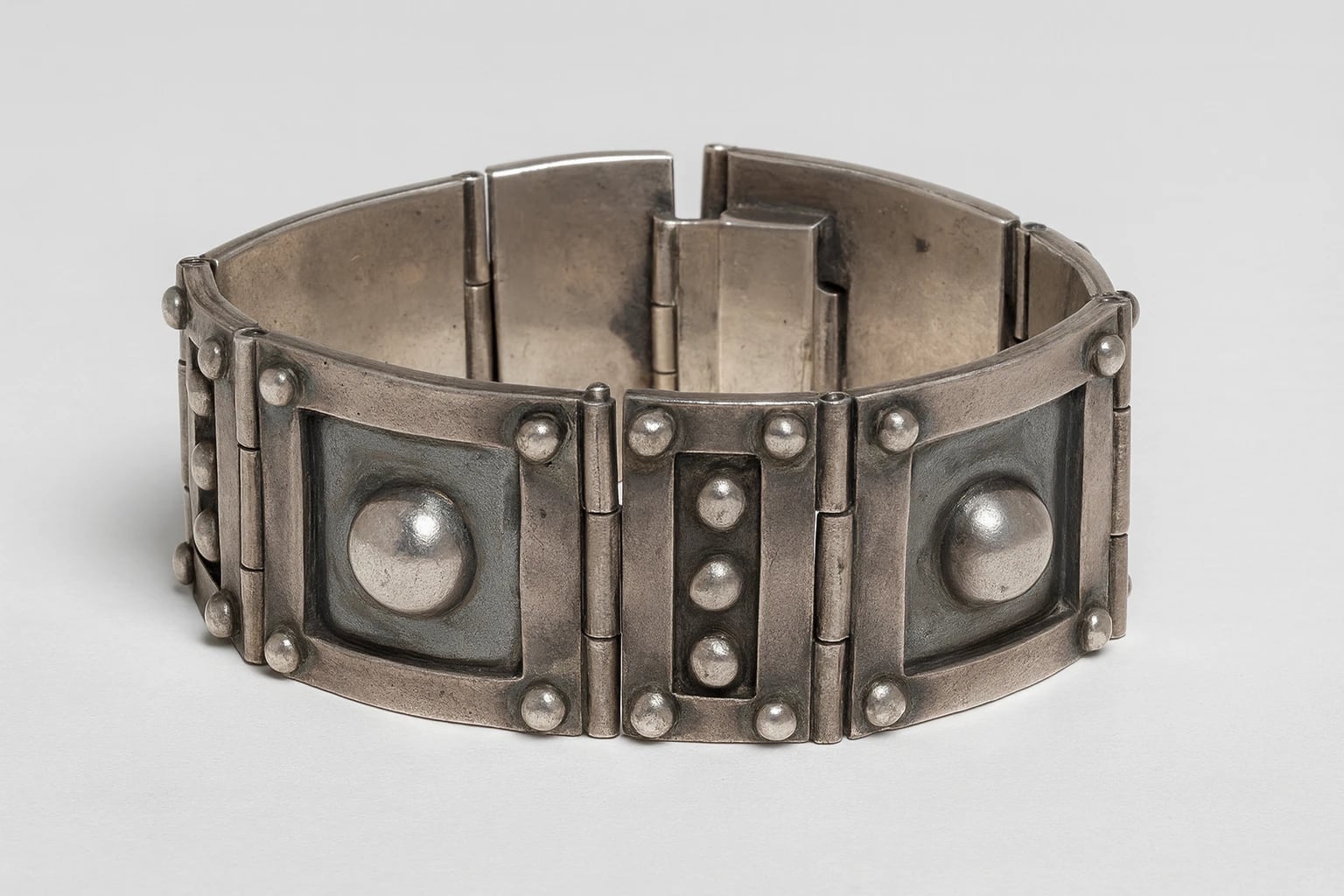
Studded Dome Panel Link Bracelet