Saves instantly, no account needed. Already a member? Sign in.
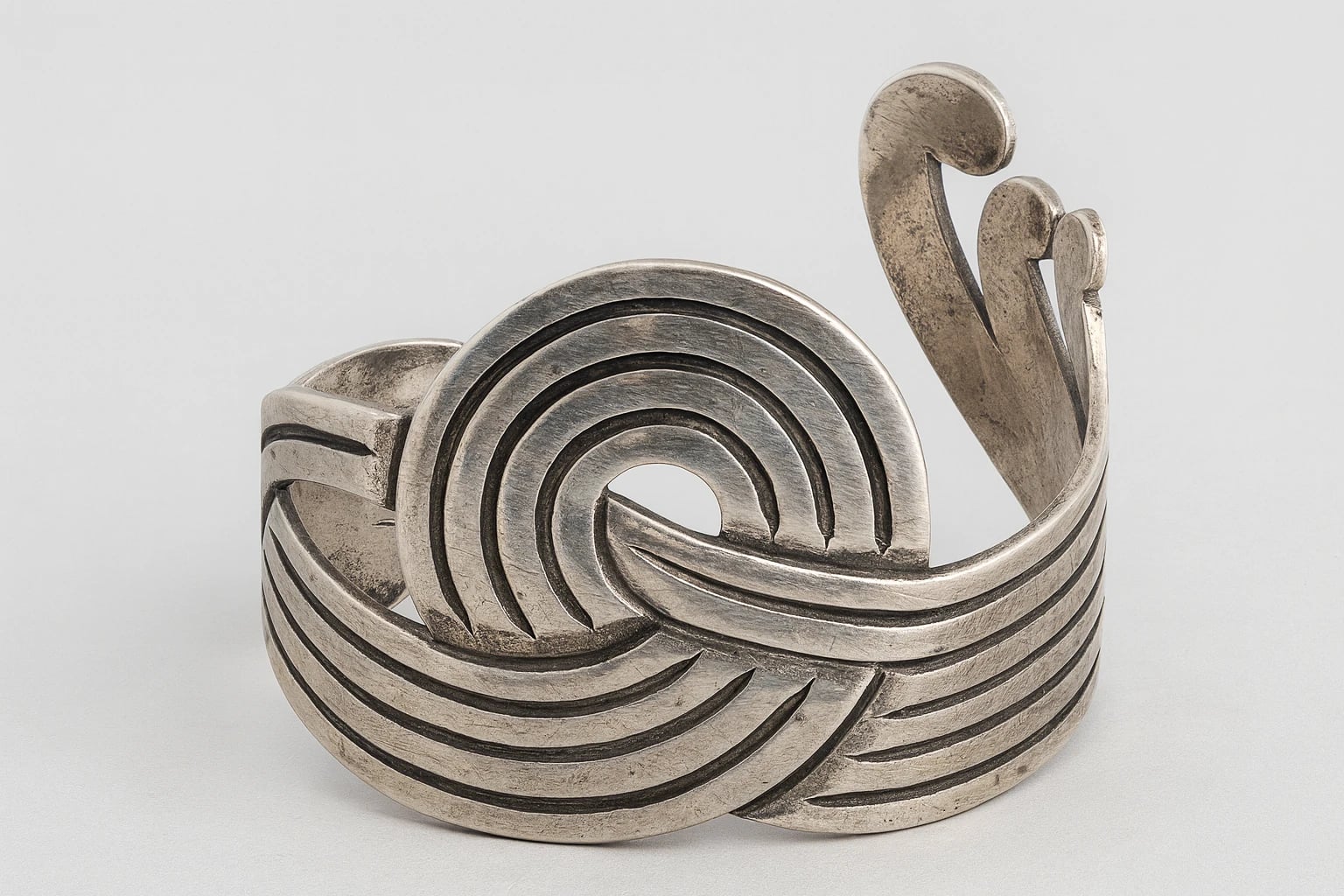
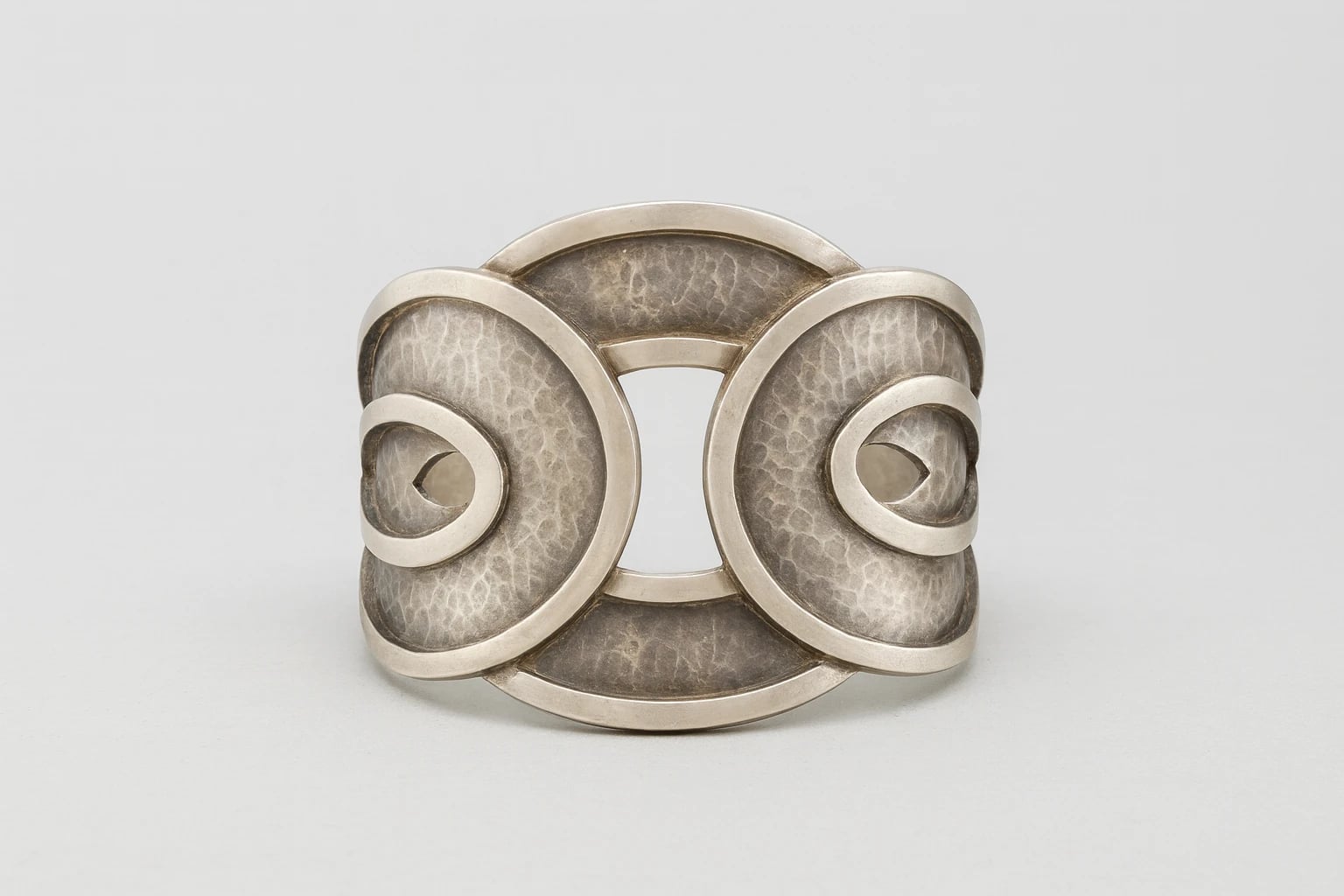
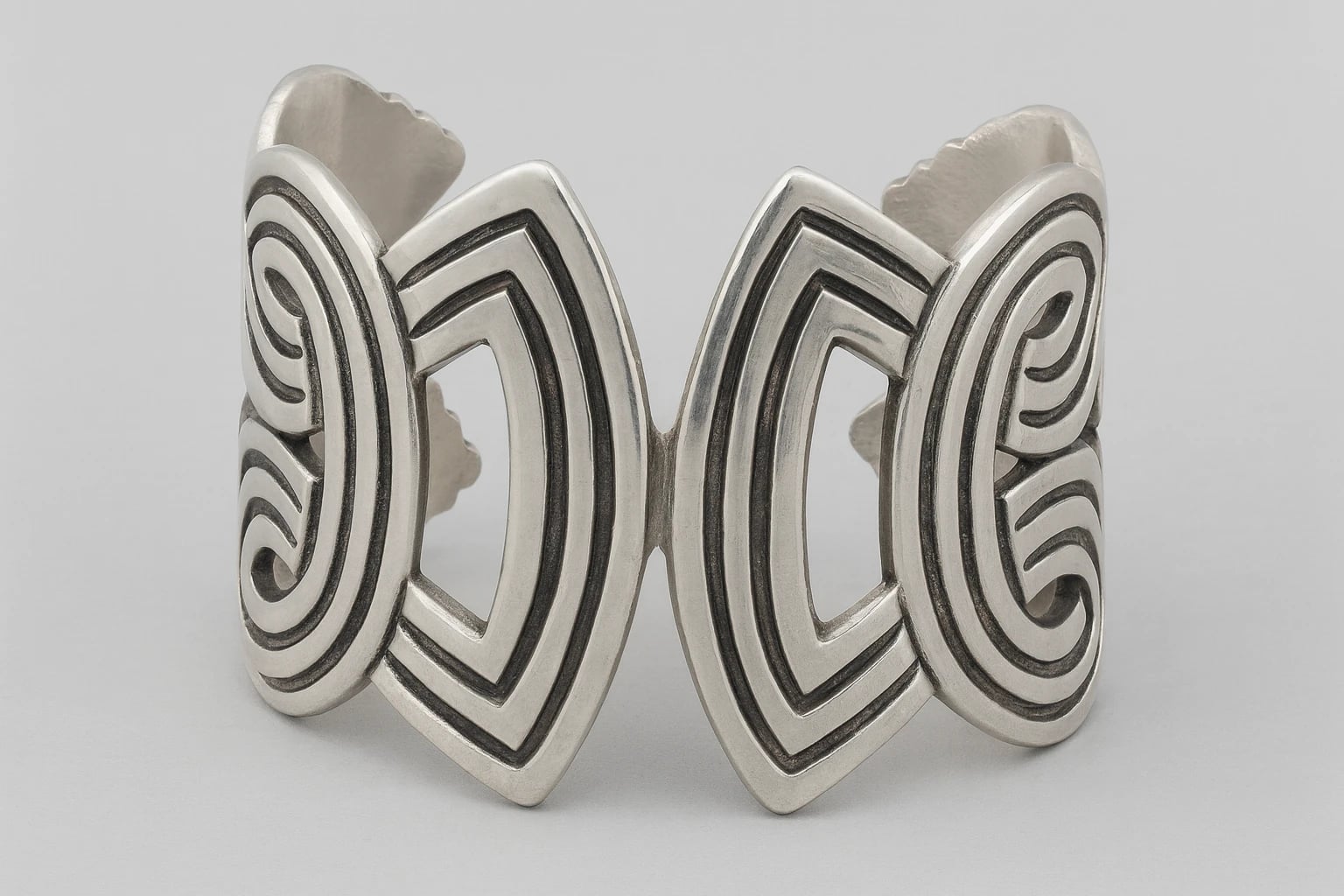
This cuff is organized around line as structure. The front rises to two inches, but the design does not depend on a single broad plate of silver. Instead, the surface is broken into paired vertical terminals and inward facing stepped forms, each built from raised bands that turn, bend, and return in measured intervals. The open center prevents the bracelet from becoming a heavy shield. Silver is used here to draw in relief, with polished ridges catching light and recessed channels giving the pattern depth.
The bracelet’s strength lies in the way its geometry remains bodily. The outer terminals curve around the wrist as rounded plaques, filled with concentric, almost ripple like channels that follow the shape of the edge. Toward the center, the pattern tightens into angular half frames, creating a pause before the two sides nearly meet. The cuff construction leaves the reverse open and gives the ornament a clear front, but the design continues around the sides rather than stopping at the face. Its rhythm is not purely symmetrical repetition. Curves and angles answer one another, so that the bracelet reads as a sequence of turns held in tension around the arm.
The old linear Los Castillo mark, the pre Eagle dating, and design number 260 place the bracelet within the workshop’s early 1940s production, when Los Castillo was still defining a language distinct from the other major Taxco talleres. The workshop had been founded in 1939 by Antonio Castillo with members of the Castillo family and Salvador Terán, and its early years were shaped by designers and silversmiths who had absorbed the discipline of Las Delicias while developing their own approach to ornament, surface, and movement. This bracelet belongs to that formative moment. It does not rely on the later Los Castillo techniques for which the firm became especially celebrated, such as married metals, inlay, enamel, or feather work. Its effect comes from the more elemental resources of silver: outline, shadow, relief, and proportion.
As a Los Castillo object, the bracelet shows how early Taxco modernism could treat the cuff as a compact architectural field. The stepped interior forms recall the workshop’s broader interest in simplified ancient and geometric sources, but the design avoids literal quotation. It translates those sources into a modern silver vocabulary suited to the wrist, where spacing and articulation matter as much as motif. In a museum collection, the bracelet is valuable for precisely this restraint. It records a phase of Los Castillo design before the firm’s later technical expansion, when a disciplined linear pattern could carry the visual identity of the workshop with clarity and economy.
Museum of Mexican Silver. “Geometric Scroll Cuff Bracelet.” Catalog no. MoMS-002306. https://museumofmexicansilver.com/pieces/los-castillo-bracelet-4
See something wrong with this record? Suggest a correction and the piece details fill in automatically.
Interwoven Spiral Cuff Bracelet with Niello