Saves instantly, no account needed. Already a member? Sign in.
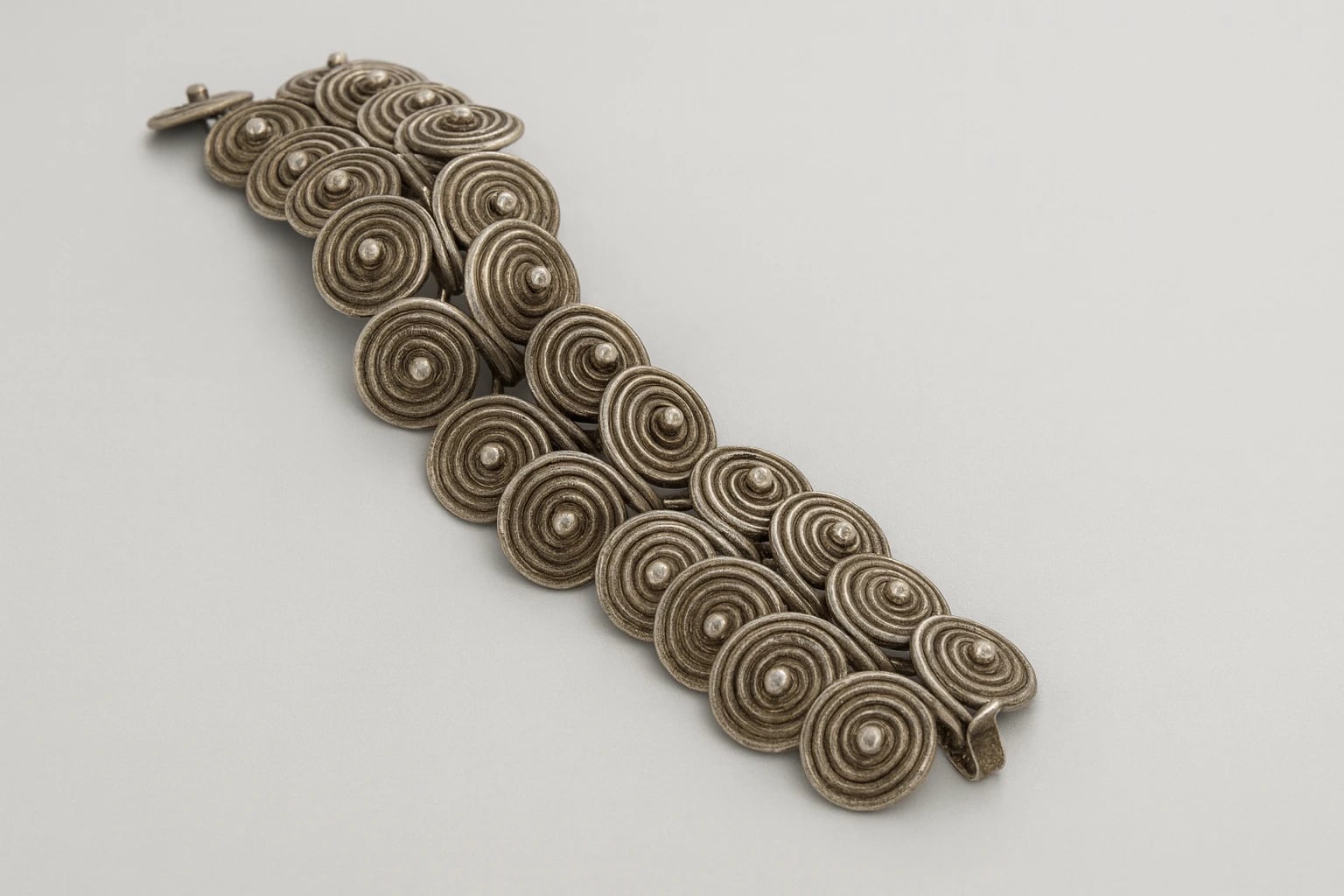
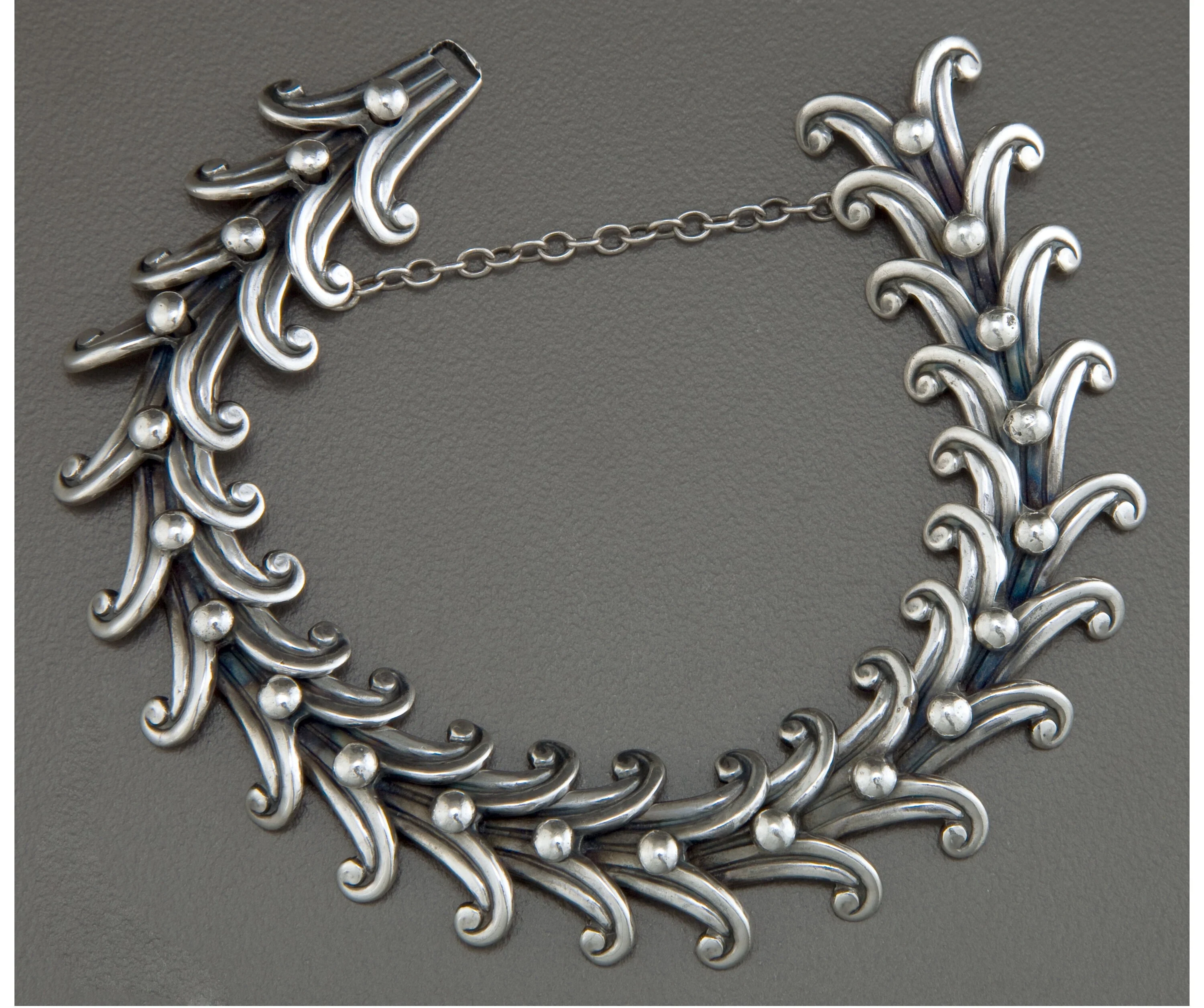
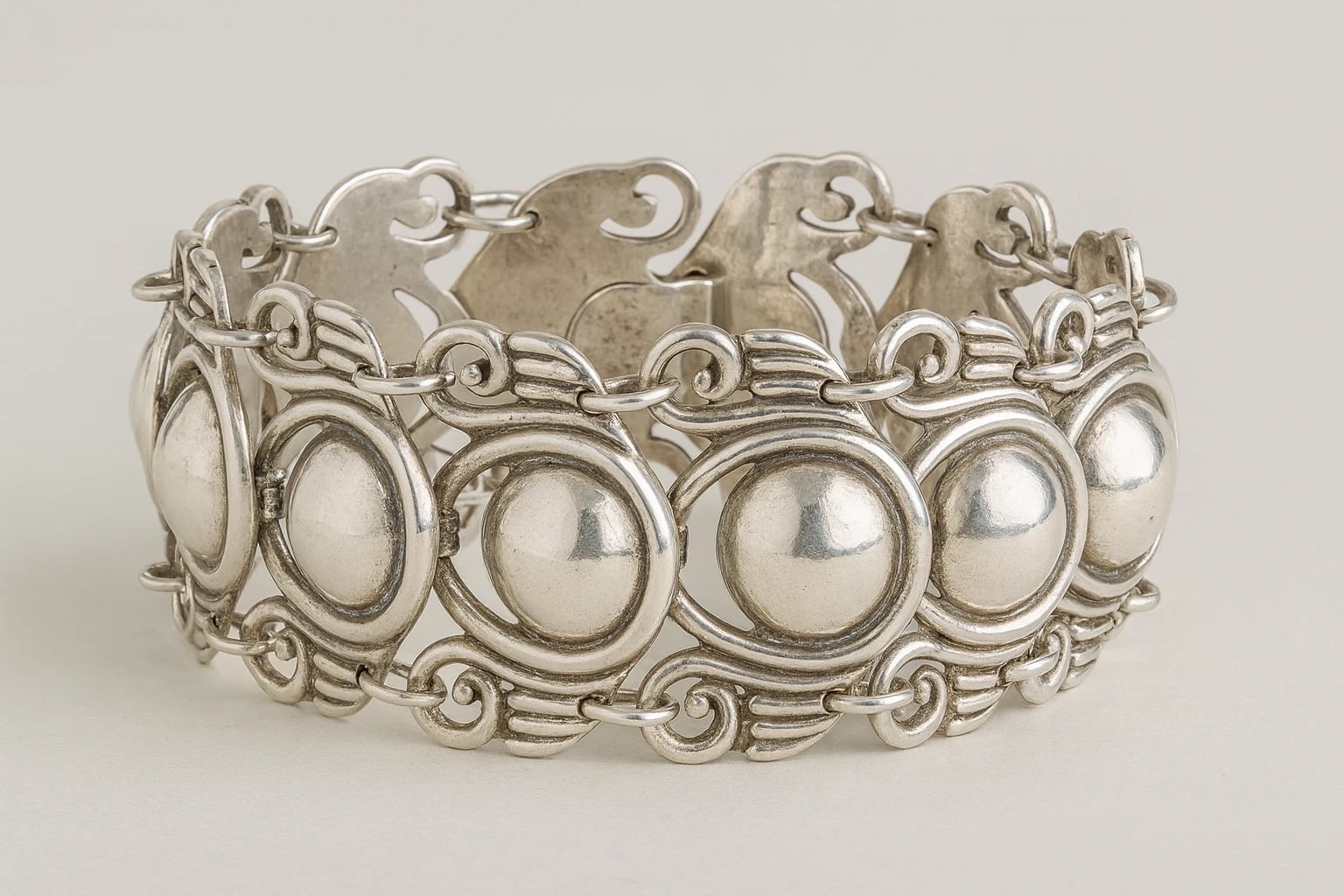
This bracelet is organized around a clear early Los Castillo idea: rounded silver volume held in place by drawing. A row of high domes forms the central band, each dome set within a circular frame and separated by small intervals of openwork. Around them, handmade wire curves, scrolls, and doubles back in a linear pattern that is decorative but also structural, tying the repeated units into a flexible bracelet rather than a rigid cuff. The result is broad on the wrist, 7 3/4 inches by 1 1/4 inches, but its open construction keeps the design from becoming heavy in appearance.
The bracelet depends on contrast between smooth reflective surfaces and active line. The domes catch light as small convex mirrors, while the surrounding wirework breaks that reflection into shadows, loops, and narrow highlights. Along the upper edge, pierced tabs and linkages create a second rhythm, flatter and more mechanical, which balances the rounded forms below. The design is not naturalistic, although its scrolls retain something of vegetal ornament. It belongs more closely to the 1940s Taxco interest in turning traditional hand skills into modern pattern, using repetition, articulation, and silhouette to make jewelry read as constructed form.
The old linear Los Castillo mark and design number 222 place the bracelet within the workshop’s early production, before the eagle assay system became the standard language of Mexican silver marking. A related example of this design is illustrated in Penny Morrill and Carole Berk’s Mexican Silver with blue glass cabochons, making this all silver version useful for understanding how Los Castillo could vary a design while preserving its underlying structure. In the cabochon version, color would punctuate the row of circular units. Here, the absence of stone or glass shifts attention to the silver itself: dome, rim, wire, hinge, and shadow become the entire composition.
Los Castillo was founded in 1939 by Antonio Castillo with members of his family and close collaborators, among them Jorge “Chato” Castillo, Justo “Coco” Castillo, Salvador Terán, and Margot van Voorhies. The workshop quickly developed an identity distinct from the other major Taxco talleres. Its early jewelry often joined technical confidence with a lively sense of ornament, and its later reputation would rest in part on complex mixed metal and inlay work. This bracelet predates those more elaborate signature techniques, but it already shows the workshop’s ability to treat construction as design. The visible wires do not disguise the making of the bracelet. They make the making legible.
Museum of Mexican Silver. “Domed Link Bracelet with Wire Scrolls.” Catalog no. MoMS-002343. https://museumofmexicansilver.com/pieces/los-castillo-bracelet-8
See something wrong with this record? Suggest a correction and the piece details fill in automatically.
Within a museum collection, the bracelet is valuable because it records Los Castillo at a formative moment, when the workshop’s language was still close to hand wrought silver jewelry but already moving toward a more inventive modern surface. Design number 222, the pre-Eagle marking, and the documented relationship to the published blue glass variant give the object a firm place in the workshop’s early chronology. Its importance lies in that combination of evidence and form: a bracelet built from domes and wire, modest in vocabulary, but exact in its control of movement, reflection, and repeated shape.
Los Castillo
Cuff Bracelet
Sterling silver