Saves instantly, no account needed. Already a member? Sign in.
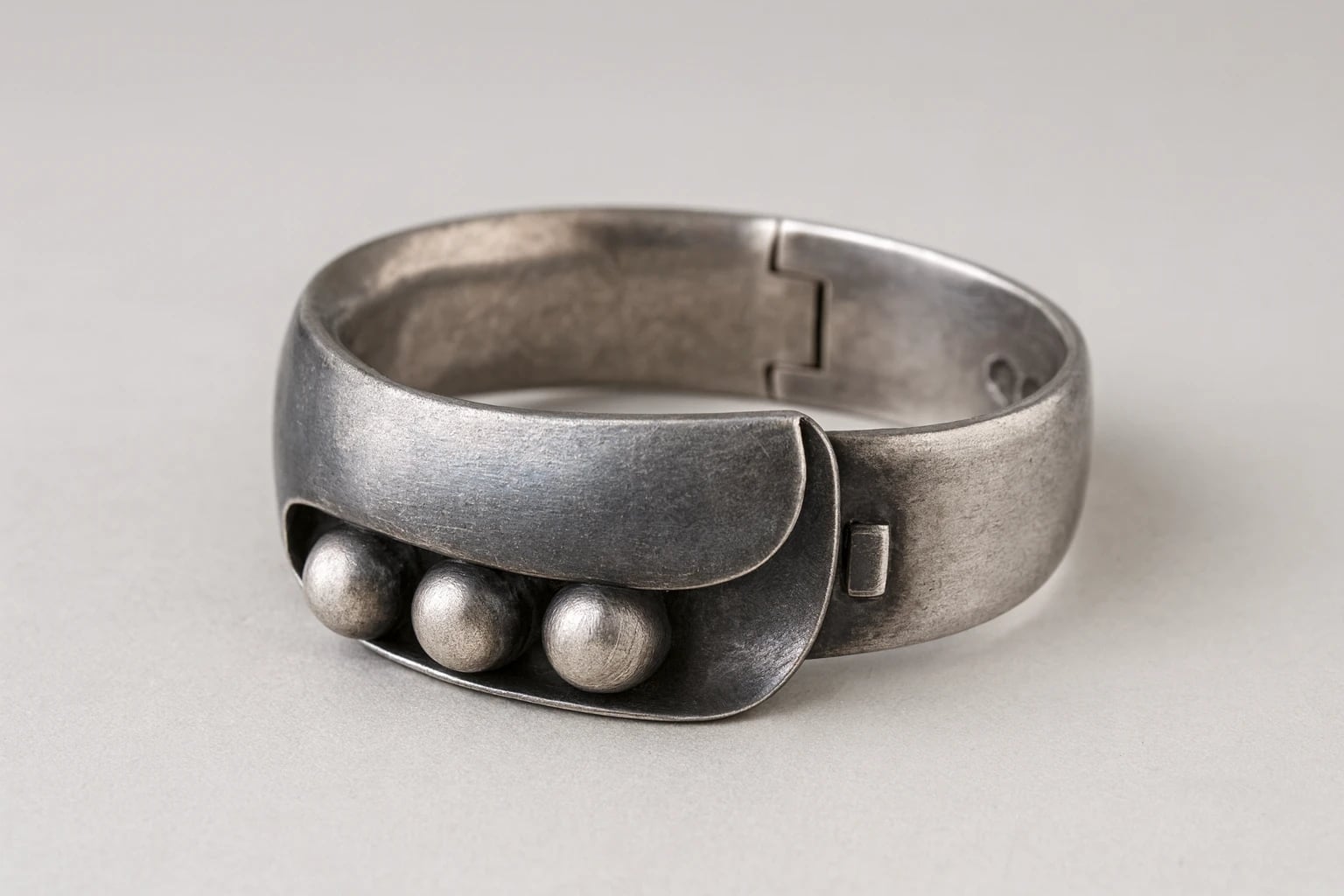
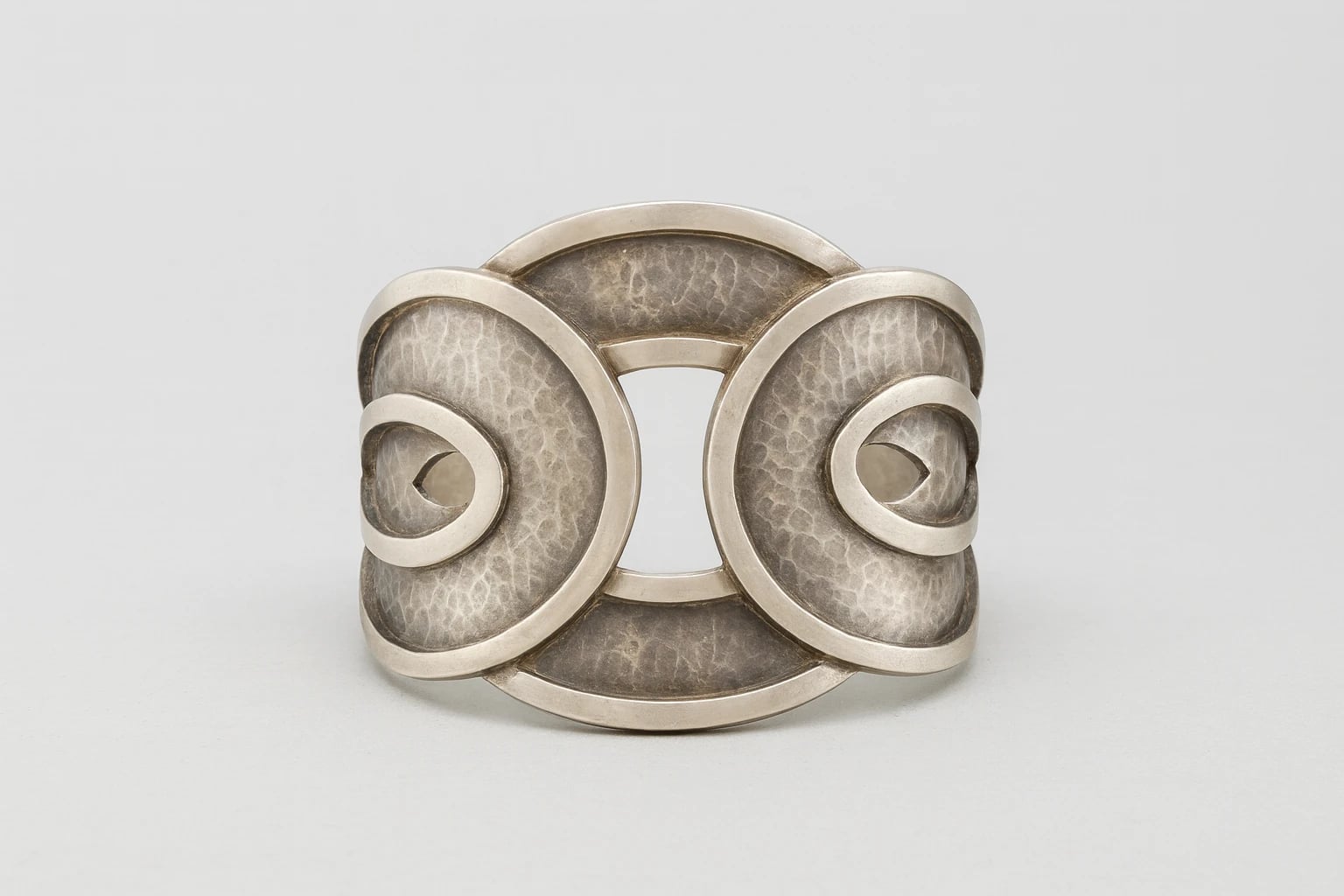
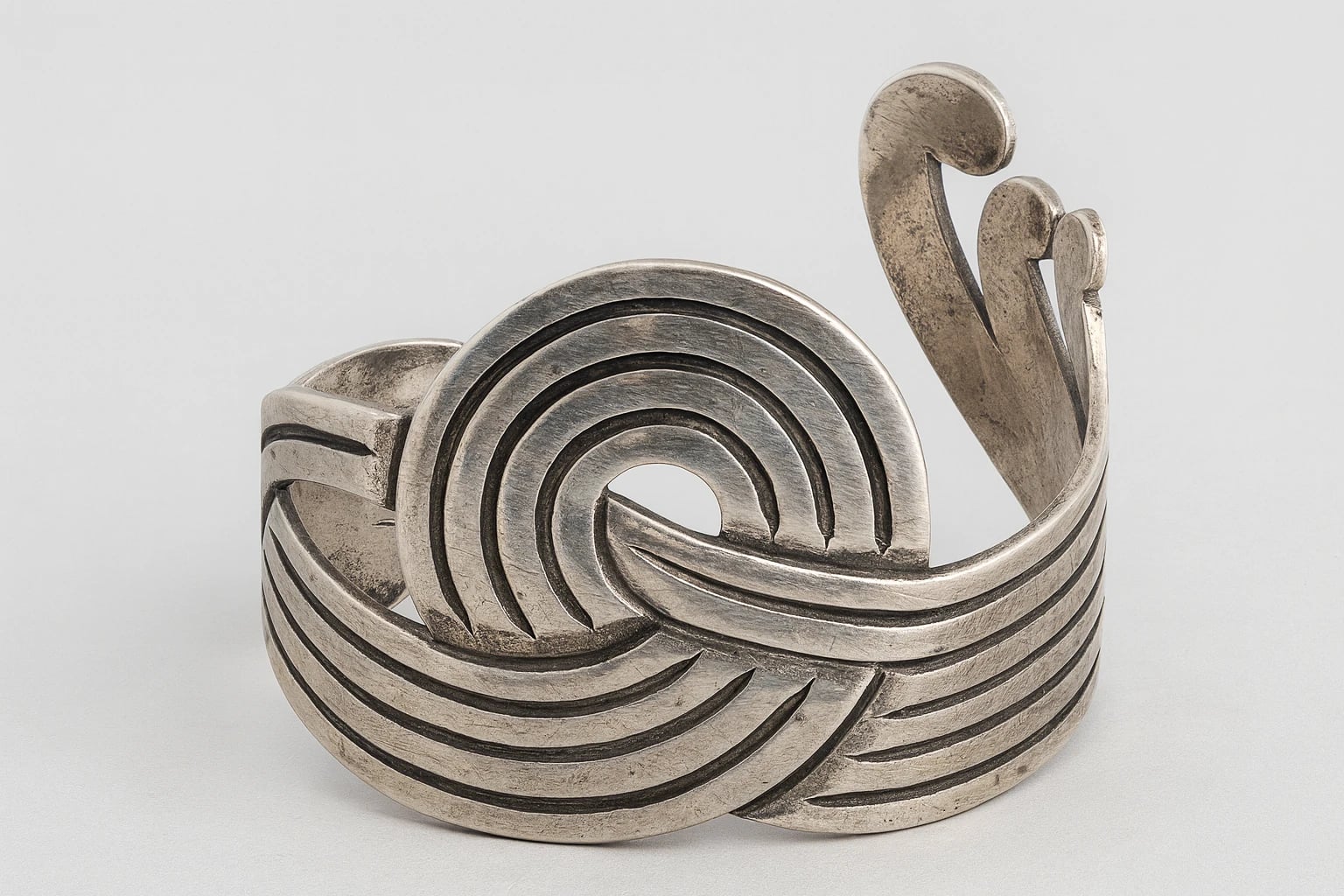
This cuff organizes its surface around a single turning motion. Broad silver bands curve inward, overlap, and separate again, so that the front of the bracelet reads as a compact spiral held in tension by the wrist. The dark niello channels do more than outline the design. They give each band a clean edge, slow the eye at the points of crossing, and make the circular movement legible against the reflective silver surface. At 1 5/8 inches high at the front, the bracelet has enough scale to make the pattern architectural, but the open cuff form keeps the design physically direct: the ornament is the structure.
The mark read from the piece, Los Castillo Taxco in a circle, Sterling Made in Mexico, design number 110A, and eagle 15, places the bracelet within the workshop’s early postwar production. Hougart records Los Castillo as using eagle number 15 among its official marks, and illustrates comparable Los Castillo marks with eagle 15 beginning in the 1948 to 1950 period. He also notes that, apart from the earliest 980 marked production, Los Castillo pieces were generally stamped with design or inventory numbers. Morrill and Berk caution that such numbers support relative chronology rather than exact dating, but for Los Castillo, as for several Taxco workshops, smaller numbers tend for the most part to appear on earlier designs. Taken together, the eagle mark, the sterling wording, and the low design number support the late 1940s dating in the Museum record.
Los Castillo was established in 1939 by Antonio Castillo with his brothers Justo and Jorge, and their cousin Salvador Terán. The workshop is often remembered for married metals, enamels, feathers, and other technically inventive surface systems, but this bracelet belongs to a more restrained line of inquiry: how an ancient or ancient-looking linear motif could be transformed into modern silver geometry. Its pattern does not copy a single identifiable archaeological source. Instead, it uses the grammar that Taxco designers repeatedly drew from ancient Mexican art, especially concentric movement, stepped rhythm, and incised contrast, and converts it into a wearable modern cuff. The result is neither pictorial revival nor decorative quotation. It is a controlled abstraction, carried by silver, black line, and the curve of the arm.
The bracelet is especially useful within a museum collection because it shows Los Castillo before the later proliferation of named technical lines such as Mosaico Azteca, Onix Negro, Pluma Azteca, and Esmalte a Fuego. Here the workshop’s intelligence lies in proportion and articulation rather than in material spectacle. The cuff demonstrates how the Taxco School could make a modernist object from a small set of means: a sheetlike form, repeated channels of darkness, and a spiral that seems to continue beyond the metal’s edge. In that economy, the bracelet preserves an early Los Castillo idea with unusual clarity.
Museum of Mexican Silver. “Interwoven Spiral Cuff Bracelet with Niello.” Catalog no. MoMS-002342. https://museumofmexicansilver.com/pieces/los-castillo-bracelet-7
See something wrong with this record? Suggest a correction and the piece details fill in automatically.
Aztec Service Bracelet
Sterling silver