Saves instantly, no account needed. Already a member? Sign in.
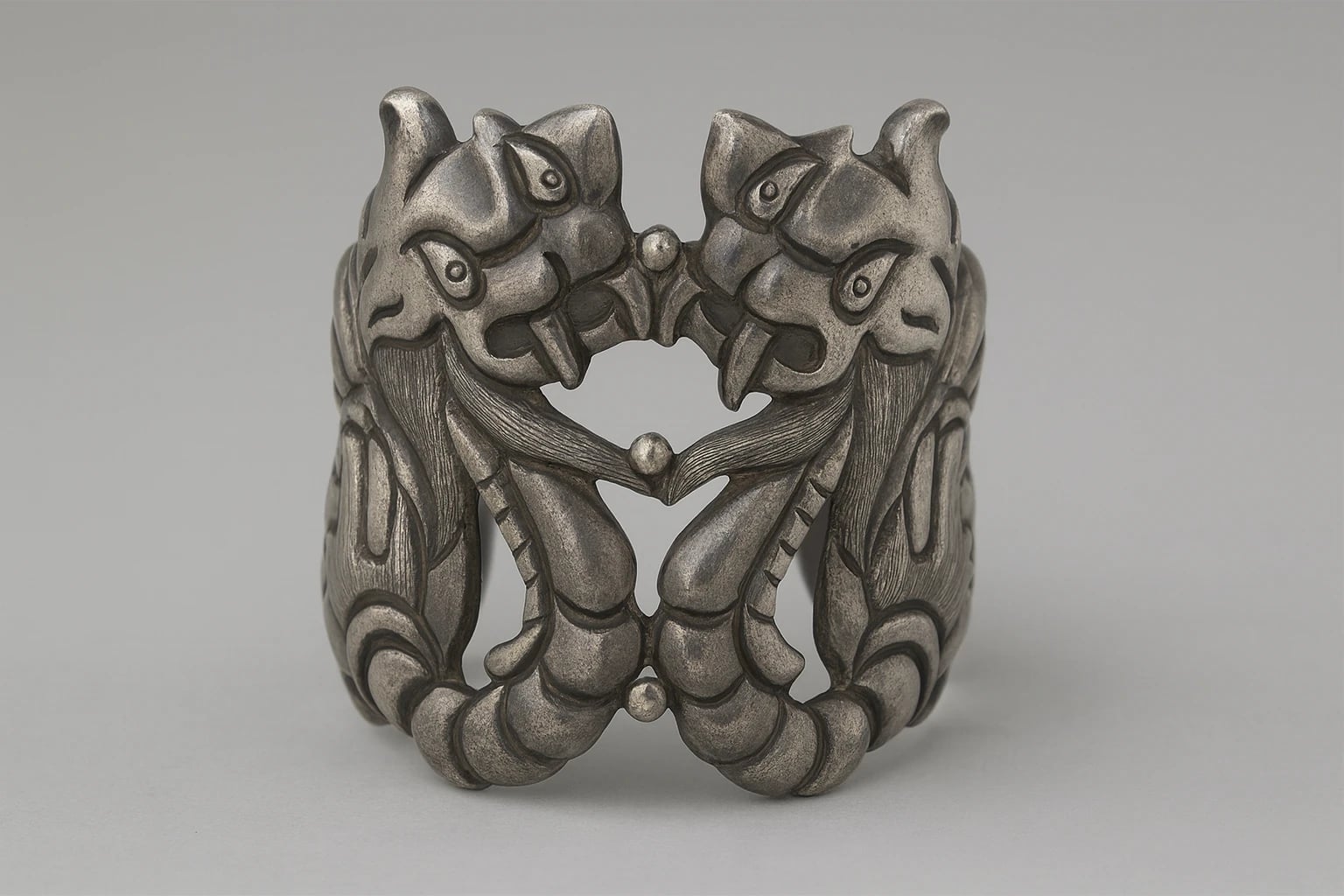
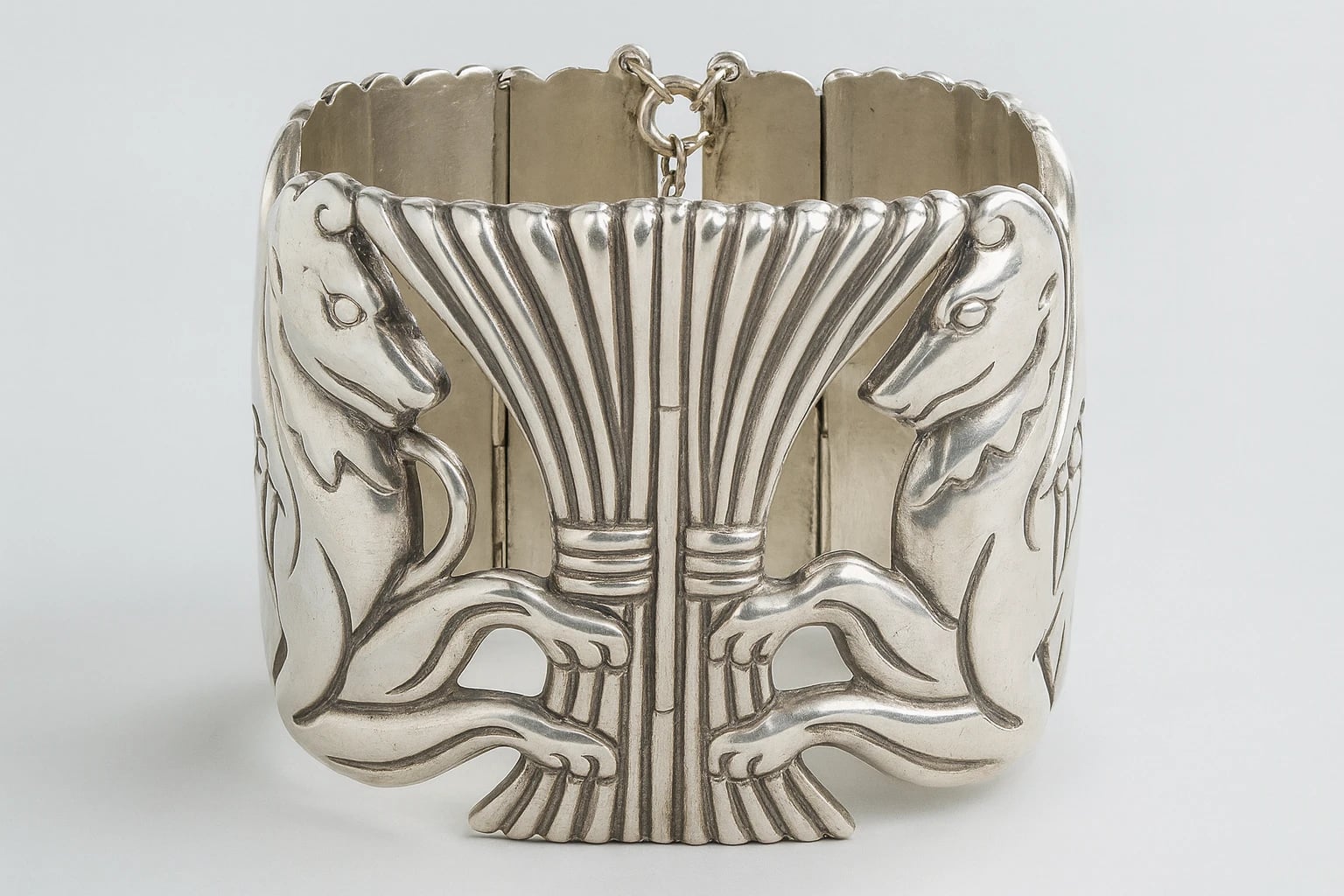
A pair of griffins gives this wide Los Castillo cuff its structure as well as its subject. The creatures face inward across a central hinge, their bodies compressed into broad heraldic profiles and their curling tails folded back into the surface of the bracelet. Between them rises a fluted, fanlike cluster of vertical forms, described in the object record as stylized brush. The design number 354, the linear 980 Los Castillo mark, Taxco, Made in Mexico, and the pre Eagle designation place the bracelet within the workshop’s early 1940s production, when Los Castillo was already developing a language distinct from the first generation of Spratling related silver. Hougart records comparable early Los Castillo 980 marks with design numbers in the 1940 to 1945 period, making the mark especially useful for understanding this bracelet’s chronology without treating it as an exact year date.
The cuff is organized around mass, symmetry, and controlled relief. Its approximately two inch height gives the design enough surface to read almost like a small repoussé panel, although the record should not be stretched beyond the documented hinge construction and visible raised ornament. The griffins are not drawn as delicate beasts. Their heads, wings, legs, and tails are reduced to swelling planes, chased lines, and bright ridges that catch light along the high points. Darker recesses around the bodies clarify the forms and give the silver a graphic force. The central hinge is not hidden. It becomes the axis of the composition, dividing the bracelet into two mirrored fields and allowing the mythical pair to meet at the wrist. The safety chain above the hinge confirms the bracelet’s practical role as a wearable object, but the frontality of the design gives it the presence of a miniature armorial plaque.
Los Castillo’s early work often moved between animal imagery, vegetal forms, ancient and colonial references, and modern design discipline rather than settling into a single source. The griffin, a mythological hybrid with long European and Near Eastern histories, is treated here less as antiquarian ornament than as a problem of silhouette and surface. The bodies are flattened against the cuff, while the scrolls, feathers, and paws are given enough relief to animate the silver as the wearer moves. This balance of legibility and abstraction belongs to the broader Mexican silver renaissance, in which workshops used jewelry to test forms that were sculptural, modern, and commercially viable without becoming impersonal. Morrill and Berk describe the taller system as one in which owners, designers, maestros, and trained silversmiths collaborated within named workshops, a structure essential to understanding a piece like this as Los Castillo work rather than the isolated production of a single hand.
Museum of Mexican Silver. “Double Griffin Hinged Cuff Bracelet.” Catalog no. MoMS-002350. https://museumofmexicansilver.com/pieces/los-castillo-bracelet-10
See something wrong with this record? Suggest a correction and the piece details fill in automatically.
The bracelet also belongs to a formative moment in the history of Los Castillo. Hougart identifies the firm as established in 1939 by Antonio Castillo with his brothers Justo and Jorge and cousin Salvador Terán, and notes Antonio’s earlier work at Spratling’s Taller de Las Delicias. Stromberg likewise emphasizes the family workshop’s founding in 1939 and the brothers’ training at Las Delicias, while noting the range of Los Castillo techniques and styles that later made the shop one of Taxco’s most inventive enterprises. This cuff precedes the workshop’s later fame for married metals, feather work, onyx lines, and enamel, yet it already shows the qualities that made Los Castillo central to the Taxco School: bold scale, confident relief, strong workshop finish, and a willingness to translate historic ornament into modern silver design. In a museum collection, it clarifies an early stage of Los Castillo’s development, when the workshop was consolidating its identity through substantial silver jewelry whose imagery was memorable, but whose real achievement lies in the command of form across the curved surface of the wrist.
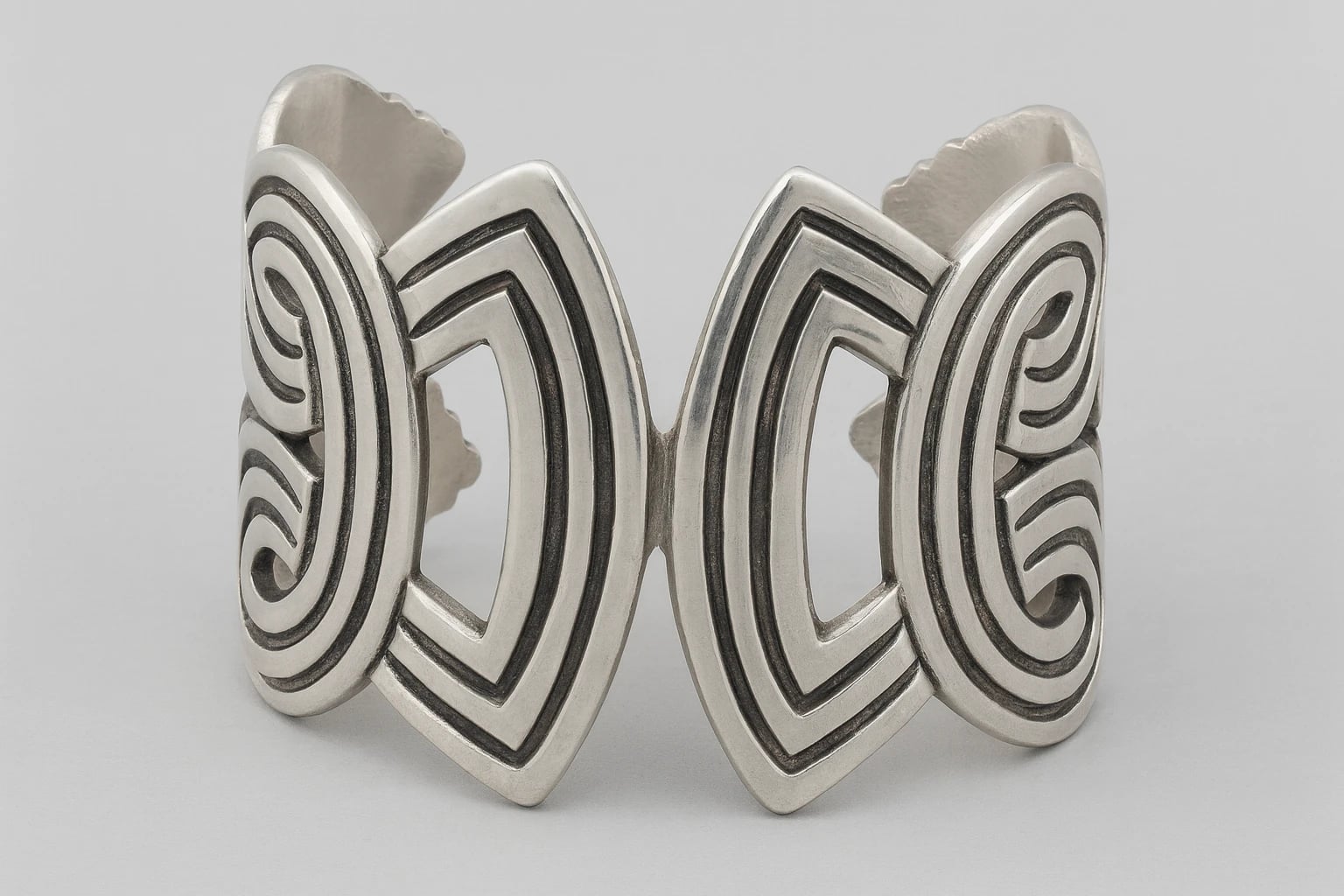
Geometric Scroll Cuff Bracelet